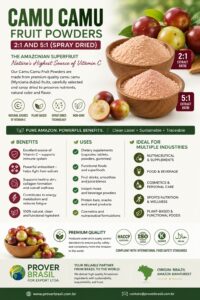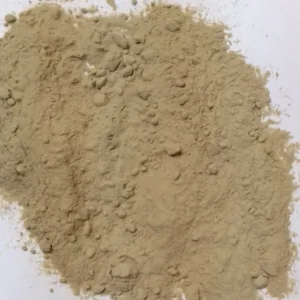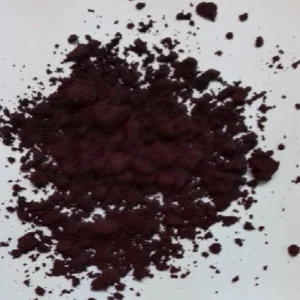

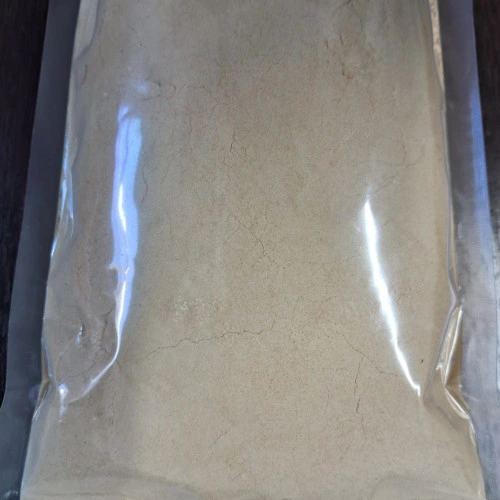
Camu Camu Fruit Powder is a Brazilian fruit ingredient produced from Myrciaria dubia (Kunth) McVaugh. The fruit is native to tropical South America and is strongly associated with the Amazon region.
Prover Brasil for Export Ltda. supplies Camu Camu Fruit Powder 2:1 and Camu Camu Fruit Powder 5:1, both produced by spray drying.
These powdered ingredients are suitable for importers, distributors, wholesalers, food companies, beverage producers, supplement formulators and other professional buyers worldwide.
Scientific Name: Myrciaria dubia (Kunth) McVaugh
Family: Myrtaceae
Plant Part: Fruit
Origin: Brazil
Processing: Spray dried
Available Concentrations: 2:1 and 5:1
Commercial Format: Bulk ingredient for professional buyers
The accepted botanical name Myrciaria dubia (Kunth) McVaugh can be verified through Plants of the World Online – Kew Science.
Camu Camu Fruit Powder is made from processed camu camu fruit.
Spray drying converts the fruit material into a practical powdered ingredient. This makes storage, transportation and industrial handling easier than working with fresh fruit.
The powdered format also allows manufacturers to incorporate camu camu into dry mixes, beverages, foods and nutritional formulations.
Camu camu has a naturally tart and acidic flavor. It combines well with citrus fruits, berries and tropical flavors such as mango, pineapple and acerola.
Camu camu has attracted scientific and commercial interest because of its naturally occurring vitamin C and plant compounds.
Scientific research has identified vitamin C, phenolic compounds, ellagic acid derivatives and other phytochemicals in camu camu and camu camu-derived powders.
Research has also evaluated spray-dried camu camu powder for food applications.
For manufacturers, the ingredient offers more than nutritional interest. It also provides a distinctive Brazilian fruit identity and a convenient powdered format.
Camu camu is widely recognized for its naturally occurring vitamin C.
Published research on spray-dried camu camu powder has measured substantial vitamin C concentrations in experimental powders.
However, vitamin C content can vary according to the fruit, processing conditions, carrier system and storage.
For commercial formulations, buyers should always use the product specification and Certificate of Analysis to confirm the actual vitamin C content of the supplied batch.
A study published in the Brazilian Journal of Food Technology evaluated vitamin C stability in spray-dried camu camu powder. The full scientific article is available through SciELO.
Camu camu contains several naturally occurring plant compounds associated with antioxidant activity.
Researchers have identified phenolic compounds, ellagic acid derivatives, ellagitannins and other phytochemicals in camu camu-derived products.
A study published in Food Chemistry characterized phenolic compounds, vitamin C and antioxidant capacity in camu camu powder products. Read the study through ScienceDirect.
These findings make Camu Camu Fruit Powder interesting for food, beverage and nutritional product development.
They should not be interpreted as evidence that a commercial powder treats, prevents or cures disease.
Vitamin C has established nutritional functions.
When a finished product provides the amount required by the regulations of its destination market, manufacturers may be able to use authorized vitamin C nutrition or health claims.
Any claim should be based on the analyzed amount contained in the finished product.
The natural vitamin C content of fresh camu camu should never replace analytical data from the commercial powder.
Additional research on vitamin C extraction and analysis in camu camu is available through PubMed.
Camu camu gives manufacturers an opportunity to incorporate a recognizable Brazilian fruit into product development.
It works particularly well in concepts involving tropical fruits, Brazilian ingredients, fruit-based nutrition and innovative beverage formulations.
Spray drying converts processed fruit material into a convenient powder.
The powder is easier to weigh, blend, store and transport than fresh fruit.
It can also simplify industrial production and international distribution.
Camu Camu Fruit Powder can be considered for many product categories.
Potential applications include beverages, nutritional powders, supplements, foods, smoothies, fruit blends, sachets, capsules and tablets.
Camu Camu Fruit Powder 2:1 offers flexibility for food, beverage and nutritional product development.
A 2:1 concentration generally represents the relationship between fruit input and the resulting concentrated ingredient according to the applicable production specification.
The exact fruit-equivalent calculation should always be confirmed in the product documentation.
Potential uses include:
The ideal dosage depends on the required flavor, serving size, product format and technical specification.
Camu Camu Fruit Powder 5:1 provides a higher fruit-equivalent concentration than the 2:1 option according to the applicable production specification.
It may be useful when formulation space is limited or when a higher fruit-equivalent input is required.
Potential applications include:
A 5:1 ratio does not automatically mean five times more vitamin C.
Vitamin C content and other analytical characteristics depend on the fruit, processing conditions, carrier composition and storage.
Manufacturers should use the actual analytical specification when calculating nutrient values.
The beverage industry offers several applications for Camu Camu Fruit Powder.
Manufacturers can evaluate it for:
Camu camu naturally has a tart flavor.
Mango, banana, pineapple, acerola, berry and citrus flavors can help create a balanced sensory profile.
During product development, manufacturers should evaluate acidity, dispersibility, sedimentation, flavor and stability.
Companies interested in another Brazilian fruit ingredient commonly used in beverage and food development can explore our Acerola Berry Products.
Supplement formulators can evaluate Camu Camu Fruit Powder for several formats.
Potential applications include capsules, tablets, sachets, stick packs and powdered nutritional products.
It can also be blended with other fruit powders or botanical ingredients.
Before commercial production, formulators should evaluate important parameters such as moisture, particle size, bulk density, flow and compatibility with other ingredients.
Companies developing Brazilian botanical formulations can also explore our Guarana Products.
Food companies can use Camu Camu Fruit Powder in several product concepts.
Potential applications include:
Heat may reduce vitamin C stability.
Manufacturers using the ingredient in baked, pasteurized or heat-processed products should test the finished product after processing.
Camu camu can complement other Brazilian fruit and botanical ingredients.
Formulators may combine it with Acerola Berry Products when developing fruit blends associated with naturally occurring vitamin C.
It can also complement Acai Berry Powder in tropical fruit, smoothie and nutrition formulations.
Companies developing beverage or supplement products may also evaluate Guarana Products.
Buyers looking for additional Brazilian fruit powders, botanical extracts and herbal ingredients can explore our complete Brazilian ingredient catalog.
These recipes demonstrate practical ways to use Camu Camu Fruit Powder.
They can also provide inspiration for commercial food and beverage development.
Ingredients
Preparation
Add the banana, mango, pineapple and liquid to a blender.
Blend until smooth.
Add the Camu Camu Fruit Powder and blend again.
The natural sweetness of banana and mango helps balance the tart character of camu camu.
For commercial production, determine the appropriate powder level through sensory and stability testing.
Ingredients
Preparation
Combine the ingredients.
Mix until evenly dispersed.
Adjust sweetness and acidity according to the desired flavor profile.
This recipe can also serve as a starting point for instant powdered drink development.
Ingredients
Preparation
Blend the fruit and liquid until smooth.
Add the Camu Camu Fruit Powder.
Blend again until evenly mixed.
Berry flavors pair well with the natural tartness of camu camu.
Ingredients
Preparation
Mix the Camu Camu Fruit Powder into the yogurt.
Add banana or mango.
Finish with the preferred toppings.
Food developers can adapt the same flavor concept to yogurt preparations, breakfast products and fruit-based snacks.
The correct concentration depends on the finished product.
Consider Camu Camu Fruit Powder 2:1 when:
Consider Camu Camu Fruit Powder 5:1 when:
Neither option is universally better.
Manufacturers should choose the grade according to serving size, technical specification, flavor profile and finished-product requirements.
Professional buyers should evaluate technical documentation before placing an order.
Important information may include:
Documentation requirements can vary according to the destination country and final application.
Store Camu Camu Fruit Powder in its original sealed packaging.
Keep it in a cool and dry environment.
Protect the powder from direct sunlight, excessive heat, humidity, excessive oxygen exposure, strong odors and cross-contamination.
Close the packaging correctly after opening.
Handling equipment should remain clean and dry.
Vitamin C is sensitive to environmental conditions. Proper storage can therefore help maintain product quality.
Manufacturers planning to declare a specific vitamin C level should conduct appropriate finished-product stability testing.
Scientific research has evaluated the stability of vitamin C in spray-dried camu camu powder.
Garcia et al. published the study “Vitamin C stability in acerola and camu-camu powder obtained by spray drying” in the Brazilian Journal of Food Technology.
Researchers evaluated physicochemical characteristics, antioxidant activity and vitamin C stability during storage.
The research reinforces the importance of suitable processing, packaging and storage.
Read the complete scientific study at SciELO – Brazilian Journal of Food Technology.
Cunha-Santos, E. C. E. et al.
Vitamin C in camu-camu [Myrciaria dubia (H.B.K.) McVaugh]: evaluation of extraction and analytical methods.
Food Research International, 2019.
The researchers evaluated vitamin C extraction and analytical methods for camu camu.
Read the publication at PubMed.
Fracassetti, D.; Costa, C.; Moulay, L.; Tomás-Barberán, F. A.
Ellagic acid derivatives, ellagitannins, proanthocyanidins and other phenolics, vitamin C and antioxidant capacity of two powder products from camu-camu fruit (Myrciaria dubia).
Food Chemistry, 2013.
The study characterized numerous phenolic compounds in camu camu-derived powder products.
Read the publication at Food Chemistry / ScienceDirect.
García-Chacón, J. M. et al.
Characterization and bioaccessibility assessment of bioactive compounds from camu-camu (Myrciaria dubia) powders and their food applications.
Food Research International, 2024.
The study evaluated bioactive compounds in camu camu powders and investigated their potential use in food applications.
Read the publication at Food Research International / ScienceDirect.
The Royal Botanic Gardens, Kew recognizes Myrciaria dubia (Kunth) McVaugh as the accepted botanical name.
See the botanical record at Plants of the World Online – Kew Science.
Camu Camu Fruit Powder is a food and formulation ingredient.
It should not be marketed as a treatment, prevention or cure for diseases.
Scientific findings about fruit composition, antioxidant activity or experimental biological effects should not automatically become claims for a commercial powder.
Manufacturers should distinguish between:
This approach creates more credible product information and reduces regulatory risk.
Camu Camu Fruit Powder is a powdered ingredient produced from camu camu fruit.
Prover Brasil for Export Ltda. supplies spray-dried 2:1 and 5:1 options for professional buyers.
The accepted botanical name is Myrciaria dubia (Kunth) McVaugh.
The species belongs to the Myrtaceae family.
Botanical information can be verified through Kew Science.
Myrciaria dubia is native to tropical South America.
The Camu Camu Fruit Powder offered by Prover Brasil originates from Brazil.
Camu camu is recognized for its naturally occurring vitamin C.
However, vitamin C concentrations in commercial powders can vary.
Professional buyers should confirm the actual value through the applicable specification or Certificate of Analysis.
The ratios describe fruit-equivalent concentration according to the applicable production specification.
The 5:1 grade represents a higher fruit-equivalent concentration than the 2:1 option.
However, 5:1 does not mean that every nutrient is five times more concentrated.
No.
The concentration ratio should not be treated as a vitamin C assay.
Use analytical results from the applicable product specification or Certificate of Analysis when calculating vitamin C content.
Yes.
Potential applications include powdered beverages, smoothie mixes, juice formulations, tropical drink blends and nutrition shakes.
Manufacturers should conduct formulation and stability tests before commercial production.
It can be evaluated for capsules, tablets, sachets, stick packs and nutritional powder formulations.
Technical suitability and regulatory requirements should be confirmed before production.
Complete solubility should not be assumed.
Performance depends on fruit solids, carrier composition, particle size and the complete formulation.
Beverage developers should evaluate dispersibility and sedimentation.
No disease-treatment or disease-prevention claim should be made for Camu Camu Fruit Powder.
Any health or nutrition claim for a finished product must be scientifically supported and legally permitted in the market where it will be sold.
Prover Brasil for Export Ltda. supplies Brazilian Camu Camu Fruit Powder to professional buyers worldwide.
Our customers include importers, distributors, wholesalers, food companies, beverage businesses and supplement formulators.
Available options include:
Companies can request current specifications, Certificate of Analysis, packaging information, available quantities and export quotations.
For more technical information about food, beverage and supplement applications, read our Camu Camu Powder from Brazil technical article.
You can also explore our complete Brazilian ingredients catalog.
Looking for Camu Camu Fruit Powder from Brazil?
Contact Prover Brasil for Export Ltda. for current commercial and technical information.
When requesting a quotation, please inform us of:
Our export team can provide information about specifications, availability, packaging and international supply.