
Buy Pau D´arco Bark Extract – Brazil – Click on ‘Products’ above or
Access: www.proverbrasil.com.br/product/pau-d-arco-taheebo-bark-powder-extract
What are the properties of pau d´arco extract (taheebo extract = lapacho extract)?
Naturopathy enthusiasts are already familiar with the wide range of benefits of products containing pau d´arco extract (taheebo extract = lapacho extract). It’s important that everyone who wants to ensure maximum quality of life also discovers the qualities of this plant, found mainly in Central and South American countries. Peru, Brazil, Paraguay, and Argentina are some of the regions whose tropical forests supply Pau D’arco powder.
Recommended especially for treating anemia and weakness, this plant was widely used by indigenous tribes, particularly the Incas, as a remedy for fevers, dysentery, snake bites, intestinal problems, wounds…
Over the years, Pau D’arco (also known as “lapacho,” “ipê-roxo,” or “taheebo”) has shown its ability to treat other pathologies, such as bronchitis, urinary tract infections, and fibroids. Therefore, the medicines are distinguished by their antiviral, antibacterial, anti-inflammatory, and antifungal properties, in addition to their diuretic and immunostimulating properties.
Of all its active ingredients, the importance of quinone should be highlighted, a substance that stimulates the liver to produce prothrombin, fundamental in blood clotting.
It has been scientifically proven that pau d´arco extract (taheebo extract = lapacho extract) is an effective solution for patients with leukemia and other cancers. The oncological properties of this remedy have been known since the 1960s, when Brazilian naturopaths and doctors applied Pau d´arco extract (taheebo extract = lapacho extract) to treat these cases, after several tribes in the Peruvian and Brazilian Amazon also used the remedy.
Therefore, pau d´arco extract (taheebo extract = lapacho extract) has anti-cancer properties. For example, in the case of leukemia, there is a reduction in the action of telomerase, which contributes to the increased death of cancerous cells. In breast tumors, this remedy allows the inhibition of estrogen receptors. Furthermore, Pau D’arco powder (= taheebo powder, lapacho powder) is effective in the treatment of liver cancer, preventing its growth and the appearance of metastases.
Did you know that this remedy can also restore the quality of life for those with bladder cancer?
Pau d´arco extract (taheebo extract = lapacho extract) increases apoptosis, that is, the programmed death of a cancerous cell, which occurs naturally during its evolution, thus allowing the renewal of cells, organs, and tissues. The same happens with lung and colon cancers. Prostate tumors should also be highlighted, in which these medications inhibit inflammation and reduce telomerase.
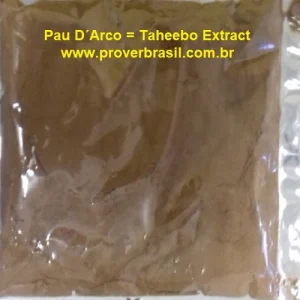
Buy Pau D´arco Bark Extract – Brazil – Click on ‘Products’ above or
Access: www.proverbrasil.com.br/product/pau-d-arco-taheebo-bark-powder-extract