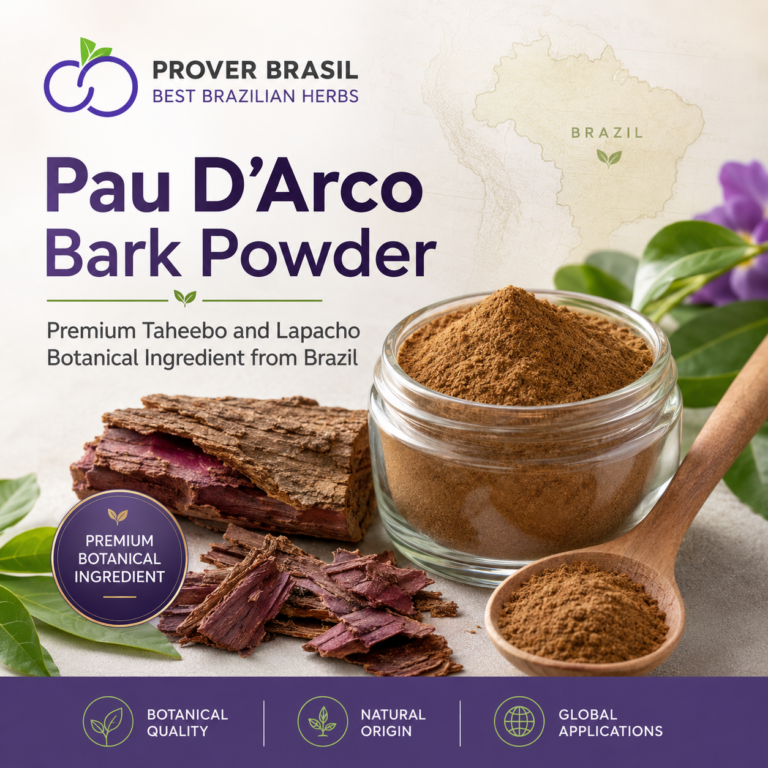
Pau D’Arco Bark Powder, internationally known as Taheebo Bark Powder or Lapacho Bark Powder, is a distinctive South American botanical ingredient valued by companies seeking authentic plant-based materials, recognizable regional identity, and flexible applications across international markets.
Obtained from the bark associated with Pau D’Arco trees, the ingredient has a long history of traditional use and is commercially available in different formats, including finely milled powder, coarse-cut bark for botanical infusions, and concentrated dry extracts.
For importers, distributors, botanical brands, tea companies, ingredient specialists, and product development teams, sourcing Pau D’Arco requires more than finding a commercially available powder. Botanical identity, plant part, particle size, processing, packaging, documentation, storage, traceability, and destination-market requirements must all be considered before placing an order.
As a Brazilian export company supplying botanical ingredients to international buyers, Prover Brasil connects global companies with Brazilian herbs, botanical powders, extracts, and superfoods through a structured business-to-business approach.
The objective is not simply to offer a familiar botanical name. It is to support professional buyers who need clear product specifications, export-oriented communication, commercial consistency, and an ingredient format compatible with their intended application.
What Is Pau D’Arco Bark Powder?
Pau D’Arco Bark Powder is a milled botanical material obtained from the bark of trees commonly associated with the names Pau D’Arco, Taheebo, Lapacho, Ipê Roxo, and related commercial designations.
The terms Pau D’Arco, Taheebo, and Lapacho are frequently used across different markets to identify bark-based botanical products from South America. However, common names may vary by country, supplier, commercial tradition, and botanical reference.
For professional sourcing, the common name should never be the only identification criterion.
Importers and manufacturers should request information about:
- botanical identification;
- plant part used;
- physical presentation;
- particle size;
- processing method;
- country of origin;
- packaging;
- storage conditions;
- available technical documentation.
This verification is especially important because closely related botanical species may circulate under similar regional or commercial names.
The ingredient supplied by Prover Brasil is presented for international business in bark-based formats designed for wholesale and industrial purchasing. The company’s published portfolio includes Pau D’Arco bark powder, coarse-cut bark material, and dry extract options for different commercial requirements. (site model)
Pau D’Arco, Taheebo, and Lapacho: Understanding the Names
One of the first challenges in the international botanical trade is terminology.
A buyer may search for “Pau D’Arco Bark Powder,” while another uses “Taheebo Powder,” “Lapacho Bark,” or “Ipê Roxo Bark.” In many commercial contexts, these names refer to related or equivalent product categories.
Nevertheless, professional documentation should move beyond common terminology.
Pau D’Arco
Pau D’Arco is the most recognizable Brazilian commercial name for the ingredient. It may be translated informally as “bow wood,” reflecting historical associations with the strength and traditional uses of the tree’s wood.
In international botanical commerce, the term is widely used for bark, bark powder, tea-cut material, extracts, capsules, and botanical blends.
Taheebo
Taheebo is a name commonly encountered in English-speaking and Asian markets. It is frequently associated with teas, botanical supplements, powdered bark, and concentrated preparations.
For search engine visibility and international sales communication, including “Taheebo” in technical and commercial content helps buyers who may not initially search for the Portuguese name Pau D’Arco.
Lapacho
Lapacho is especially recognizable in Spanish-speaking markets and parts of Europe. It is commonly associated with herbal tea, cut bark, botanical powder, and traditional South American ingredients.
Using the three expressions—Pau D’Arco, Taheebo, and Lapacho—helps international buyers identify the product while reducing confusion caused by regional naming differences.
Why Pau D’Arco Bark Powder Attracts International Buyers
Global demand for botanical ingredients continues to encourage companies to diversify their portfolios with materials connected to specific regions, traditions, and product experiences.
Pau D’Arco Bark Powder offers several commercial advantages.
It has a clear South American identity, a recognizable botanical story, multiple presentation formats, and potential applications in herbal tea, powdered botanical blends, capsules, tablets, research projects, and specialized formulations, subject to applicable regulations.
The ingredient can help companies develop portfolios centered on:
- Brazilian botanicals;
- South American herbal traditions;
- plant-based ingredients;
- botanical tea concepts;
- regional ingredient collections;
- wellness-oriented product categories;
- specialty botanical powders;
- traditional bark ingredients.
Its value, however, should not be communicated through exaggerated therapeutic promises.
Responsible commercial positioning focuses on origin, format, processing, quality criteria, botanical identity, traditional context, and suitability for the buyer’s intended application.
Main Commercial Formats of Pau D’Arco Bark
Pau D’Arco can be supplied in different physical presentations. Choosing the right format depends on the manufacturing process, final product, packaging system, extraction method, and target market.
Pau D’Arco Bark Powder
The finely milled powder is suitable for companies that need a more uniform botanical material for industrial handling.
Depending on formulation requirements and applicable legislation, bark powder may be evaluated for use in:
- botanical powder blends;
- encapsulated products;
- compressed formats;
- dry formulation systems;
- research and development;
- traditional botanical preparations;
- specialty herbal products.
Particle-size requirements should be discussed before ordering because “powder” can describe materials with substantially different granulometries.
A buyer developing capsules may require a different physical profile from a company using the ingredient in a tea blend or extraction process.
Coarse Pau D’Arco Bark
Coarse-cut or granulated bark is generally more suitable for herbal tea bags, loose botanical blends, decoction-style preparations, and applications in which the physical appearance of the bark is part of the product experience.
Prover Brasil lists a coarse presentation of approximately 2 mm for tea-sachet applications, subject to commercial confirmation and current availability. (site model)
The coarse format can offer practical advantages when the buyer wants:
- visible botanical pieces;
- reduced powder dispersion;
- easier filtration;
- tea-focused presentation;
- controlled blending with other herbs;
- a more traditional appearance.
Pau D’Arco Dry Extract
A dry extract is different from raw bark powder.
The extract is produced through a concentration process in which selected soluble components are transferred from the botanical material into a liquid medium and subsequently converted into a dry form.
Prover Brasil’s published product information includes a spray-dried Pau D’Arco dry extract with a stated 4:1 ratio, subject to technical and commercial confirmation for each order. (site model)
Extracts may be considered by companies seeking:
- reduced dosage volume in a formulation;
- greater process standardization;
- easier integration into dry blends;
- concentrated botanical material;
- more consistent industrial handling;
- formulation flexibility.
Bark powder and dry extract should not be treated as interchangeable ingredients. Their composition, concentration, processing, physical behavior, and labeling requirements may differ significantly.
Powder, Coarse Bark, or Extract: Which Format Should a Buyer Choose?
The correct choice depends on the intended use.
A tea company may prefer coarse bark because it provides visible plant material and supports filtration. A capsule company may evaluate fine powder or dry extract based on fill weight, flow, density, and regulatory classification.
A laboratory may prefer an extract with defined production parameters, while a traditional herbal product company may prioritize minimally processed bark material.
Before requesting a quotation, buyers should determine:
- the intended application;
- the destination country;
- the required particle size;
- whether raw powder or extract is needed;
- expected order volume;
- packaging requirements;
- mandatory technical documents;
- applicable regulatory category.
This preliminary definition reduces misunderstandings and helps the supplier prepare a more relevant commercial proposal.
Potential Applications for Pau D’Arco Bark Powder
Pau D’Arco Bark Powder is a versatile raw material, but every application must be assessed according to the laws and technical requirements of the destination market.
Botanical Capsules
Fine bark powder may be evaluated for encapsulation when the material’s density, moisture, granulometry, flow, and microbiological profile are compatible with the buyer’s manufacturing process.
Manufacturers must also determine whether the ingredient is legally permitted in the intended product category and how it must be identified on the label.
Powdered Botanical Blends
Pau D’Arco can be combined with other botanical powders in formulations developed around South American ingredients, traditional herbs, or specialized plant-based concepts.
Compatibility tests are recommended because color, aroma, taste, density, and particle size influence the final blend.
Herbal Tea and Infusion Products
Coarse bark is generally more appropriate than fine powder for tea bags and loose herbal preparations.
The cut size should support water contact while remaining compatible with the sachet material and filtration system.
In some traditions, bark materials are prepared through simmering or decoction rather than a brief infusion. Consumer instructions, however, must follow the formulation, safety review, and legal requirements established by the responsible company.
Botanical Extract Manufacturing
Companies with extraction facilities may purchase raw bark or bark powder as starting material for proprietary extraction processes.
In this case, the buyer should evaluate:
- extraction solvent;
- extraction ratio;
- target constituents;
- drying method;
- carrier system;
- residual solvent limits;
- process yield;
- stability;
- final specification.
Research and Product Development
Pau D’Arco Bark Powder may also be sourced for analytical work, prototype development, extraction studies, botanical characterization, and formulation trials.
Research use does not automatically authorize commercial use. Final products must comply with the regulatory requirements of the market where they will be manufactured, sold, or distributed.
Pau D’Arco Bark Powder as a Brazilian Botanical Ingredient
Brazil has extensive botanical diversity and a strong international identity connected to tropical fruits, herbs, seeds, barks, roots, and natural raw materials.
For foreign buyers, Brazilian origin can create meaningful commercial differentiation when it is supported by reliable sourcing, consistent documentation, and professional export procedures.
Pau D’Arco fits naturally within portfolios that also feature ingredients such as:
- guarana;
- acai;
- acerola;
- camu-camu;
- catuaba;
- jatoba;
- Brazilian ginseng;
- muira puama;
- herbal extracts;
- Amazonian fruit powders.
A Brazilian botanical collection can be positioned around regional diversity, traditional knowledge, formulation potential, ingredient discovery, or product innovation.
The commercial narrative should remain accurate. Origin alone does not guarantee quality, sustainability, safety, or regulatory acceptance.
Those factors must be confirmed through supplier qualification and product-specific documentation.
The Importance of Botanical Identity
Botanical identity is one of the most important aspects of herbal ingredient sourcing.
Common names can refer to different plants, while a single species may have several names across countries and languages.
Professional buyers should request the scientific name used in the product specification and verify that it matches their regulatory, technical, and formulation requirements.
This is particularly relevant for Pau D’Arco because older botanical references, commercial documents, and contemporary taxonomic classifications may use different scientific nomenclature.
Industry materials may refer to species within the genera Tabebuia or Handroanthus. The NIH Dietary Supplement Label Database also shows Pau D’Arco products identified with different botanical expressions, including Tabebuia impetiginosa, Tabebuia avellanedae, and Handroanthus impetiginosus. (DSLD)
For this reason, the specification supplied for the actual batch should be treated as the primary commercial reference rather than relying exclusively on a generic internet description.
Confirming the Plant Part
The buyer must also confirm which part of the plant is used.
Commercial descriptions may refer to bark, inner bark, stem bark, or cut bark. These expressions should not be assumed to be identical without documentation.
The requested plant part can affect:
- composition;
- visual appearance;
- fiber content;
- taste;
- processing behavior;
- extraction yield;
- analytical profile;
- regulatory classification.
A professional purchase specification should clearly define the material expected by the buyer.
Quality Criteria for Pau D’Arco Bark Powder
Quality cannot be evaluated through color or aroma alone.
A comprehensive specification may include physical, chemical, microbiological, and contaminant-related parameters according to the product and destination market.
Appearance and Organoleptic Profile
The powder should have a botanical appearance compatible with the approved reference.
Natural variations may occur because plant ingredients are influenced by raw-material origin, harvest, drying, milling, and storage.
However, substantial differences between batches should be investigated before use.
Particle Size
Particle size affects flow, blending, dust formation, extraction, capsule filling, sedimentation, and final-product texture.
Buyers should avoid requesting only “fine powder.” A measurable or commercially defined granulometry creates a clearer specification.
Moisture Content
Excessive moisture may affect stability, flow, microbiological quality, and storage performance.
Moisture limits should be defined according to the product, analytical method, packaging, and buyer requirements.
Why Documentation Matters in International Trade
A botanical powder can appear suitable while still failing to meet the buyer’s regulatory or technical requirements.
Documents help both parties define what is being purchased and how it can be imported, received, tested, and used.
Depending on availability, product type, and destination requirements, buyers may request:
- product specification;
- certificate of analysis;
- safety data information;
- botanical identification;
- country-of-origin information;
- packing details;
- commercial invoice;
- packing list;
- batch information;
- export documentation.
The buyer remains responsible for confirming which documents are required by customs authorities, regulatory agencies, manufacturers, laboratories, and commercial partners in the destination country.
A supplier can provide information about the product, but it cannot replace the importer’s regulatory assessment.
Packaging for Wholesale Pau D’Arco Bark Powder
Industrial packaging must protect the material during storage and international transportation.
Prover Brasil’s published product page lists wholesale packaging formats that include fiber barrels for Pau D’Arco powder, coarse bark, and dry extract. The displayed sizes include 20 kg for powder, 20 kg for coarse bark, and 15 kg for dry extract, subject to confirmation at the time of quotation. (site model)
Packaging requirements may vary according to:
- order size;
- product format;
- material density;
- transport method;
- destination-country rules;
- buyer handling system;
- moisture protection;
- contractual specifications.
Buyers should confirm both net and gross weight, internal liner, external dimensions, pallet configuration, and labeling before finalizing the order.
Storage and Handling Considerations
Pau D’Arco Bark Powder should be stored according to the supplier’s instructions and the approved product specification.
In general, botanical powders require protection from excessive heat, humidity, direct sunlight, contamination, and strong odors.
The packaging should remain properly sealed until use.
After opening, the manufacturer should apply controlled handling procedures to reduce moisture uptake, cross-contamination, and loss of traceability.
A professional storage program may include:
- batch identification;
- quarantine and release status;
- temperature and humidity monitoring;
- pest control;
- first-expire, first-out procedures;
- cleaning controls;
- packaging inspection;
- retained samples.
Shelf life should never be assumed from another botanical ingredient. It must be confirmed through the applicable supplier documentation and the buyer’s own stability program.
Formulation Considerations
Botanical ingredients can influence a product beyond their marketing name.
Pau D’Arco Bark Powder may affect color, taste, aroma, texture, density, flow, sedimentation, and overall sensory acceptance.
Taste and Aroma
Bark ingredients can present woody, earthy, and naturally bitter characteristics.
The intensity may vary according to plant part, particle size, processing, and concentration.
Product developers may need to evaluate flavor compatibility when combining Pau D’Arco with fruits, spices, sweeteners, or other botanicals.
Color
Natural botanical color can vary between batches.
This variation should be considered when the final product has strict visual requirements, especially in powdered blends, capsules, beverages, and tea sachets.
Flow and Density
Fine botanical powders may compact, generate dust, or flow differently from standardized food powders.
Manufacturers should perform tests using their own equipment before scaling production.
Compatibility with Other Ingredients
Pau D’Arco may be combined with other herbs or botanical ingredients, but compatibility should be assessed technically.
A combination that appears commercially attractive may produce challenges involving flavor, moisture, density, stability, or labeling.
Regulatory Responsibility and Market Compliance
Pau D’Arco’s commercial status may vary by country and product category.
A botanical allowed in herbal tea may not automatically be permitted in a dietary supplement, conventional food, cosmetic, or medicinal product.
Before purchasing, the importer should verify:
- whether the botanical is permitted;
- which scientific name is recognized;
- which plant part is authorized;
- maximum or customary use conditions;
- required warnings;
- labeling terminology;
- health-claim restrictions;
- import documentation;
- quality-testing requirements.
Regulations can change, and approval in one country does not create authorization in another.
The final manufacturer, importer, or brand owner must complete the appropriate legal and technical review.
Responsible Communication About Pau D’Arco
Pau D’Arco has a long history in traditional botanical practices, and scientific literature has investigated compounds associated with the plant.
However, traditional use and laboratory research do not establish that Pau D’Arco Bark Powder can diagnose, prevent, treat, or cure disease.
Commercial content should avoid unsupported claims related to cancer, infections, immune disorders, inflammation, or other medical conditions.
Safety also requires attention. Published consumer health references note that evidence for clinical effectiveness remains limited and that concentrated use may present safety concerns, including potential interactions related to blood clotting. (Verywell Health)
Product companies should therefore:
- avoid disease-treatment claims;
- perform qualified safety assessments;
- review target-consumer restrictions;
- confirm appropriate labeling;
- evaluate interactions and warnings;
- comply with local advertising rules.
The correct commercial approach is to position Pau D’Arco as a botanical ingredient, not as a guaranteed medical solution.
Why Traceability Is Important
Traceability allows a company to connect the final product to the received ingredient batch and its corresponding records.
This is important for quality investigations, customer complaints, regulatory inspections, recalls, stability monitoring, and supplier performance evaluation.
A traceability system should connect:
- supplier;
- ingredient name;
- batch or lot number;
- receiving date;
- test results;
- manufacturing records;
- finished-product batches;
- distribution information.
Companies should avoid mixing unidentified material or removing batch labels before internal traceability has been established.
Sustainability and Responsible Botanical Sourcing
Botanical ingredients depend on natural resources, making responsible sourcing an important commercial consideration.
Buyers increasingly ask questions about geographic origin, harvesting methods, processing, and supply-chain continuity.
Pau D’Arco sourcing must be evaluated carefully because bark collection can affect the tree when poorly managed.
Responsible commercial discussions may include:
- legal origin;
- supply-chain documentation;
- harvesting practices;
- raw-material availability;
- processing controls;
- long-term supply capacity;
- species identification.
Sustainability claims should only be used when they can be supported by appropriate evidence.
General expressions such as “eco-friendly,” “wild harvested,” or “sustainably sourced” should not be added to labels or campaigns without verification.
Pau D’Arco for Tea Companies
Tea companies often require a different ingredient specification from capsule or extraction companies.
For tea applications, buyers may prioritize:
- coarse and uniform cut;
- low dust content;
- visible bark pieces;
- suitable filtration;
- consistent appearance;
- controlled moisture;
- sensory profile;
- microbiological quality.
The material must also be compatible with the selected package, whether loose-leaf format, pyramid sachet, conventional filter bag, or botanical blend.
A tea company should test the ingredient under its actual preparation instructions.
Water temperature, preparation time, botanical concentration, and cut size can influence the appearance and sensory characteristics of the beverage.
Pau D’Arco for Capsule and Supplement Companies
Capsule manufacturers may require fine powder with controlled flow, density, moisture, microbiological limits, and particle size.
The material should be tested on the buyer’s own equipment because botanical powders may behave differently during feeding and filling.
Pau D’Arco for Extract and Ingredient Companies
Companies performing extraction need detailed knowledge of their incoming raw material.
The extraction yield and chemical profile may be influenced by:
- species;
- plant part;
- particle size;
- moisture;
- solvent;
- time;
- temperature;
- material-to-solvent ratio;
- filtration;
- drying method.
Pilot testing is recommended before large-scale purchasing.
The buyer should also define whether it needs raw bark powder or a finished dry extract.
A finished 4:1 extract, for example, should not be represented as identical to four parts of raw powder in every technical or physiological respect. Extraction selectivity and processing can alter the final profile.
How to Request a Pau D’Arco Bark Powder Quotation
A complete inquiry helps the supplier respond more efficiently.
The buyer should provide:
- company name;
- destination country;
- required product format;
- expected quantity;
- intended application;
- preferred particle size;
- required packaging;
- necessary technical documents;
- target delivery schedule;
- preferred Incoterm or shipping arrangement;
- port or airport of destination.
Incomplete inquiries such as “send price for Pau D’Arco” may require several additional exchanges before an accurate quotation can be prepared.
For a broader view of available ingredients, buyers can explore Prover Brasil’s portfolio of Brazilian botanical powders, extracts, herbs, and superfoods.
Supplier Qualification Before Ordering
Professional importers should qualify every botanical supplier according to their internal procedures.
Supplier qualification may include reviewing:
- company identification;
- export experience;
- product specifications;
- sample consistency;
- communication quality;
- documentation capacity;
- packaging;
- production lead time;
- complaint procedures;
- traceability;
- commercial terms.
A sample can help the buyer assess appearance, aroma, granulometry, density, and preliminary process compatibility.
However, a sample is not a substitute for batch-specific quality documentation or incoming-material testing.
Common Purchasing Mistakes
Several mistakes can delay botanical ingredient projects.
Buying by Common Name Alone
A buyer who requests only “Lapacho Powder” may receive a material that does not match the intended botanical identity or plant part.
The order specification should be precise.
Confusing Raw Powder with Extract
Powder and extract differ in concentration, processing, price, physical characteristics, and regulatory presentation.
The purchase order should clearly identify the required format.
Ignoring Particle Size
A powder that is too coarse may not fill capsules efficiently. A material that is too fine may create dust or pass through tea filters.
Granulometry should match the process.
Assuming All Documents Are Included
Analyses and certificates may depend on the product, batch, quantity, destination, and contractual agreement.
Document requirements should be confirmed before the order is placed.
Making Medical Claims Too Early
Promotional claims must be reviewed according to the destination market.
Traditional reputation does not authorize disease-treatment statements.
Ordering Commercial Volume Without Testing
A preliminary sample or pilot batch can identify problems involving taste, color, flow, extraction, or packaging before a large purchase.
Why Work with Prover Brasil?
International buyers need communication that connects Brazilian ingredient availability with practical export requirements.
Prover Brasil operates as a Brazilian export company supplying herbs, botanical extracts, fruit powders, superfoods, and other ingredients in wholesale formats to global customers. The company states that it has operated from Belo Horizonte since 2001. (site model)
For buyers evaluating Pau D’Arco Bark Powder, the company can support commercial discussions involving:
- available presentation;
- wholesale quantity;
- packing;
- product specifications;
- export documentation;
- destination;
- shipping arrangements;
- complementary Brazilian ingredients.
This business-to-business orientation is particularly relevant for distributors, importers, laboratories, manufacturers, tea companies, and ingredient companies seeking direct communication with a Brazilian exporter.
Frequently Asked Questions About Pau D’Arco (Taheebo = Lapacho) Bark Powder
Is Pau D’Arco the same as Taheebo and Lapacho?
These names are commonly used in international commerce for related bark-based botanical products.
Because common terminology can vary, buyers should confirm the scientific name, plant part, and product specification before ordering.
What is Pau D’Arco Bark Powder made from?
It is a milled botanical material obtained from Pau D’Arco bark.
The exact botanical identity and plant part should be verified in the supplier’s specification for the offered product.
Is Pau D’Arco Bark Powder the same as Pau D’Arco Extract?
No.
Bark powder is mechanically milled plant material. An extract undergoes a process designed to transfer and concentrate selected soluble components.
The products have different specifications and should not be treated as interchangeable.
What is the difference between fine powder and coarse bark?
Fine powder is milled into smaller particles and may be suitable for capsules, powder blends, extraction, or other industrial applications.
Coarse bark contains larger particles and is generally more suitable for tea sachets, loose herbal blends, and filtration-based preparations.
Can Pau D’Arco be used in herbal tea?
Coarse Pau D’Arco bark is commercially associated with herbal tea products.
The company placing the final product on the market must confirm legal status, preparation instructions, safety, and labeling requirements.
Can Pau D’Arco Powder be encapsulated?
The fine powder may be evaluated for capsule manufacturing.
Before use, manufacturers should assess particle size, density, flow, microbiological quality, legal status, and formula safety.
Does Pau D’Arco Bark Powder treat diseases?
Pau D’Arco should not be marketed as a treatment or cure unless a specific product has received the legally required authorization for such claims.
Traditional use and preliminary research do not replace clinical evidence or regulatory approval.
Is Pau D’Arco safe for everyone?
Safety depends on the product, amount, consumer profile, medications, and intended use.
Companies should complete a qualified safety review and provide warnings required by the destination market. Consumers using botanical supplements should consult an appropriate healthcare professional, particularly when taking medication or managing a health condition.
Which botanical name should appear on the label?
The appropriate botanical name depends on the identity of the supplied ingredient and the labeling rules of the destination country.
Buyers should rely on batch and product documentation rather than selecting a scientific name independently.
What packaging is available?
Prover Brasil’s published product information lists fiber-barrel formats for powder, coarse bark, and dry extract.
Packing size and availability should be reconfirmed during quotation.
Can Prover Brasil supply wholesale quantities?
Prover Brasil presents Pau D’Arco products for bulk and international business-to-business supply.
Minimum quantity, lead time, packaging, documentation, and shipping conditions must be confirmed for each inquiry.
Is a sample available before a commercial order?
Sample availability and conditions should be requested directly from the company.
Buyers should explain the intended application and testing requirements when submitting the request.
What documents should importers request?
Requirements vary by country and product category.
Common requests may include specifications, certificate of analysis, batch information, packing details, invoice, origin information, and relevant test reports.
Can Pau D’Arco be combined with other Brazilian botanicals?
It may be evaluated in formulations with other botanical ingredients, subject to compatibility, safety, sensory, stability, and regulatory assessment.
How should Pau D’Arco Bark Powder be stored?
The ingredient should be stored according to the supplier’s product specification, generally protected from moisture, heat, direct sunlight, contamination, and strong odors.
How can international buyers request a quotation?
Buyers should contact Prover Brasil with the product format, quantity, destination country, intended application, required documents, and preferred shipping terms.
Conclusion
Pau D’Arco Bark Powder, also commercially recognized as Taheebo Bark Powder and Lapacho Bark Powder, offers international companies an authentic Brazilian botanical ingredient with a strong regional identity and multiple potential applications.
Its commercial versatility includes fine powder, coarse-cut bark, and dry extract formats. Each presentation supports different industrial objectives, from herbal tea and capsule development to extraction, research, and specialized botanical formulations.
Successful sourcing requires more than choosing a product by name.
Buyers must evaluate botanical identity, plant part, particle size, quality parameters, packaging, documentation, regulatory status, safety, and process compatibility.
Responsible communication is equally important. Pau D’Arco should be positioned through its botanical origin, traditional context, ingredient format, and commercial potential—not through unsupported medical promises.
Prover Brasil supports international companies seeking Brazilian herbs, botanical powders, extracts, and superfoods in wholesale formats, with export-oriented communication and product options designed for professional buyers.
To request specifications, discuss quantities, confirm packaging, or receive a commercial quotation, access Prover Brasil’s international contact channel for Pau D’Arco Bark Powder and send the details of your sourcing project.