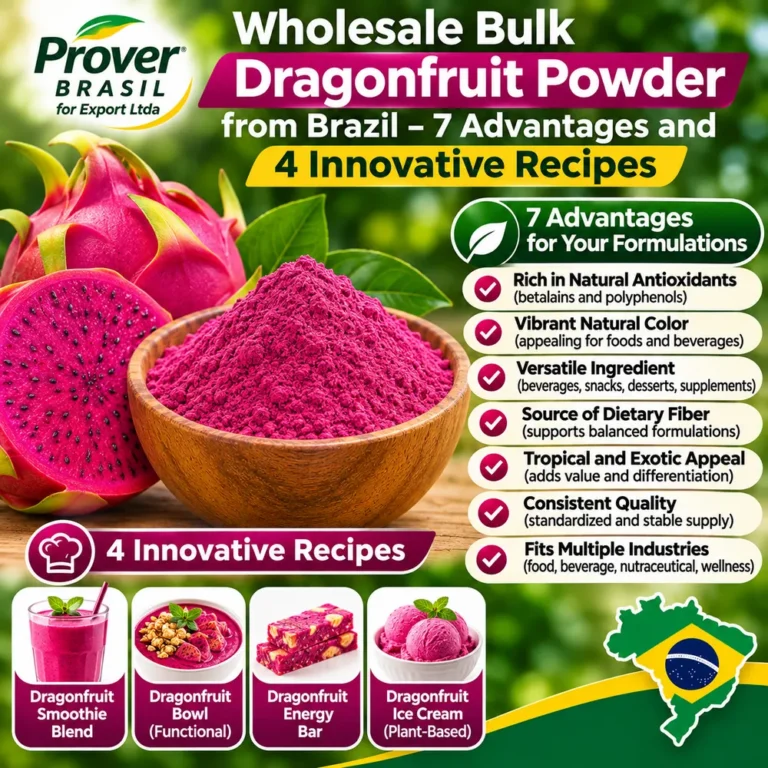
Wholesale Bulk Dragonfruit Powder from Brazil – 7 Advantages and 4 Innovative Recipes
A tropical fruit that looks almost too extraordinary to be real. A delicate flavor that pairs with ingredients from around the world. And a dry ingredient format that opens opportunities for international food innovation.
Welcome to the world of Dragonfruit Powder, also known as Pitaya Powder.
For years, dragon fruit has attracted attention because of its unusual appearance, tropical identity and growing presence in beverages, desserts and fruit-based products. Yet for industrial buyers, the most interesting question is not how the fresh fruit looks.
It is what can be created with dragonfruit powder in a commercial formulation.
A beverage company may be searching for a new tropical flavor. A dessert producer might want a distinctive fruit ingredient. An international distributor could be looking to expand its range of specialty fruit powders.
Each represents a different business opportunity.
Prover Brasil for Export Ltda. supplies Dragonfruit Powder 2:1, spray dried, from Brazil for international wholesale and bulk B2B buyers.
In this guide, we explore seven practical advantages, four innovative product-development recipes, the technical questions behind successful formulations and the steps importers should consider before ordering.
Meet Dragon Fruit: An Extraordinary Fruit with Commercial Potential
Dragon fruit is also known as pitaya or pitahaya.
The fruit is famous for its distinctive external appearance, with colored skin and characteristic leaf-like scales. Different dragon fruit varieties may contain white, pink or red flesh, and they can vary substantially in flavor, pigment composition and other properties.
This variation is extremely important for ingredient buyers.
The botanical reference associated with Prover Brasil’s product is Cereus undatus, an older scientific name associated with the species now accepted as Selenicereus undatus (Haw.) D.R.Hunt.
The name Hylocereus undatus is another commonly encountered synonym.
The plant belongs to the Cactaceae family.
Although dragon fruit is cultivated in Brazil and many other countries, the species is not originally native to Brazil. Its accepted native distribution includes parts of Central America.
Dragonfruit Powder 2:1 at a Glance
Commercial Detail
Product Information
Product
Dragonfruit Powder 2:1
Alternative name
Pitaya Powder
Accepted botanical name
Selenicereus undatus
Other names
Hylocereus undatus, Cereus undatus
Botanical family
Cactaceae
Ingredient source
Dragon fruit
Commercial origin
Brazil
Processing method
Spray dried
Product format
Powder
Reference packing
25 kg fiber barrel
Market
Wholesale and bulk B2B
Exporter
Prover Brasil for Export Ltda.
The commercial ratio of 2:1 should be interpreted according to the actual technical specification. It does not by itself establish the proportion of fruit solids, the complete ingredient composition or a particular nutritional concentration.
Why the Food Industry Is Interested in Dragonfruit Powder
International food innovation often begins with a familiar product format and an unfamiliar ingredient.
A company might already sell smoothie mixes, yogurt preparations or fruit beverage powders. Instead of developing a completely new production process, it could evaluate an additional fruit ingredient in a product category it already understands.
Dragonfruit Powder creates that possibility.
However, the suitability of a fruit powder depends on much more than the ingredient’s name. Flavor, appearance, composition, processing behavior and stability must all be assessed.
That is why the following advantages focus on practical formulation and purchasing opportunities rather than unsupported health promises.
7 Advantages of Dragonfruit Powder for International B2B Buyers
Advantage 1 — Distinctive Tropical Fruit Positioning
Dragon fruit has a recognizable visual identity and a name that consumers can associate with tropical food innovation.
For food companies, it offers an opportunity to explore differentiated product concepts.
For ingredient distributors, it provides an additional category to present alongside conventional fruit powders such as strawberry, mango and apple.
The botanical source and country of origin should be represented accurately in product descriptions.
Advantage 2 — Practical Spray-Dried Powder Format
Fresh dragon fruit requires handling, transportation and storage appropriate for a perishable fruit.
A properly specified spray-dried powder offers a different ingredient format that can be weighed, blended and incorporated into certain dry food systems.
This can be useful in beverage premixes, dessert preparations and other applications where dry ingredients are preferred.
Actual storage requirements and shelf life must be confirmed for the commercial product.
Advantage 3 — Opportunities for Tropical Beverage Innovation
Dragonfruit Powder may be evaluated in smoothies, drink mixes, beverage concentrates and other suitable formulations.
Its relatively delicate fruit character can provide opportunities for combining it with more intense ingredients.
Mango, passion fruit, pineapple, strawberry and coconut are examples of flavors that could be investigated in product-development trials.
The actual flavor intensity of the supplied powder should be confirmed through sensory testing.
Advantage 4 — Flexible Use in Dessert Development
Dessert companies can explore dragonfruit powder in yogurt preparations, frozen desserts, fruit creams and dry dessert mixes.
Powdered ingredients may be convenient for certain formulation methods, particularly when a producer wants to control ingredient weights and dry blending.
The powder’s behavior in dairy, plant-based and acidic systems should be assessed independently.
Advantage 5 — Potential for Color-Related Product Research
Dragon fruit is often associated with visually striking products, but not every variety produces intense pink or red flesh.
Pigment content depends on the botanical material, fruit variety and processing conditions.
Red-fleshed pitaya materials may contain betalain pigments, which are subjects of food-science research.
However, a powder derived from white-fleshed dragon fruit should not be assumed to provide intense red color.
Buyers seeking a specific color effect must request the actual product specification and, where appropriate, test color intensity and stability.
Advantage 6 — New Possibilities for Multi-Fruit Blends
Dragonfruit Powder can be explored in formulations combining different fruit ingredients.
For example, pairing dragon fruit with mango may produce a different sensory profile from combining it with strawberry or citrus.
This allows developers to create distinct product concepts using the same general ingredient category.
The successful combination depends on sensory balance, ingredient composition and application testing.
Advantage 7 — Wholesale Supply for International Product Development
Prover Brasil supplies Dragonfruit Powder 2:1 from Brazil for professional international buyers.
Importers, wholesalers, food companies and ingredient distributors can discuss current availability, technical specifications, commercial packing and export conditions.
A structured purchasing enquiry helps ensure the proposed product meets the buyer’s technical requirements.
The Dragonfruit Innovation Kitchen: 4 Recipe Concepts
The following four recipes are original, illustrative formulas for food product-development teams.
They demonstrate how Dragonfruit Powder 2:1 might be evaluated in different applications.
All quantities are intended as starting points for bench-scale trials, not verified commercial inclusion rates. The supplier’s actual composition and food suitability must be confirmed before use. Commercial products also require appropriate food-safety, regulatory, processing and shelf-life validation.
Recipe 1 — Tropical Dragonfruit & Mango Smoothie
Product concept: A refreshing tropical smoothie for cafés, food-service businesses or ready-to-drink development.
Trial batch: 1,000 g
Ingredients
Ingredient
Quantity
Chilled water
600 g
Mango puree
200 g
Banana puree
140 g
Dragonfruit Powder 2:1
25 g
Sugar or suitable sweetener
25 g
Lemon juice
10 g
Total
1,000 g
Preparation
Place the chilled water in a clean blending vessel.
Add the mango and banana purees.
Blend until the fruit base is uniform.
Add Dragonfruit Powder gradually while mixing.
Add sugar and lemon juice.
Continue blending until the ingredients are evenly distributed.
Evaluate the flavor, texture, color and sedimentation characteristics.
Product Development Notes
Mango provides a recognizable tropical flavor, while banana contributes creaminess.
Dragonfruit Powder can be investigated as an additional tropical fruit component.
The resulting color depends on the actual dragonfruit powder and the other ingredients.
For a commercial smoothie, developers must validate storage conditions, ingredient safety and the required preservation process.
Choosing the Right Dragonfruit Powder for Your Recipe
Before developing a commercial product, food companies should confirm that the powder they intend to purchase matches the desired application.
For example, a beverage company seeking a highly colored pink drink must not assume that every Dragonfruit Powder delivers the same color effect.
Likewise, a dry beverage premix developer should not assume that all spray-dried fruit powders disperse completely in water.
The selection process should begin with the finished-product objective.
A Product Developer’s Decision Guide
Development Goal
Most Important Evaluation
Tropical smoothie
Taste and mouthfeel
Instant drink mix
Dispersibility and powder flow
Yogurt dessert
Texture and compatibility
Frozen dessert
Flavor and freeze-thaw behavior
Dry fruit blend
Particle and moisture characteristics
Color-sensitive product
Verified color performance
International distribution
Specifications and export documentation
Each application places different demands on the ingredient.
The most suitable option is the one that satisfies the relevant technical requirements.
What Food Science Reveals About Dragon Fruit Powders
Scientific research on dragon fruit provides useful information about powder processing, storage and formulation.
A study published in the International Journal of Food Science & Technology investigated spray-dried powders produced from red- and white-fleshed dragon fruit.
The researchers found that drying conditions and storage humidity influenced powder behavior. In their experimental preparations, high relative humidity caused undesirable physical changes, including caking.
These findings highlight why storage and packaging conditions are relevant when purchasing fruit powders.
Other studies have examined the stability of betacyanin pigments in red-fleshed dragon fruit preparations.
The results demonstrate that pigment behavior can depend on the raw material, processing conditions and storage environment.
However, these studies should not be treated as certificates for a specific commercial batch of Dragonfruit Powder 2:1.
For industrial buyers, technical specifications and product-specific evaluation remain essential.
A Key Lesson About Color
A striking dragon fruit image may show white flesh with black seeds, red flesh, or another visual appearance.
These fruits should not automatically be treated as identical ingredient sources.
Before advertising a commercial Dragonfruit Powder as a natural red color contributor, buyers should verify the raw material, actual powder appearance and relevant pigment information.
Accurate product descriptions help prevent formulation problems and misleading marketing claims.
The Transition from a Kitchen Recipe to Industrial Production
A laboratory recipe can be a useful starting point, but commercial production introduces additional requirements.
Consider the instant Dragonfruit Drink Mix presented earlier.
At a 1 kg trial scale, a small mixing system may produce an apparently uniform blend.
At a much larger scale, particle-size differences and moisture sensitivity could influence powder behavior.
A food company should therefore investigate consistency across increasing batch sizes.
Ingredient Preparation
Confirm the powder’s physical characteristics and storage requirements.
Mixing and Processing
Determine whether the equipment achieves the required distribution of ingredients.
Sensory Evaluation
Compare taste, aroma and appearance across different batches.
Stability Assessment
Study the finished product over its intended shelf life under appropriate testing conditions.
Commercial Cost
Calculate the ingredient cost at the actual inclusion level, considering packaging, transportation, processing and production losses.
Regulatory Review
Confirm that the complete finished formulation complies with requirements in the destination market.
These steps help transform an attractive recipe into a better-supported commercial concept.
Dragonfruit Powder in Multi-Fruit Formulations
One approach to product innovation is combining a less familiar fruit with an ingredient consumers already recognize.
This can create new flavor concepts without requiring an entirely unfamiliar finished-product format.
Dragonfruit and Mango
Mango provides a recognizable tropical flavor and can be evaluated alongside dragon fruit in smoothies and beverage preparations.
We are evaluating Dragonfruit Powder 2:1 from Brazil for an industrial beverage formulation.
Please provide your current product specification, ingredient composition, available packing and commercial quotation.
Our estimated requirement is [Quantity in KG], with delivery to [Destination Country].
We would also appreciate information on available technical documentation and international shipping conditions.
Best regards,
Purchasing Department
This level of detail helps the supplier identify the correct product and respond to the buyer’s actual commercial needs.
Frequently Asked Questions About Dragonfruit Powder
What Is Dragonfruit Powder?
Dragonfruit Powder is a processed ingredient derived from dragon fruit, also known as pitaya, supplied in powdered form.
Does Prover Brasil Supply Dragonfruit Powder from Brazil?
Yes. Prover Brasil for Export Ltda. lists Dragonfruit Powder 2:1, spray dried, for international wholesale and bulk B2B buyers.
Is Dragonfruit Powder the Same as Pitaya Powder?
Dragon fruit and pitaya are commonly used names for related fruit ingredients. However, the precise botanical species and commercial composition should be confirmed for each product.
What Does Dragonfruit Powder 2:1 Mean?
The concentration designation must be interpreted according to the actual product specification. It does not establish a fixed nutrient or pigment concentration.
Can Dragonfruit Powder Be Used in Beverages?
It may be evaluated for beverages and powdered drink mixes, depending on its composition, dispersibility, flavor and legal suitability.
Is Dragonfruit Powder Always Pink?
No. Dragon fruit varies by species and variety. The actual powder color must be confirmed rather than inferred from promotional images.
Is Dragonfruit Powder Completely Water-Soluble?
Complete solubility should not be assumed. The powder’s physical behavior depends on its composition and processing.
Can Dragonfruit Powder Be Used in Yogurt and Desserts?
It can be evaluated in suitable dairy, plant-based and dessert formulations using controlled product-development testing.
What Packaging Does Prover Brasil List?
The product page lists 25 kg fiber barrels as reference commercial packing. Current availability should be confirmed.
How Can Importers Request a Wholesale Quotation?
Contact Prover Brasil with the required quantity, destination country, intended application and technical requirements.
Scientific and Botanical References
1. Royal Botanic Gardens, Kew — Selenicereus undatus
Botanical classification, accepted scientific name and synonyms associated with dragon fruit.
These publications provide scientific background. They do not establish the composition, pigment concentration or performance of the specific commercial Dragonfruit Powder 2:1 supplied by Prover Brasil.
Bring Brazilian Dragonfruit Powder into Your Next Product
Whether your company is developing a tropical smoothie, a powdered beverage, a creamy dessert or an innovative fruit blend, Dragonfruit Powder offers possibilities for ingredient evaluation.
But successful development requires an appropriate product specification, realistic formulation testing and reliable commercial communication.
Prover Brasil for Export Ltda. supplies Dragonfruit Powder 2:1, spray dried, from Brazil to international professional buyers.
For a wholesale quotation, please provide your required quantity, destination country, preferred packing and intended application.
The recipes are illustrative, unvalidated formulation concepts for qualified food-development teams. Product composition, food safety, legal suitability, processing requirements and shelf-life performance must be verified before commercial use.
Discover 7 advantages of Aloe Vera Leaf Dry Extract 2:1 from Brazil. Explore spray-dried powder technology, industrial applications, research and international wholesale B2B sourcing.
Discover 7 advantages of Avocado Fruit Powder 2:1 from Brazil and 4 innovative savory recipes for dips, snack seasonings, crackers and sauces. Wholesale B2B sourcing by Prover Brasil.
Discover 7 advantages of Jabuticaba Powder 2:1 from Brazil and 4 innovative product development recipes. Explore smoothies, desserts, drink premixes and wholesale B2B sourcing from Prover Brasil.
Explore our full catalog of premium, certified Brazilian botanical ingredients. Select your required specifications and request a custom commercial quote directly from our export specialists.