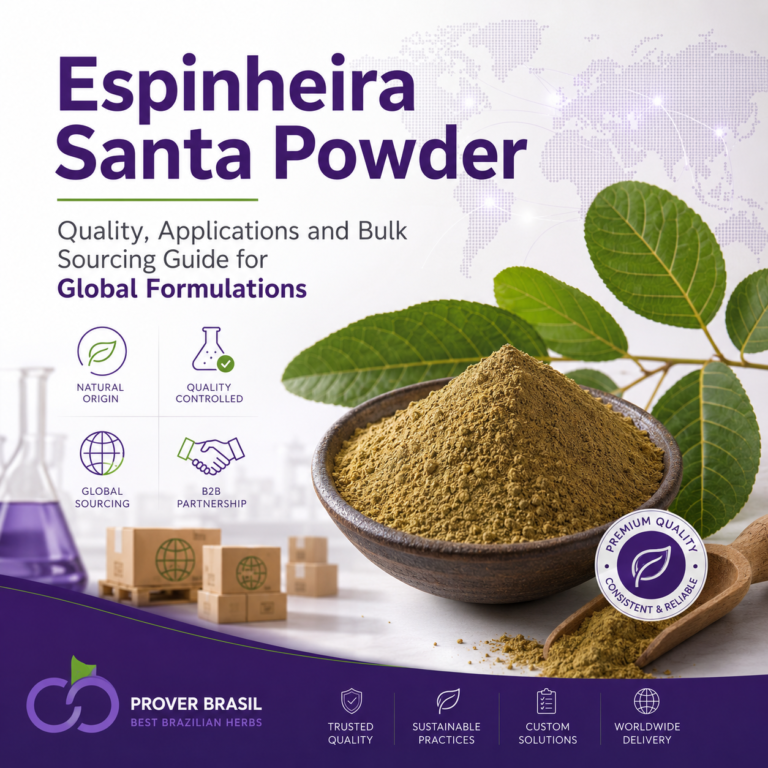
Below is the complete English article, developed with a distinct B2B angle focused on ingredient quality, applications, documentation, sourcing, and commercial conversion.
Espinheira Santa Powder: Quality, Applications and Bulk Sourcing Guide for Global Formulations
Espinheira Santa Powder is a distinctive South American botanical ingredient valued by companies developing herbal products, botanical blends, capsules, powdered preparations and wellness-focused formulations. Obtained from carefully processed leaves, the powder combines a strong Brazilian botanical identity with versatile industrial applications.
As international interest in traceable plant-based ingredients continues to grow, buyers are paying closer attention to botanical identity, processing standards, particle size, moisture, microbiological parameters, documentation and consistency between batches. Selecting Espinheira Santa Powder based only on price can create formulation problems, regulatory complications and inconsistencies in the final product.
The ingredient is widely known by the scientific name Maytenus ilicifolia, although Brazil’s official common designation was updated to Monteverdia ilicifolia in 2022. Both names may still appear in scientific literature, commercial specifications and international databases, making accurate botanical identification especially important. (Serviços e Informações do Brasil)
With experience in Brazilian botanicals and international trade since 2001, Prover Brasil supplies Brazilian botanical ingredients to global markets, supporting importers, distributors, wholesalers and industrial buyers seeking bulk ingredients with commercial reliability and export-oriented service. (siteemodelo)
What Is Espinheira Santa Powder?
Espinheira Santa Powder is generally obtained by drying and milling selected leaves of the Espinheira Santa plant. The resulting material retains the natural botanical matrix of the leaf, including its characteristic plant fibers, tannins, phenolic compounds and other naturally occurring constituents.
Brazilian pharmacopoeial documentation defines Espinheira Santa herbal material as the dried leaves of Maytenus ilicifolia and establishes identity and quality parameters, including a minimum level of total tannins for the referenced herbal drug. These official standards demonstrate the importance of botanical authentication and analytical control when evaluating the ingredient. (Biblioteca Digital Anvisa)
Unlike a purified compound or standardized extract, the powder represents the milled botanical material in a broader and less concentrated form. This makes it suitable for projects that prioritize a recognizable whole-leaf botanical profile.
Its natural sensory characteristics may include:
- A distinctly herbal aroma;
- Green to brownish-green coloration;
- A bitter and astringent flavor profile;
- Fine or moderately fine particle size;
- Natural variations associated with agricultural origin.
Color, aroma and particle distribution may vary according to harvest conditions, drying procedures, milling specifications and storage. For industrial buyers, these variables should be addressed through clear technical specifications rather than visual evaluation alone.
Botanical Identity: Maytenus ilicifolia or Monteverdia ilicifolia?
The botanical name is one of the most important elements in sourcing Espinheira Santa Powder.
For many years, the plant was internationally identified as Maytenus ilicifolia Mart. ex Reissek. Following a taxonomic update adopted by the Brazilian health authority, the official Brazilian designation became Monteverdia ilicifolia (Mart. ex Reissek) Biral. (Serviços e Informações do Brasil)
Both names may therefore appear in:
- Botanical databases;
- Certificates of analysis;
- Scientific publications;
- Customs documentation;
- Ingredient specifications;
- Product development records;
- Regulatory submissions;
- Commercial catalogues.
When requesting a quotation, buyers should confirm that the botanical identity is clearly stated and that the selected plant part is identified as the leaf.
Common names alone are not sufficient because “Espinheira Santa” may be used informally for different botanical species. Substitution or adulteration can affect composition, quality, safety and regulatory acceptance.
Why Botanical Authentication Matters
Botanical authentication helps confirm that the material corresponds to the intended species and plant part.
Depending on the project and available documentation, identity evaluation may involve:
- Macroscopic or microscopic analysis;
- Organoleptic examination;
- Chromatographic profiling;
- Comparison with authenticated reference material;
- Review of harvest and traceability records;
- Evaluation against pharmacopoeial parameters.
A low-cost material without reliable identity documentation may create significantly higher costs later through rejected batches, unsuccessful laboratory testing or regulatory delays.
Why Espinheira Santa Powder Attracts International Interest
Espinheira Santa occupies an established position within Brazilian herbal traditions and is especially associated with digestive wellness applications.
This traditional relevance has encouraged research into its phytochemical composition and botanical characteristics. Scientific literature has investigated tannins, catechins, epicatechin, flavonoids and other phenolic constituents found in the leaves and preparations derived from them. (Alice)
However, commercial communication must distinguish among:
- Traditional botanical use;
- Whole-leaf powder;
- Concentrated extracts;
- Standardized extracts;
- Preclinical studies;
- Human clinical studies;
- Legally authorized claims.
Research conducted with an extract cannot automatically be applied to an unstandardized leaf powder. Concentration, extraction solvent, dosage, phytochemical profile and final presentation can differ substantially.
For that reason, Espinheira Santa Powder should be positioned as a botanical raw material for compliant product development, rather than promoted with exaggerated therapeutic promises.
Main Applications of Espinheira Santa Powder
The ingredient can be evaluated for several product categories, subject to the laws of the target market and the technical requirements of the formulation.
Herbal Capsules and Tablets
Capsules are among the most practical formats for incorporating Espinheira Santa Powder.
They help mask part of the ingredient’s bitter taste and allow formulators to define a consistent serving size. The powder may be used individually or blended with other compatible botanicals.
Before encapsulation, the technical team should evaluate:
- Bulk density;
- Flow characteristics;
- Moisture;
- Particle size;
- Hygroscopic behavior;
- Capsule capacity;
- Blend uniformity;
- Stability;
- Microbiological specifications.
A botanical powder with poor flow may require formulation adjustments or compatible processing aids. Capsule size should be selected according to the intended quantity and the powder’s density.
Powdered Herbal Blends
Espinheira Santa Powder may be incorporated into multi-ingredient botanical blends developed for adult wellness markets.
In these applications, its strong sensory profile must be carefully considered. The natural bitterness and astringency may influence the overall taste of the formulation, especially when the product is mixed directly with water.
Possible formulation strategies include:
- Combining it with complementary herbal notes;
- Using flavor systems;
- Adjusting the serving quantity;
- Encapsulating the final blend;
- Using single-dose sachets;
- Creating products intended for infusion or preparation.
Sensory trials should be performed before commercial scale-up.
Herbal Tea and Infusion Concepts
Espinheira Santa leaves have a long history of use in herbal preparations. Depending on the particle size and local regulations, the ingredient may be considered for tea blends, infusion products or botanical sachets.
A very fine powder may not be ideal for conventional filter bags because particles can migrate through the material and create sediment. For this application, buyers may need a cut or granulated format rather than a finely milled powder.
The correct physical presentation should therefore be defined during the quotation stage.
Botanical Formulation Development
Espinheira Santa Powder can also be evaluated for research, pilot formulations and specialized botanical concepts.
Potential business segments include:
- Herbal wellness brands;
- Nutraceutical laboratories;
- Botanical ingredient distributors;
- Compounding supply chains;
- Tea companies;
- Research institutions;
- Natural product developers;
- Specialized importers.
The permitted category and claims depend on the destination country. An ingredient treated as an herbal material in one market may be subject to different restrictions in another.
Espinheira Santa Leaf Powder Versus Dry Extract
One of the most important commercial distinctions is the difference between Espinheira Santa Powder and an Espinheira Santa extract.
Whole-Leaf Powder
Whole-leaf powder is obtained by drying and milling the botanical material.
Its principal characteristics include:
- Presence of the broader leaf matrix;
- Natural plant fiber;
- Lower processing complexity;
- Less concentration than an extract;
- Strong botanical identity;
- Potentially larger serving volume;
- Natural variation between agricultural batches.
This format may suit formulations seeking a recognizable, minimally transformed botanical ingredient.
Dry Extract
A dry extract is obtained through an extraction process designed to transfer selected soluble constituents into a concentrated preparation.
Depending on the process, the extract may differ in:
- Extraction ratio;
- Solvent;
- Carrier system;
- Marker compounds;
- Solubility;
- concentration;
- Color;
- Taste;
- Bulk density;
- Recommended incorporation level.
A recent preliminary clinical study evaluated standardized dry extracts of Monteverdia ilicifolia. Those findings relate to the specific standardized preparations studied and should not be generalized to every Espinheira Santa powder or commercial extract. (PubMed Central (PMC))
Which Format Is Better?
Neither format is universally better.
The right option depends on the intended product, dosage form, label positioning, technical specification, regulatory pathway and cost structure.
Whole-leaf powder may be preferable when the project requires:
- A natural botanical matrix;
- A less concentrated ingredient;
- Traditional herbal positioning;
- Powder blending;
- Straightforward ingredient declarations.
An extract may be preferable when the project requires:
- Lower incorporation volume;
- Greater concentration;
- Defined extraction parameters;
- Specific marker standardization;
- Improved process compatibility.
The technical and regulatory teams should make this decision before requesting samples or commercial quantities.
Essential Quality Parameters
Professional sourcing requires a written specification that defines what constitutes an acceptable batch.
The exact tests depend on the market and application, but commonly evaluated parameters include:
- Botanical name;
- Plant part;
- Country of origin;
- Appearance;
- Color;
- Aroma;
- Flavor;
- Particle size;
- Moisture or loss on drying;
- Total ash;
- Foreign matter;
- Microbiological limits;
- Heavy metals;
- Pesticide residues;
- Mycotoxins when applicable;
- Identity testing;
- Marker or tannin evaluation when required;
- Storage conditions;
- Shelf life.
Brazilian pharmacopoeial documentation provides a useful technical reference for the identity and quality assessment of Espinheira Santa leaves, but each buyer must determine which specifications apply to the final market and product category. (Biblioteca Digital Anvisa)
Particle Size
Particle size affects mixing, encapsulation, sedimentation and appearance.
A finer powder can offer improved blend uniformity but may generate more dust and exhibit lower flow. A coarser material may be more appropriate for certain infusion formats.
The quotation should specify whether the project requires:
- Fine powder;
- Standard milled powder;
- Coarse powder;
- Cut leaves;
- A defined mesh range.
Using terms such as “fine” without a measurable parameter can lead to misunderstandings.
Moisture Control
Excessive moisture can affect flow, microbiological stability and shelf life.
The ingredient should be stored in suitable packaging, protected from humidity, heat, direct sunlight and strong odors.
After opening, industrial users should follow controlled handling procedures to reduce moisture absorption and environmental contamination.
Microbiological Quality
Botanical materials are agricultural ingredients and require appropriate microbiological control.
Applicable limits depend on the country and product type. Buyers should define testing requirements in advance, especially for ingredients intended for products consumed without a heat-treatment stage.
When additional processing is required, the method should be evaluated for its impact on the botanical profile, color, flavor and documentation.
Traceability and Documentation
Documentation is fundamental in international botanical trade.
The required package may vary according to the importer, destination and intended application, but commercial buyers commonly request:
- Product specification;
- Certificate of analysis;
- Technical data sheet;
- Safety data information when applicable;
- Botanical identity;
- Country-of-origin information;
- Batch identification;
- Shelf-life statement;
- Storage instructions;
- Packing details;
- Commercial invoice;
- Packing list;
- Export documentation;
- Additional laboratory reports when agreed.
Not every document or analytical test is automatically included in every commercial offer. Requirements should be communicated before the quotation is finalized.
This prevents unexpected costs and ensures that the selected batch is compatible with the importer’s compliance process.
Regulatory Considerations for International Buyers
Espinheira Santa Powder does not have the same regulatory status in every country.
Before importing or launching a product, the buyer should verify:
- Whether the botanical is permitted;
- Which plant part is accepted;
- Whether premarket notification is required;
- Whether it is classified as food, supplement, herbal material or medicine;
- Which claims are authorized;
- Whether maximum use levels apply;
- Which contaminant limits must be met;
- Which language is required on labels;
- Whether novel-food rules apply;
- Whether additional import permits are necessary.
The buyer remains responsible for confirming that the ingredient and finished formulation comply with the destination market.
Statements based on traditional use must not be converted into unauthorized disease-treatment claims.
Safety Communication
Official Brazilian monograph information includes precautions for certain populations and circumstances, including pregnancy, breastfeeding, younger age groups and potential interactions. The same documentation advises professional guidance when symptoms persist or adverse effects occur. (Serviços e Informações do Brasil)
A 2024 preclinical investigation also highlighted the need for additional safety evaluation, particularly in relation to liver conditions and potential interactions. These findings reinforce the importance of responsible formulation, evidence review and jurisdiction-specific labeling. (PubMed)
Commercial buyers should therefore avoid presenting Espinheira Santa Powder as universally appropriate for every consumer.
Authenticity and the Risk of Botanical Substitution
Espinheira Santa has historically faced challenges involving substitution with other species sold under similar common names.
This is commercially significant because two plants may look similar while presenting different chemical profiles and regulatory identities.
Risk-reduction measures include:
- Purchasing through established commercial channels;
- Requesting the full botanical name;
- Confirming the plant part;
- Reviewing batch documentation;
- Defining identity testing;
- Maintaining reference samples;
- Conducting risk-based laboratory analysis;
- Establishing supplier-approval procedures.
A lower-priced offer without proper identity controls may not represent the same ingredient.
Packaging for Bulk Supply
Packaging should protect Espinheira Santa Powder during storage and international transport.
Depending on quantity and commercial configuration, bulk botanical powders may be packed in food-grade inner liners placed inside suitable external containers.
The selected packaging should help protect against:
- Moisture;
- Light;
- Environmental contamination;
- Cross-contact;
- Odor absorption;
- Physical damage;
- Product loss during handling.
Buyers should confirm:
- Net weight per package;
- Gross weight;
- Number of units;
- Pallet configuration;
- Packaging material;
- Label information;
- Storage requirements;
- Container-loading conditions.
The appropriate packing format depends on order volume, route, destination requirements and warehouse operations.
Sample Evaluation Before a Commercial Order
For new projects, sample evaluation can help determine whether the ingredient is compatible with the intended application.
A useful sample-assessment process may include:
- Visual and sensory inspection;
- Review of the technical specification;
- Identity confirmation;
- Laboratory analysis when required;
- Pilot formulation;
- Stability observation;
- Packaging compatibility;
- Regulatory review;
- Internal approval;
- Commercial scale planning.
A sample confirms the characteristics of the submitted material, but agricultural ingredients may show natural variation. Buyers should therefore establish acceptable ranges rather than rely exclusively on an exact visual match.
Commercial Factors That Influence the Quotation
The quotation for Espinheira Santa Powder may be influenced by:
- Requested quantity;
- Product format;
- Particle-size specification;
- Packaging configuration;
- Laboratory requirements;
- Documentation package;
- Destination country;
- Incoterm;
- Freight method;
- Current availability;
- Order frequency;
- Special handling requirements.
An accurate inquiry allows the commercial team to prepare a more relevant proposal.
The buyer should provide:
- Company name;
- Destination country;
- Estimated quantity;
- Intended application;
- Required particle size;
- Required tests;
- Packaging preference;
- Delivery terms;
- Expected purchasing schedule.
Browsing the Prover Brasil portfolio of Brazilian botanical ingredients can help buyers identify complementary powders, herbs, superfoods and extracts for broader sourcing projects. (siteemodelo)
Combining Espinheira Santa with Other Botanical Ingredients
For multi-ingredient projects, Espinheira Santa may be evaluated alongside other botanicals according to the desired positioning and regulatory framework.
The combination must be assessed for:
- Flavor compatibility;
- Color;
- Serving quantity;
- Ingredient interactions;
- Stability;
- Consumer profile;
- Label clarity;
- Claim compliance;
- Total botanical load.
Adding several ingredients does not automatically improve a formulation. Each component should have a defined technical and commercial purpose.
Overly complex blends can create challenges involving taste, capsule size, analytical testing and consumer understanding.
Industrial Development Tips
A successful botanical formulation begins with realistic technical planning.
Define the Product Format First
The required ingredient specifications will differ for capsules, tablets, sachets, tea bags and loose powders.
Evaluate Sensory Impact
Espinheira Santa has a noticeable botanical character. Taste masking or encapsulation may be necessary.
Account for Density
The weight that fits into a capsule depends on powder density, not only capsule volume.
Establish a Written Specification
Color, particle size and microbiological limits should be measurable whenever possible.
Confirm Regulations Before Printing Labels
Regulatory review should occur before final packaging and marketing materials are approved.
Avoid Transferring Extract Research to Powder Claims
Whole-leaf powder and standardized extracts are different preparations.
Plan for Batch Variation
Natural variation should be managed through specifications, analytical controls and approved tolerance ranges.
Why Work with Prover Brasil?
International sourcing involves more than identifying a botanical name.
Buyers need clear communication, suitable documentation, export coordination, commercial consistency and an understanding of the logistical demands involved in moving Brazilian ingredients to international markets.
Prover Brasil has operated from Belo Horizonte since 2001 and works with bulk botanical ingredients, herbs, superfoods and extracts for international clients. (siteemodelo)
The company’s commercial approach supports:
- Importers;
- Distributors;
- Wholesalers;
- Herbal brands;
- Nutraceutical businesses;
- Botanical formulators;
- Food and beverage companies;
- Specialized laboratories.
By communicating application, quantity, destination and technical requirements at the beginning of the process, buyers can receive a proposal aligned more closely with their project.
Frequently Asked Questions About Espinheira Santa Powder
What is Espinheira Santa Powder?
Espinheira Santa Powder is a milled botanical ingredient generally obtained from dried leaves of Monteverdia ilicifolia, also widely known as Maytenus ilicifolia.
It is evaluated for herbal, nutraceutical and botanical formulations, subject to the regulations of the destination market.
Is Maytenus ilicifolia the same as Monteverdia ilicifolia?
They refer to the same botanical species under different taxonomic nomenclature.
Brazil’s official common designation was updated from Maytenus ilicifolia to Monteverdia ilicifolia in 2022. (Serviços e Informações do Brasil)
Which plant part is used?
Commercial Espinheira Santa Powder is typically associated with the leaves.
The plant part should always be clearly identified in technical and commercial documentation.
Is Espinheira Santa Powder the same as an extract?
No.
The powder is obtained by milling dried botanical material, while an extract undergoes a process designed to concentrate selected soluble constituents.
What does Espinheira Santa Powder taste like?
It generally has a characteristic herbal, bitter and astringent sensory profile.
The exact intensity can vary according to the botanical batch, particle size and processing conditions.
Can it be used in capsules?
It may be evaluated for capsules, subject to density, flow, serving-size, safety and regulatory requirements.
Pilot encapsulation tests are recommended before commercial scale-up.
Can it be used in tea products?
Its suitability depends on particle size, formulation design and applicable regulations.
A coarse or cut format may perform better than a fine powder in conventional filter bags.
Does the powder contain tannins?
Espinheira Santa leaves naturally contain tannins. Brazilian pharmacopoeial documentation uses total tannins as one of the quality parameters for the herbal material. (Biblioteca Digital Anvisa)
The exact analytical profile of a commercial batch should be confirmed through the applicable specification or test report.
Is the ingredient standardized?
A whole-leaf powder is not automatically standardized to a specific marker level.
Standardization must be explicitly defined, tested and documented. Buyers should not assume that every powder has the same concentration.
Is Espinheira Santa Powder suitable for every consumer?
No botanical ingredient should be considered universally suitable.
Finished-product developers must review safety, contraindications, interactions, dosage, consumer group and labeling requirements. Official Brazilian documentation includes specific precautions for Espinheira Santa preparations. (Serviços e Informações do Brasil)
Can therapeutic claims be used?
Claims depend on the destination country, product classification, preparation and supporting evidence.
Traditional use or research on a standardized extract does not automatically authorize disease-treatment claims for a whole-leaf powder.
How should the powder be stored?
It should generally be kept sealed in a cool, dry place, protected from moisture, direct sunlight, excessive heat and strong odors.
The specific storage conditions stated in the supplier documentation should be followed.
What is the shelf life?
Shelf life depends on the processing, packaging, storage conditions and established product specification.
The applicable batch documentation should be reviewed before purchase.
Can a sample be requested?
Sample availability depends on current stock, destination, quantity and commercial conditions.
Buyers should provide their technical requirements so the most relevant material can be evaluated.
What information is needed for a quotation?
Provide the destination country, estimated quantity, intended application, desired format, required laboratory tests, packaging preference and delivery terms.
This information helps avoid incomplete or inaccurate quotations.
Does natural color variation indicate a quality problem?
Not necessarily.
Botanical powders may vary naturally according to harvest, drying and milling conditions. The batch should be evaluated against an approved specification rather than color alone.
Why is botanical identification important?
Different species can share similar common names.
Confirming the scientific name and plant part helps reduce the risk of substitution, inconsistent composition and regulatory problems.
Conclusion
Espinheira Santa Powder offers a distinctive opportunity for companies seeking an authentic Brazilian botanical ingredient for herbal, nutraceutical and specialized wellness formulations.
Its commercial value depends on more than its traditional reputation. Successful sourcing requires attention to botanical identity, plant part, particle size, microbiological quality, documentation, traceability, sensory characteristics and regulatory compatibility.
Buyers should also understand the difference between whole-leaf powder and concentrated extracts. Scientific findings associated with one preparation cannot automatically support claims for another.
By defining technical requirements early, evaluating samples and working with an experienced export company, businesses can reduce sourcing risks and build more consistent botanical products.
Prover Brasil supports international clients seeking bulk Brazilian ingredients with commercial guidance, export coordination and access to a diversified botanical portfolio.
For availability, technical information and commercial conditions, request an Espinheira Santa Powder bulk quotation from Prover Brasil and include your destination, required quantity, intended application and specification needs.
This material is ready for publication and maintains a commercial tone without using the restricted terms or making unsupported medical promises.