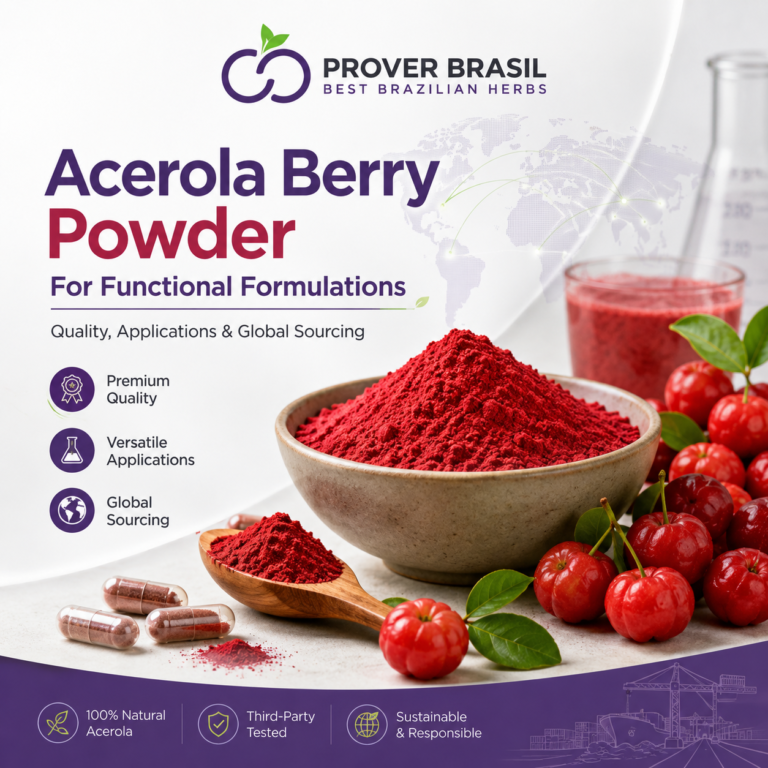
Acerola Berry Powder has become a strategic ingredient for food, beverage, nutraceutical, sports nutrition and wellness companies seeking naturally sourced vitamin C, tropical fruit positioning and greater formulation versatility.
For industrial buyers, however, choosing an acerola ingredient requires more than confirming its origin or reviewing a commercial description. Vitamin C concentration, processing method, carrier composition, moisture, solubility, microbiological profile, packaging and storage conditions can directly affect how the powder performs in the final formulation.
This is especially important because acerola is naturally rich in sensitive compounds. Research has identified acerola as one of the most concentrated natural sources of vitamin C, while also confirming the presence of phenolic compounds, carotenoids and other constituents that contribute to its value as a functional ingredient.
The challenge for purchasing teams and formulation specialists is to select a powder that aligns with the intended product, processing conditions, regulatory strategy and target market.
With international operations based in Belo Horizonte since 2001, Prover Brasil supplies Brazilian superfoods and botanical ingredients to global B2B markets, supporting companies that require commercial organization, documentation and international logistics. The company works with botanical extracts, fruit powders, herbs and other ingredients for industrial applications.
What Is Acerola Berry Powder?
Acerola Berry Powder is a dry ingredient obtained from acerola, a small tropical fruit known for its vivid red color, tart flavor and naturally high concentration of ascorbic acid.
The fruit is commonly associated with the botanical name Malpighia emarginata, although other botanical references may appear in technical and commercial documentation. For procurement purposes, buyers should verify the botanical identification stated in the specification sheet and Certificate of Analysis.
Fresh acerola is highly perishable and contains a substantial amount of water. Converting the fruit or its concentrated juice into powder improves its suitability for storage, transportation, blending and use in industrial formulations.
Depending on the processing method and commercial specification, the ingredient may be supplied as:
- Acerola fruit powder;
- Acerola juice powder;
- Acerola extract powder;
- Standardized vitamin C powder;
- Spray-dried acerola powder;
- Acerola powder combined with a carrier.
These forms are not automatically interchangeable. Each may present different characteristics regarding vitamin C concentration, fruit solids, acidity, color, flavor, dispersibility and application dosage.
Why Acerola Berry Powder Is Relevant to Modern Formulations
Consumers increasingly examine ingredient lists and look for products associated with recognizable fruits, botanicals and naturally sourced nutrients.
In this context, Acerola Berry Powder provides more than nutritional functionality. It can also support a product’s commercial narrative by connecting vitamin C with a familiar tropical fruit.
This positioning is particularly relevant for brands developing:
- Naturally sourced vitamin products;
- Functional beverages;
- Plant-based supplements;
- Clean-label formulations;
- Wellness powders;
- Sports nutrition blends;
- Fruit-based gummies;
- Nutricosmetic products;
- Premium food supplements.
The ingredient can help replace or complement isolated ascorbic acid when the formulation strategy requires a fruit-derived source.
However, substituting one vitamin C source for another is not always a direct one-to-one process. The dosage must consider the actual vitamin C assay, moisture, carrier percentage, processing losses and desired nutrient declaration in the finished product.
Acerola as a Natural Source of Vitamin C
Vitamin C is the main nutritional characteristic associated with acerola. Its concentration varies according to cultivar, fruit maturity, climate, harvesting conditions, extraction method and processing parameters.
Green or less mature acerola generally presents a different composition from fully ripe fruit. This variation is important for industrial sourcing because the appearance, taste and vitamin C level of the final powder can depend on the raw material selected.
A 2026 study involving green acerola reported high ascorbic acid recovery and successfully stabilized the extract through spray drying. The resulting powder maintained low water activity without a significant loss of the antioxidant composition measured in the study.
This does not mean that every commercial powder will present the same concentration or stability. Buyers must evaluate the specification of the actual batch under consideration.
Vitamin C Percentage Must Be Confirmed
The expression “rich in vitamin C” is not sufficient for industrial purchasing.
The specification should state whether the vitamin C content is:
- Naturally occurring in the fruit;
- Standardized to a minimum percentage;
- Calculated on a dry basis;
- Measured as ascorbic acid;
- Declared at the time of processing;
- Guaranteed until the end of the ingredient’s shelf life.
A powder standardized to a defined vitamin C level provides a different formulation reference from a non-standardized fruit powder.
When the product will support a nutritional claim, the formulator should also account for vitamin degradation during the finished product’s processing and storage.
Acerola Berry Powder Versus Synthetic Ascorbic Acid
Acerola powder and synthetic ascorbic acid can both contribute vitamin C, but they serve different formulation and positioning strategies.
Synthetic ascorbic acid is normally highly concentrated, has a predictable assay and can be used at relatively low dosages. It may be suitable when the primary objective is technical vitamin C fortification without the need for a fruit-based ingredient story.
Acerola Berry Powder offers vitamin C within a fruit-derived matrix. Depending on the specification, this matrix may also contain organic acids, pigments and other naturally occurring constituents.
For many brands, the main advantage is the ability to declare acerola as an ingredient and build a formulation around natural origin, tropical identity or fruit-based nutrition.
The choice should consider:
- Required vitamin C dosage;
- Target ingredient declaration;
- Finished product flavor;
- Color expectations;
- Processing temperature;
- Cost per effective dose;
- Stability throughout shelf life;
- Regulatory requirements;
- Brand positioning.
Acerola should not be selected solely because it sounds more natural. It must also perform consistently in the specific formulation.
How Acerola Berry Powder Is Processed
Different drying technologies can be used to transform acerola juice, pulp or extract into powder.
The selected method affects physical properties, concentration, cost, stability and suitability for particular applications.
Spray Drying
Spray drying converts a liquid feed into fine particles by atomizing it into a controlled stream of heated air.
Because fruit juices are naturally rich in sugars and organic acids, carrier materials may be added to improve drying efficiency, reduce stickiness and create a more stable powder.
Common carriers may include maltodextrin, gum arabic or other permitted ingredients. Their presence should be clearly identified because they influence fruit concentration, nutritional values, allergen assessment and label declaration.
Research involving acerola has shown that spray-drying conditions and carrier systems can affect water activity, hygroscopicity, flowability, vitamin retention and storage stability.
Spray-dried powder is often selected for beverage mixes, capsules, tablets, nutrition powders and large-scale industrial blends.
The Role of Carriers in Acerola Powder
Carriers are commonly used in fruit powder processing to improve stability, reduce stickiness and facilitate handling.
Their presence is not automatically a quality problem. In many cases, the carrier is technically necessary to obtain a functional and commercially stable powder.
The critical issue is transparency.
The specification should identify:
- Carrier type;
- Approximate proportion;
- Fruit or extract content;
- Vitamin C assay;
- Additional processing aids;
- Allergen status;
- Genetically modified ingredient status, when applicable.
A powder with a higher carrier percentage may require a larger dosage to deliver the same quantity of acerola solids or vitamin C as a more concentrated option.
For this reason, quotations should not be compared exclusively by price per kilogram. The buyer should evaluate price per effective formulation dose.
Main Industrial Applications of Acerola Berry Powder
Acerola is versatile, but the ideal specification changes according to the product category.
Dietary Supplements
Acerola Berry Powder can be incorporated into capsules, tablets, sachets, gummies and powdered vitamin blends.
In supplements, formulators normally prioritize:
- Standardized vitamin C content;
- Batch consistency;
- Low moisture;
- Microbiological compliance;
- Controlled particle size;
- Compatibility with excipients;
- Stability during shelf life.
For capsules, the powder’s bulk density and flow behavior can affect filling efficiency. For tablets, compression behavior and interaction with binders must be tested.
In gummies, acerola can contribute acidity and fruit positioning, but vitamin losses during heating should be considered.
Capsules and Tablets
Capsule formulations often require a relatively concentrated ingredient to avoid excessive serving sizes.
A low-assay fruit powder may occupy too much capsule volume to achieve the desired vitamin C declaration. A standardized format can provide greater dosage control.
Tablet development may require evaluation of:
- Compressibility;
- Powder flow;
- Hygroscopicity;
- Lubricant compatibility;
- Disintegration;
- Final tablet hardness.
Pilot testing is essential because botanical powders may behave differently from isolated vitamins.
Powdered Supplements
Acerola can be combined with other fruit powders, minerals, plant proteins, fibers and botanical extracts.
In these formulations, sensory evaluation is especially important. Acerola naturally has an acidic profile that may improve some fruit blends but become overly dominant in others.
Sweeteners, flavors and buffering ingredients may be required to achieve the desired taste.
Functional Beverages and Instant Drink Mixes
Acerola Berry Powder is widely compatible with beverage concepts associated with wellness, daily nutrition and active lifestyles.
Potential applications include:
- Vitamin drink powders;
- Effervescent blends;
- Smoothie mixes;
- Hydration products;
- Fruit beverages;
- Wellness shots;
- Tea-based formulations;
- Sports drink powders.
For beverage applications, buyers should evaluate dispersibility rather than relying only on the word “soluble.”
A powder can disperse in water while still forming sediment, foam or visible particles. The desired performance depends on whether the final beverage is clear, opaque, carbonated, dairy-based or fruit-based.
Acidity and Flavor Balance
Acerola has a naturally tart flavor.
This can be advantageous in citrus, berry, tropical fruit and red fruit profiles. It may also help balance sweetness in flavored supplement powders.
However, excessive acidity can make the product difficult to consume. Formulators should test the complete flavor system at the intended serving level.
Gummies, Chewables and Confectionery
The fruit identity and acidity of acerola make it relevant to gummies, chewable tablets and functional confectionery.
The main technical concern is heat exposure. Vitamin C is sensitive to processing conditions, and losses can occur during cooking, holding, drying and storage.
The formulation should be validated after processing rather than relying only on the vitamin C level of the raw ingredient.
Overages may be required, but they should be determined through stability studies and regulatory review.
Functional Foods and Nutrition Bars
Acerola Berry Powder can be included in:
- Nutrition bars;
- Breakfast products;
- Fruit preparations;
- Powdered desserts;
- Snack coatings;
- Superfood blends;
- Bakery formulations.
In dry products, the ingredient may contribute nutritional value and a subtle acidic fruit note.
In products exposed to baking or extrusion, the impact of heat on vitamin C must be evaluated. The amount added before processing may differ from the amount remaining at the end of shelf life.
An experimental study has also investigated acerola powder as an alternative source of ascorbic acid in bread formulations, demonstrating its relevance beyond beverages and supplements.
Sports Nutrition
Acerola can be incorporated into pre-workout blends, recovery powders, hydration products and daily wellness supplements aimed at active consumers.
Its role should be clearly defined. It may function as:
- A vitamin C source;
- A tropical fruit ingredient;
- Part of an antioxidant-oriented blend;
- A supporting ingredient in powdered nutrition;
- A clean-label alternative within a wider formula.
The ingredient should not be presented as an immediate performance enhancer unless the finished product has appropriate evidence and the claim is permitted in the target country.
Beauty and Nutricosmetic Formulations
Acerola may also be considered for beauty supplements, collagen blends and nutricosmetic concepts.
Vitamin C is frequently included in formulations associated with collagen metabolism and antioxidant nutrition. However, all label statements must comply with the rules of the market where the finished product will be sold.
For topical cosmetic applications, formulators must assess color, odor, pH, solubility, preservation and compatibility with the complete system.
A food-grade acerola powder is not automatically suitable for every cosmetic formulation.
How to Evaluate Acerola Berry Powder Quality
A professional purchasing process should combine commercial analysis with technical documentation and sample testing.
The product name alone does not provide enough information to determine suitability.
Through its bulk ingredient and botanical product portfolio, Prover Brasil supports international buyers seeking Brazilian fruit powders, superfoods, herbs and botanical extracts for different industrial applications. The company’s catalog includes acerola berry products alongside other ingredients for food, supplement and wellness markets.
Vitamin C Assay
The Certificate of Analysis should state the vitamin C result and the analytical method when applicable.
Buyers should confirm whether the result represents:
- A minimum guaranteed level;
- A typical value;
- The actual batch result;
- A dry-basis result;
- A value at the time of release.
This distinction affects formulation accuracy.
Moisture and Water Activity
Moisture and water activity influence powder stability, microbial risk, caking and flow.
A powder with inadequate moisture control may absorb water from the environment, form lumps and lose handling quality.
Water activity is especially useful because it describes the amount of available water in the material rather than only the total moisture percentage.
Solubility and Dispersibility
The required behavior depends on the application.
A capsule powder may not require complete water solubility. An instant beverage, however, may need rapid dispersion with minimal sediment.
Testing should consider:
- Water temperature;
- Mixing intensity;
- Serving concentration;
- pH;
- Other ingredients;
- Time before consumption.
Particle Size and Flowability
Particle size affects blending, dust formation, capsule filling, tablet compression and beverage texture.
A very fine powder may disperse quickly but create more dust. A larger particle may flow better but settle differently in liquid.
The specification should match the intended processing equipment.
Color and Sensory Profile
Acerola powder can vary from pale cream or pink to red or orange, depending on the fruit, concentration, processing method and carrier.
Color variation does not automatically indicate poor quality. However, unexplained differences between batches can affect the appearance of the finished product.
A sensory evaluation should review:
- Aroma;
- Acidity;
- Bitterness;
- Fruit character;
- Off-notes;
- Aftertaste.
Microbiological Specifications
Microbiological requirements should reflect the ingredient’s application and the destination market.
The Certificate of Analysis may include limits or results for:
- Total plate count;
- Yeasts and molds;
- Coliforms;
- Escherichia coli;
- Salmonella;
- Other microorganisms requested by the buyer.
Specifications should be agreed upon before the purchase order is confirmed.
Documentation for International Buyers
Documentation is a central part of B2B ingredient sourcing.
Before placing an order, the buyer should determine which documents are mandatory for customs clearance, quality approval and finished product registration.
Common documents may include:
- Product specification sheet;
- Certificate of Analysis;
- Safety Data Sheet;
- Ingredient statement;
- Allergen declaration;
- Country-of-origin information;
- Genetically modified ingredient statement;
- Microbiological report;
- Packing list;
- Commercial invoice;
- Certificate of origin, when required;
- Phytosanitary or sanitary documents, when applicable.
Not every document applies to every shipment. Requirements depend on the destination country, ingredient classification and intended use.
The importer remains responsible for confirming local requirements with customs agents, regulatory consultants and competent authorities.
Storage and Shelf-Life Considerations
Vitamin C is sensitive to oxygen, moisture, heat and light.
For this reason, Acerola Berry Powder should generally be maintained in sealed packaging, protected from humidity and stored under the conditions stated by the ingredient company.
Opening and closing the package repeatedly can expose the powder to humid air and accelerate caking or degradation.
For industrial use, good practices include:
- Closing the package immediately after sampling;
- Using clean and dry utensils;
- Avoiding direct sunlight;
- Controlling warehouse temperature and humidity;
- Following first-expired, first-out inventory rotation;
- Recording the date when each package is opened;
- Avoiding storage near strong odors.
Research on encapsulated acerola powder has shown that storage temperature influences the degradation rate of vitamin C and phenolic compounds, reinforcing the importance of controlled storage conditions.
Packaging for Bulk Acerola Berry Powder
Bulk packaging must protect the ingredient throughout handling, warehousing and international transit.
Depending on the agreed format, powders may be packed in fiber drums, cartons, multilayer bags or other food-grade systems with an internal liner.
The buyer should confirm:
- Net weight;
- Packaging material;
- Inner liner specification;
- Pallet configuration;
- Package dimensions;
- Storage instructions;
- Lot identification;
- Shelf life;
- Minimum order quantity.
Packaging decisions also affect freight efficiency. A format that protects the ingredient well but uses space inefficiently may increase shipping costs.
Questions to Ask Before Buying Acerola Berry Powder
A structured qualification process reduces misunderstandings and protects both parties.
Important questions include:
- What is the exact product type?
- What is the botanical identification?
- What is the vitamin C specification?
- Is the vitamin content standardized?
- Which carrier is used?
- What is the carrier percentage?
- Which drying method is applied?
- What is the country of origin?
- Which microbiological limits apply?
- What is the shelf life?
- Which storage conditions are recommended?
- Which documents are available?
- What is the minimum order quantity?
- Which packaging format is offered?
- Can a sample be evaluated before ordering?
- Which shipping methods are available?
- Are destination-specific documents available?
These questions help purchasing teams compare options using technical value rather than only price.
Comparing Acerola Quotations Correctly
Two Acerola Berry Powder quotations may appear similar while representing substantially different ingredients.
One powder may contain a higher concentration of vitamin C but also have a higher price per kilogram. Another may be more economical but require a larger dosage in the finished formula.
The correct comparison should consider:
- Vitamin C delivered per kilogram;
- Required dosage per serving;
- Carrier percentage;
- Freight cost;
- Import duties;
- Packaging size;
- Testing requirements;
- Expected processing losses;
- Finished product stability.
A lower price per kilogram does not guarantee a lower cost per finished unit.
Regulatory Responsibility and Product Claims
Acerola is widely recognized as a vitamin C-rich fruit, but commercial claims must be based on the composition of the finished product.
An ingredient’s natural profile does not automatically authorize statements such as:
- Prevents disease;
- Treats infections;
- Eliminates inflammation;
- Guarantees immunity;
- Reverses aging;
- Prevents cancer.
Food and supplement claims are regulated differently across markets.
The finished-product company should validate nutrient levels, review local legislation and ensure that packaging, advertising and technical materials use permitted language.
This is especially important when the product is sold in multiple countries.
Why Source Acerola Berry Powder from Brazil?
Brazil has established experience with acerola cultivation and fruit ingredient processing.
For global buyers, Brazilian sourcing can support:
- Access to tropical fruit ingredients;
- Diversification of the ingredient portfolio;
- Authentic origin positioning;
- Development of functional food concepts;
- International bulk shipments;
- Combination with other Brazilian superfoods.
Acerola also complements ingredients such as açaí, guarana, camu-camu, cupuaçu, beetroot and botanical extracts.
This makes it relevant for companies building a broader portfolio of fruit powders and natural ingredients rather than purchasing a single isolated item.
Prover Brasil as an International B2B Sourcing Partner
Prover Brasil for Export Ltda. is based in Belo Horizonte, Brazil, and has operated in international trade since 2001.
Its portfolio includes acerola products, açaí powder, guarana, fruit powders, superfoods, herbs and botanical extracts. The company states that it supports worldwide distribution and offers air cargo, sea freight and express courier options, including courier solutions for sample evaluations.
For purchasing departments, this structure helps centralize communication regarding:
- Ingredient selection;
- Commercial quotations;
- Order quantities;
- Documentation;
- Packaging;
- Destination logistics;
- Sample requests;
- Shipping alternatives.
The buyer should provide the destination country, required quantity, intended application and desired specification so that the quotation can be prepared more accurately.
Frequently Asked Questions About Acerola Berry Powder
Is Acerola Berry Powder naturally rich in vitamin C?
Yes. Acerola is scientifically recognized as a fruit with a naturally high vitamin C concentration.
The actual amount in a commercial powder depends on the raw material, maturity, processing method, carrier content and product specification.
Is acerola powder the same as pure vitamin C?
No.
Acerola powder is a fruit-based ingredient or extract containing vitamin C within a broader matrix. Pure ascorbic acid is a highly concentrated isolated compound.
They differ in dosage, ingredient declaration, flavor, color and formulation behavior.
What is standardized Acerola Berry Powder?
A standardized powder is supplied according to a defined minimum or target vitamin C concentration.
The specification and batch Certificate of Analysis should confirm the applicable level.
Does Acerola Berry Powder contain a carrier?
Many spray-dried fruit powders contain a carrier to improve drying, flowability and stability.
The buyer should verify the carrier type and proportion in the specification.
Is Acerola Berry Powder water soluble?
Its behavior depends on the product type.
Some powders disperse effectively in water but may not create a completely transparent solution. Beverage formulators should test the sample at the intended dosage.
Can acerola powder be used in capsules?
Yes, provided that the powder’s vitamin C concentration, particle size, density and microbiological specifications are suitable for the formulation.
Can it be added to gummies?
Yes.
However, the formulation team should consider heat exposure, acidity, interaction with the gelling system and vitamin C losses during processing and storage.
Is Acerola Berry Powder suitable for beverages?
Yes. It can be used in instant drink mixes, smoothie powders, wellness beverages, sports nutrition and fruit-based formulations.
Dispersibility, sedimentation, flavor and acidity should be evaluated during development.
Can acerola powder support a clean-label formulation?
It may support formulations positioned around recognizable fruit ingredients and naturally sourced vitamin C.
The final label and marketing statements depend on the complete formulation and local regulations.
What documents should buyers request?
Typical documents include a specification sheet, Certificate of Analysis, allergen declaration, ingredient statement, country-of-origin information and shipping documents.
Additional tests or declarations may be required by the destination country.
How should Acerola Berry Powder be stored?
The powder should be maintained in sealed packaging under the storage conditions stated in its technical documents.
Protection from heat, moisture, oxygen and direct light is particularly important.
What is the shelf life of acerola powder?
Shelf life varies according to processing, packaging, vitamin C specification and storage conditions.
Buyers should use the period stated in the official product documentation rather than applying a generic estimate.
Is a sample recommended before ordering?
Yes. A sample allows the formulation and quality teams to evaluate sensory characteristics, solubility, dosage and compatibility before a commercial purchase.
Can acerola powder be combined with other fruit powders?
Yes. Acerola is often compatible with açaí, camu-camu, berries, citrus fruits and tropical fruit blends.
The final combination should be tested for flavor, color, stability and nutrient content.
How is the price of Acerola Berry Powder determined?
Pricing may be influenced by vitamin C concentration, processing method, carrier composition, quantity, packaging, documentation and shipping method.
A precise quotation requires information about the desired specification and destination.
Conclusion
Acerola Berry Powder is a versatile ingredient for companies developing functional beverages, dietary supplements, gummies, powdered nutrition, wellness foods, sports products and nutricosmetic formulations.
Its commercial value is closely connected to its naturally high vitamin C content, tropical origin and compatibility with clean-label product strategies.
However, a successful sourcing decision requires more than selecting an ingredient described as acerola powder. Buyers should compare vitamin C assay, carrier system, moisture, water activity, sensory profile, microbiological limits, documentation, packaging and performance in the final formulation.
The most suitable specification is the one that delivers consistent technical performance, supports the intended label and remains stable throughout processing and shelf life.
Prover Brasil combines a diverse portfolio of Brazilian ingredients with experience in international B2B supply, documentation and worldwide logistics.
To discuss quantities, specifications, packaging and destination requirements, request an Acerola Berry Powder quotation from Prover Brasil and provide your target market and intended application to receive commercially relevant information.