Wholesale Bulk Acai Berry Powder
Explore Wholesale Bulk Acai Berry Powder from Brazil for beverages, foods and nutrition products. Review its benefits, industrial uses, quality criteria and sourcing guidance for international buyers.


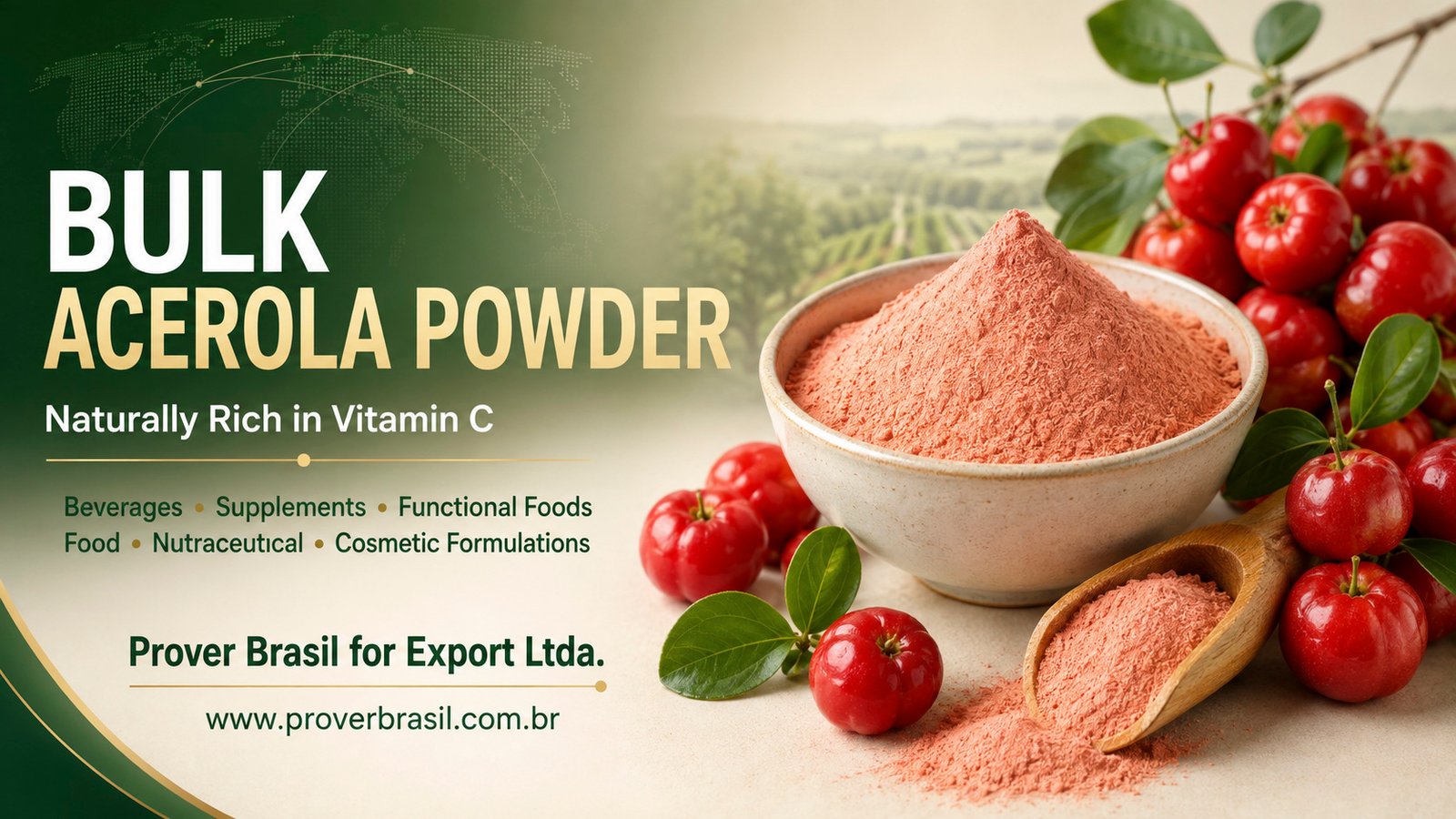 Choosing an acerola ingredient for industrial use involves more than comparing fruit origin or vitamin C percentages. Product developers must also consider dispersibility, flavor impact, color, moisture, carrier composition, storage conditions and compatibility with the intended application.
Brazilian bulk acerola powder offers companies a practical way to introduce acerola fruit solids and naturally occurring nutrients into dry and liquid formulations. Its concentrated fruit profile makes it relevant to beverage companies, food processors, supplement brands and ingredient distributors looking for a recognizable tropical ingredient.
Prover Brasil for Export Ltda. supplies Brazilian botanical ingredients to international buyers. Product specifications, packaging options and commercial conditions should be confirmed for each inquiry.
Acerola powder is produced from the fruit of the acerola tree, botanically identified as Malpighia emarginata DC. The name Malpighia glabra is also found in older scientific literature and commercial documentation, but M. emarginata is widely used in current botanical references.
Fresh acerola is highly perishable. Transforming the fruit into powder provides a format that is easier to transport, store, measure and incorporate into industrial products. Depending on the production method and commercial grade, the ingredient may vary in fruit solids, naturally occurring vitamin C, carrier system, color, acidity and solubility.
For that reason, buyers should not assume that every acerola powder will perform identically. The correct grade should be selected according to the finished product and its processing conditions.
Acerola is particularly valued for its naturally occurring vitamin C. The fruit also contains phenolic compounds, carotenoids and other constituents that contribute to its overall composition.
However, the commercial value of bulk acerola powder extends beyond a single nutrient. It can help formulators develop products with:
The actual vitamin C content and nutrient contribution must always be verified through the product specification and certificate of analysis. Any label claim must comply with the regulations of the country where the finished product will be sold.
Acerola powder can be incorporated into powdered beverages, hydration mixes, fruit blends and instant drink preparations. Its natural acidity works especially well with citrus, berry and tropical flavors.
During development, formulators should test the powder’s dispersibility, sedimentation, acidity and sensory contribution. These characteristics can change according to the concentration used and the other ingredients in the formula.
Supplement companies may use acerola powder in capsules, tablets, sachets and multi-ingredient nutritional blends. It is frequently combined with other fruit powders and botanical ingredients.
For supplements, purchasing teams should evaluate the declared vitamin C content, serving-size calculations, particle size, flow properties and compatibility with the selected production process.
Bulk acerola powder can be evaluated for nutrition bars, powdered food blends, gummies, fruit preparations and other value-added foods. Its tangy character may complement sweet formulations by adding acidity and balancing flavor.
Because vitamin C is sensitive to processing and storage conditions, pilot-scale testing is important when the finished product will be exposed to heat, oxygen, moisture or extended shelf life.
Acerola can be combined with açaí, camu camu and other Brazilian fruit ingredients to create differentiated tropical blends. In these applications, the powder contributes both composition and product identity.
Formulators should define whether acerola is intended to be a primary ingredient, a supporting fruit component or a standardized nutrient source. That decision affects the required dosage and specification.
Dry premixes offer manufacturers and foodservice operators a convenient way to standardize ingredient measurement. Acerola powder may be used in fruit bases, powdered smoothie preparations and specialty beverage systems.
Flowability, hygroscopicity and packaging protection are particularly important when the powder will be repeatedly handled after the package is opened.
The powder format simplifies weighing, blending, transportation and inventory management compared with highly perishable fresh fruit.
Acerola is recognized for its vitamin C content. Nevertheless, the concentration can vary according to fruit maturity, processing method, storage and commercial grade.
The ingredient can be evaluated for beverages, foods, supplements and powdered blends, allowing importers to serve multiple industrial segments.
Acerola provides a clear botanical and geographic identity that can help distinguish a formulation from products based only on isolated nutrients.
Its tart profile can complement açaí, guarana, camu camu, citrus fruits and other ingredients frequently used in functional formulations.
A commercial name alone does not provide enough information to qualify an ingredient. Before placing an order, buyers should request and review the technical documentation for the specific lot or grade.
Documentation should identify the botanical name, plant part, country of origin and product form. Buyers should also determine whether the ingredient is a fruit powder, juice powder or powdered extract, since these materials may have different compositions and applications.
If vitamin C is important to the finished product, request the test method, declared range and lot-specific result. Avoid calculating nutritional claims from general information about fresh acerola.
Some powdered ingredients use carriers to support drying, stability and handling. The type and proportion of carrier can influence labeling, flavor, solubility and formulation performance. Buyers should request this information before approving a grade.
Relevant parameters may include:
Not every parameter is required for every application. The final checklist should reflect the buyer’s manufacturing process and quality system.
Depending on the destination and application, buyers may need results for total plate count, yeast and mold.
Required limits should be agreed upon before shipment rather than assumed from a general product description.
Vitamin C is sensitive to oxygen, temperature, light and moisture. Research on spray-dried acerola and camu camu powders found that higher storage temperature increased vitamin C degradation. This demonstrates why packaging and warehousing conditions matter throughout the supply chain.
Bulk acerola powder should generally be kept tightly closed in a cool, dry environment, protected from direct light and sources of heat. The exact storage instructions and shelf life must follow the technical specification supplied with the product.
Once a package is opened, exposure to humid air can cause clumping and accelerate quality loss. Manufacturers should limit the time that the powder remains exposed and use suitable procedures for resealing or transferring it to protected containers.
A structured technical inquiry helps both the buyer and supplier identify the appropriate grade. Before requesting a quotation, consider providing:
Sharing these details at the beginning of the sourcing process reduces specification mismatches and makes commercial evaluation more efficient.
Scientific literature describes acerola as a fruit with considerable vitamin C content and a diverse group of phenolic compounds and carotenoids. The concentration of these compounds is not fixed. Cultivar, fruit maturity, agricultural conditions, processing and storage can all influence the final composition.
This variability has an important commercial implication: scientific information about acerola fruit should not replace batch-specific testing of an industrial powder.
Studies also indicate that controlling moisture and storage temperature can improve the retention of sensitive compounds in powdered products. Therefore, ingredient evaluation should connect nutritional objectives with practical considerations such as packaging, warehouse conditions and the expected shelf life of the finished formulation.
Not necessarily. Fruit powder, juice powder and extract powder can differ in processing, concentration, carrier content and analytical specifications. Buyers should confirm the precise product identity before ordering.
No. Vitamin C content can vary according to fruit maturity, processing method, formulation and storage. Use the specification and certificate of analysis for the offered grade.
It can be evaluated for powdered beverages, fruit drinks, smoothie preparations and other beverage systems. Compatibility should be confirmed through formulation and stability trials.
Certain grades may be suitable, but manufacturers must evaluate particle size, flow, density, moisture and compatibility with their equipment and formula.
Vitamin C degrades more rapidly under unfavorable temperature, moisture and oxygen conditions. Suitable packaging and controlled storage help preserve ingredient quality.
Provide the destination country, application, required quantity, packaging preference and technical requirements. This information helps identify the appropriate product and commercial conditions.
Importers, distributors and industrial buyers can contact Prover Brasil for Export Ltda. to discuss Brazilian bulk acerola powder for international supply.
Technical characteristics and availability may vary by grade and lot. Request the current specification, packaging information, minimum order details and quotation before approving the ingredient for commercial production.
Prover Brasil for Export Ltda.
Website: https://www.proverbrasil.com.br/
Use 3–4 relevant internal links, distributed naturally. Do not place all of them in the same paragraph.
https://proverbrasil.com.br/produto/acerola-extracts-powders/https://proverbrasil.com.br/products/https://proverbrasil.com.br/produto/acai-powder-2/