

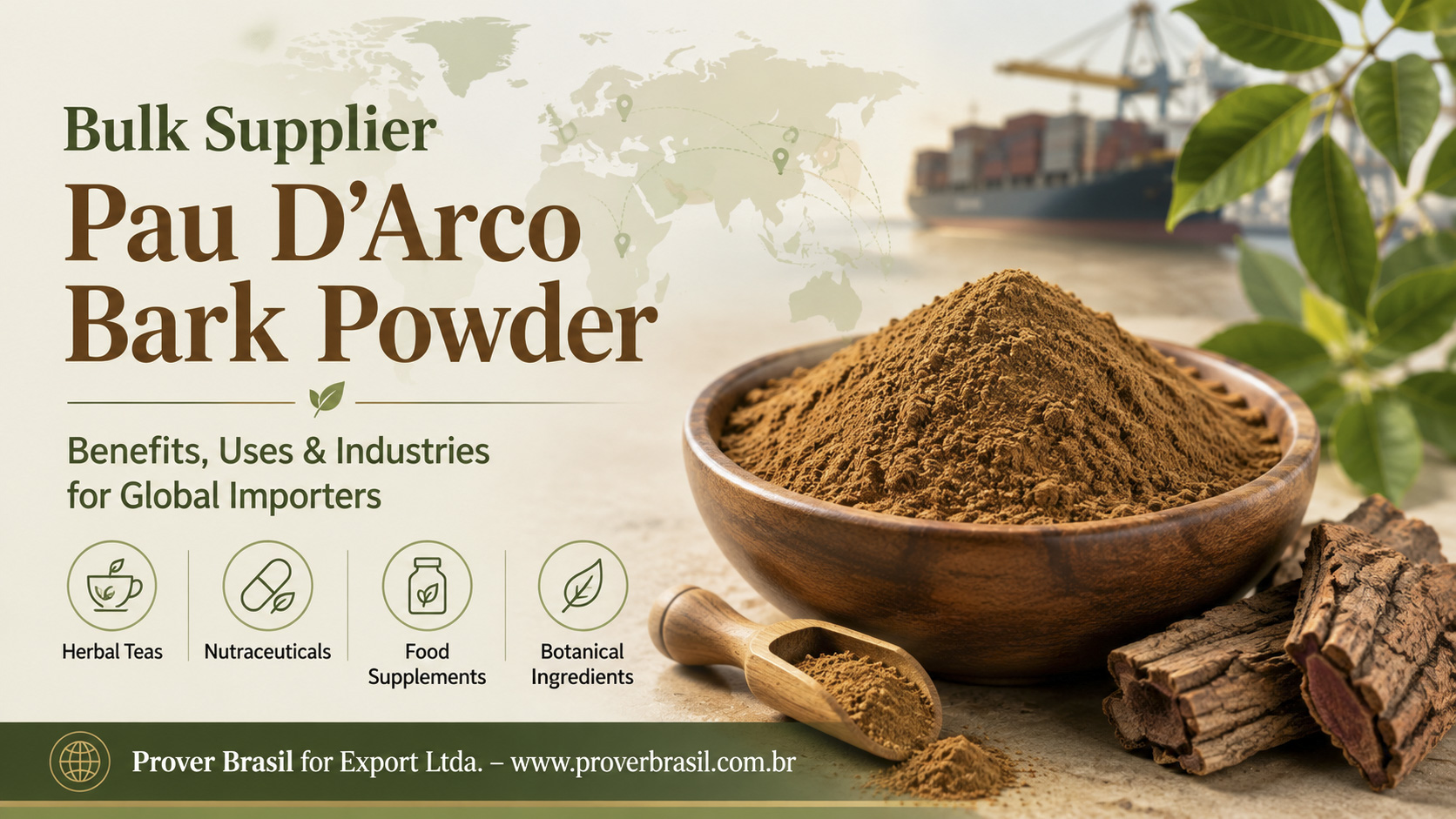
International buyers searching for a Bulk Supplier Pau D´arco Bark Powder need more than a product name and a quotation. Botanical identity, plant part, particle size, analytical documentation, packaging, intended application and destination-market requirements can all influence a purchasing decision.
Pau D’Arco is a traditional South American bark botanical also known internationally as Taheebo, Lapacho and Ipe Roxo. Its long history of traditional use, recognizable Brazilian origin and distinctive botanical profile have made it relevant to tea companies, nutraceutical formulators, botanical ingredient distributors, research teams and businesses developing herbal products.
Prover Brasil for Export Ltda. supplies Brazilian Pau D’Arco ingredients to international B2B customers. Buyers looking specifically for bark powder can explore the Pau D’Arco Bark Products page and request information according to quantity, application and destination country.
Pau D’Arco Bark Powder is produced from dried bark that is milled into a powder suitable for further formulation or packing.
The botanical is widely known through different commercial names. These include Pau D’Arco, Lapacho, Taheebo and Ipe Roxo. However, professional sourcing should not rely only on common names.
The Prover Brasil product information identifies the botanical traditionally used in trade as Tabebuia avellanedae Lorentz ex Griseb. The currently accepted botanical classification is Handroanthus impetiginosus (Mart. ex DC.) Mattos.
This distinction is useful for importers because botanical nomenclature may vary between scientific literature, commercial documents and markets.
A professional buyer normally evaluates much more than price per kilogram.
The powder must fit the intended production process. Particle size can influence flow, mixing, filling and dispersion. Botanical identity must also correspond with purchasing specifications and documentation.
For international sourcing, buyers commonly evaluate:
This procurement approach helps importers compare offers based on technical suitability instead of relying on commercial terminology alone.
For product developers, Pau D’Arco Bark Powder offers several practical advantages.
First, it has a recognizable South American botanical identity. Names such as Pau D’Arco, Taheebo and Lapacho are already established in international botanical markets.
Second, the powdered format is versatile. Companies can evaluate it for capsules, powdered botanical blends, herbal preparations and selected infusion products.
Third, the powder retains the characteristic profile of the milled bark. This may be useful for businesses seeking a traditional botanical raw material rather than a concentrated extract.
Finally, Pau D’Arco has generated considerable scientific interest. Researchers have investigated naturally occurring constituents of the bark and related preparations, including naphthoquinones, phenolic compounds and other phytochemicals.
These advantages relate to sourcing, formulation and botanical positioning. They should not be interpreted as guarantees of therapeutic effects.
Pau D’Arco has a long association with traditional infusions and decoctions in South America. Scientific reviews also describe the historical use of preparations made from the inner bark.
For commercial tea applications, companies should consider whether powder or cut bark is better suited to the intended product.
Powder may be evaluated for selected sachets and blended formulations. However, particle migration, filtration, sedimentation and infusion behavior should be tested during product development.
Pau D’Arco has a naturally woody and bitter sensory character. Therefore, tea developers may combine it with other botanicals according to their desired flavor profile.
Pau D’Arco Bark Powder can also be evaluated for capsule products and multi-botanical powder blends.
In these applications, particle size and bulk density become especially important. A powder that works well in one filling system may behave differently in another.
Pilot testing can help determine flow behavior, capsule capacity, blend uniformity and compatibility with other botanical ingredients.
Companies developing finished products should also verify permitted uses, labeling rules and applicable requirements in the country where the final product will be sold.
The botanical identity of Pau D’Arco gives product-development teams another option for creating South American botanical concepts.
The powder can be explored as part of:
Botanical capsules, herbal powder combinations, traditional wellness concepts, research formulations and multi-ingredient products.
However, the intended use should always guide ingredient selection.
A powdered bark and a bark extract are not interchangeable. Bark powder consists of milled plant material, while an extract undergoes additional processing and may have different concentration, dispersibility and formulation characteristics.
Buyers should therefore specify Pau D’Arco Bark Powder clearly when requesting quotations.
Understanding this difference can prevent purchasing errors.
Pau D’Arco Bark Powder is the dried botanical material in milled form. It provides the natural profile of the powdered bark.
Pau D’Arco Bark Extract undergoes an extraction process. Its characteristics can depend on extraction method, ratio, carrier system and other production parameters.
For buyers, neither format is automatically better. The correct choice depends on the intended formulation.
Companies needing a traditional milled-bark ingredient may prefer powder. Formulators requiring a concentrated ingredient may investigate an extract instead.
Prover Brasil offers different Pau D’Arco bark formats on its Pau D’Arco Bark Products page.
Pau D’Arco has attracted scientific attention because researchers have identified several classes of naturally occurring compounds in the botanical.
A comprehensive 2020 review discussed quinones, flavonoids, naphthoquinones, benzoic-acid derivatives, coumarins, iridoids and phenolic compounds associated with Tabebuia impetiginosa. The authors also emphasized that further scientific evidence and clinical research are required.
Another investigation studied a water extract of Tabebuia avellanedae and identified phenylpropanoid glycosides that demonstrated antioxidant activity in a laboratory assay.
Researchers have also investigated the effect of a Pau D’Arco aqueous extract on Nrf2-related cellular pathways. This work involved experimental laboratory and animal models rather than evidence establishing a health outcome from commercial bark powder in humans.
For businesses developing botanical products, these publications provide useful scientific background. However, findings involving isolated constituents, extracts, cells or animals should not be converted directly into disease-treatment claims for Pau D’Arco Bark Powder.
Companies, researchers and product-development teams can consult the following publications.
Tabebuia impetiginosa: A Comprehensive Review on Traditional Uses, Phytochemistry, and Immunopharmacological Properties — Molecules, 2020
This broad scientific review discusses traditional use, phytochemistry, botanical classification and experimental pharmacological research.
Read the complete study on PubMed Central
Red Lapacho (Tabebuia impetiginosa) — A Global Ethnopharmacological Commodity? — Journal of Ethnopharmacology, 2009
This review examines historical use, phytochemistry, international commercialization and the importance of quality control.
View the study on PubMed
Bioactive Phenylpropanoid Glycosides from Tabebuia avellanedae — Molecules, 2013
Researchers investigated compounds isolated from a water extract and evaluated their activity in laboratory assays.
View the research on PubMed
Pau d’Arco Activates Nrf2-Dependent Gene Expression via the MEK/ERK Pathway — Journal of Toxicological Sciences, 2014
This experimental study investigated molecular pathways associated with an aqueous Pau D’Arco preparation.
View the study on PubMed
Safety and Tolerability of Pau d’Arco (Tabebuia avellanedae) — Advances in Integrative Medicine, 2022
This small open-label human study evaluated safety and tolerability in twelve participants. The authors stated that further research is needed.
View the clinical research on PubMed
These publications should be interpreted according to their study design. Laboratory findings do not automatically establish clinical benefits in humans.
Selecting a Bulk Supplier Pau D´arco Bark Powder should involve a defined purchasing specification.
Before placing a commercial order, buyers should confirm the declared botanical identity, plant part, powder specification, required documentation and packaging.
Particle size deserves particular attention. Fine powder may offer different blending and filling behavior from a coarser material.
Moisture protection is also important because botanical powders should be protected during storage and international transport.
A buyer should therefore communicate the intended application before ordering. This helps determine whether the requested Pau D’Arco format is suitable for the project.
Professional B2B transactions normally require documentation that allows the importer to evaluate the supplied batch and organize customs and internal quality procedures.
Requirements vary by country and intended use. Therefore, buyers should inform the exporter about any documentation or analytical parameters required before confirming an order.
A batch-specific Certificate of Analysis is listed among the product information provided by Prover Brasil.
Companies can also browse the complete Prover Brasil botanical product portfolio when sourcing several Brazilian ingredients for the same purchasing program.
International botanical sourcing requires planning beyond the ingredient itself.
Order volume, packaging, freight method, destination, customs requirements and documentation can influence the final landed cost.
Depending on commercial requirements, international shipments may be arranged through air freight, courier services or sea freight.
Importers should provide the destination country and estimated quantity when requesting a quotation. This information helps the export team evaluate the appropriate logistics option.
Brazil has a long commercial and cultural relationship with Pau D’Arco and other South American botanical ingredients.
For international buyers, sourcing from Brazil can provide direct access to companies experienced in Brazilian botanical export operations.
Prover Brasil for Export Ltda. works with importers, distributors, ingredient traders, herbal-product companies, nutraceutical businesses and professional formulators seeking Brazilian botanical raw materials for international markets.
When contacting Prover Brasil, provide enough information for the export team to prepare a useful commercial proposal.
Include the product required, approximate quantity, destination country, intended application, preferred particle size when relevant and any specific analytical or documentation requirements.
You can contact Prover Brasil for a commercial quotation.
Prover Brasil for Export Ltda. supplies Brazilian Pau D’Arco botanical ingredients to international B2B customers. Buyers can request quotations according to quantity, application and destination country.
Yes. Pau D’Arco is widely marketed under names including Taheebo, Lapacho and Ipe Roxo. However, importers should verify the scientific name and plant part rather than relying only on common names.
Potential B2B applications include herbal products, tea formulations, capsules, nutraceutical products, botanical powder blends, research projects and specialized ingredient distribution.
No. Bark powder is dried and milled botanical material. An extract undergoes additional processing and can have different concentration and formulation characteristics.
Ask about botanical identity, plant part, particle size, analytical specification, batch documentation, packaging, storage conditions, available quantity and international shipping options.
Yes. Researchers have studied Pau D’Arco, Tabebuia avellanedae, Tabebuia impetiginosa and related constituents in phytochemical, laboratory, animal and limited human research. Current evidence should be interpreted according to the type and limitations of each study.
No. Laboratory or animal findings do not prove that commercial Pau D’Arco Bark Powder can prevent, treat or cure a disease in humans. Product communication should remain consistent with the evidence and applicable regulations.
Finding the right Bulk Supplier Pau D´arco Bark Powder means evaluating quality, botanical identity, application requirements, documentation and international logistics together.
For importers, distributors and professional botanical buyers, Prover Brasil for Export Ltda. offers access to Brazilian Pau D’Arco Bark Powder and other botanical ingredients for international trade.
Explore the Pau D’Arco product options or contact Prover Brasil to request product information and a commercial quotation.