

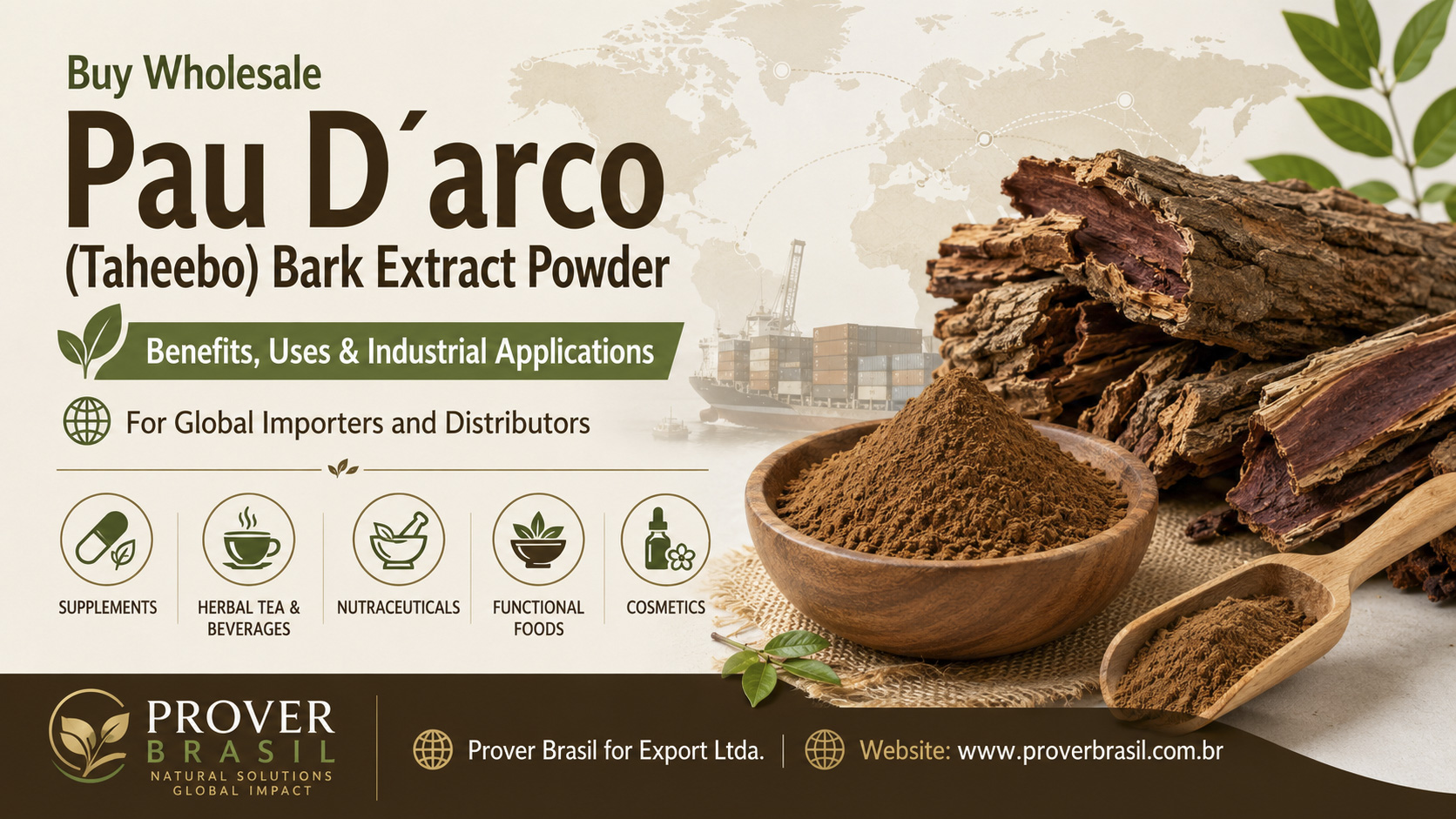
Companies looking to Buy Wholesale Pau D´arco Taheebo Bark Extract Powder can source this Brazilian botanical ingredient for use in supplements, botanical formulations, powdered blends, research projects and other industrial applications.
Pau D´arco is also known internationally as Taheebo, Lapacho and Ipe Roxo. It has a long history of traditional use in South America and remains the subject of scientific research because of the naturally occurring compounds found in its bark.
Prover Brasil for Export Ltda. supplies Pau D´arco Dry Extract 4:1 for international commercial buyers.
Importers can review our Pau D´arco Taheebo Bark products, explore our Botanical Extracts or browse our Brazilian botanical ingredients.
Pau D´arco Taheebo Bark Extract Powder is a concentrated botanical ingredient obtained from Pau D´arco bark.
The botanical is commonly associated with trees belonging to the Handroanthus and Tabebuia groups.
Scientific literature may refer to Pau D´arco using names such as:
Commercial names commonly include:
Because several scientific and commercial names are used internationally, professional buyers should always confirm botanical identity and plant part when evaluating a Pau D´arco ingredient.
A comprehensive scientific review discusses the traditional uses, phytochemistry and pharmacological research involving Tabebuia impetiginosa.
Read the scientific review at PubMed Central
Prover Brasil for Export Ltda. offers Pau D´arco Dry Extract 4:1 for international commercial supply.
The 4:1 ratio refers to the relationship between the amount of botanical raw material used and the resulting concentrated extract.
For professional purchasing departments, however, the extract ratio should not be the only consideration.
Buyers should also evaluate:
These points help purchasing and quality-control teams select the appropriate botanical ingredient for their project.
Industrial buyers often choose a concentrated dry extract because it provides a practical format for formulation and handling.
A powdered extract can be suitable for companies working with dry botanical ingredients and multi-ingredient formulations.
Potential advantages include:
Actual performance should always be evaluated within the buyer’s finished formulation.
Pau D´arco extract can be evaluated by companies in several industries.
Final applications and marketing claims should always comply with the regulations of the destination market.
Pau D´arco Bark Extract Powder may be evaluated for botanical supplement formulations.
Potential formats include:
Its concentrated format may be useful when several ingredients need to be incorporated into one formula.
Nutraceutical developers may evaluate Taheebo Bark Extract as part of botanical product concepts.
Research and development teams can assess characteristics such as:
Pilot testing is recommended before commercial-scale production.
Pau D´arco Dry Extract 4:1 can also be studied for use in multi-botanical powder systems.
Companies developing these products should evaluate particle characteristics, density and mixing uniformity.
This is especially important when a formulation contains several botanical powders in different proportions.
Product developers may investigate Pau D´arco Extract Powder when developing botanical concepts for international markets.
The ingredient may be evaluated together with other South American botanicals during formulation research.
Pau D´arco extract may also be investigated during beverage development.
Formulators should evaluate:
Not every botanical extract behaves in the same way in liquid formulations. Therefore, laboratory testing is important before commercialization.
Botanical research teams in the cosmetics industry may also investigate Pau D´arco-derived materials.
Suitability depends on the intended formulation, concentration, regulatory requirements and finished-product specifications.
Pau D´arco has received scientific attention because researchers have identified several groups of naturally occurring compounds in the bark.
Published literature discusses compounds including:
Two frequently discussed compounds are lapachol and beta-lapachone.
However, the presence and concentration of botanical compounds can vary depending on plant material, processing and extraction conditions.
A comprehensive review of Pau D´arco phytochemistry is available through PubMed Central.
Tabebuia impetiginosa: Traditional Uses, Phytochemistry and Research
Scientific studies have investigated Pau D´arco bark extracts in several experimental models.
These studies help researchers better understand the botanical and its compounds.
However, laboratory and animal studies should not be interpreted as evidence that a finished product can diagnose, prevent, treat or cure disease.
A study published in the Journal of Ethnopharmacology investigated a water extract produced from the inner bark of Tabebuia avellanedae.
Researchers studied its effects in laboratory and animal models involving inflammatory processes.
Another scientific study evaluated an ethanolic extract of Taheebo inner bark in experimental models associated with inflammation and pain.
Researchers have also studied Tabebuia avellanedae bark extract using experimental gastric models.
One study investigated gastroprotective activity.
Another publication investigated mechanisms associated with gastric-mucosa healing.
A later study investigated Handroanthus impetiginosus bark extracts and cytokine responses using primary human lymphocytes under laboratory conditions.
The findings supported additional research into compounds present in the botanical.
Companies, importers, formulators and research departments interested in Pau D´arco can consult these publications.
Tabebuia impetiginosa: A Comprehensive Review on Traditional Uses, Phytochemistry, and Immunopharmacological Properties
PubMed Central – Read the complete publication
In Vitro and In Vivo Anti-Inflammatory Effects of Taheebo, a Water Extract from the Inner Bark of Tabebuia avellanedae
Analgesic and Anti-Inflammatory Effects in Animal Models of an Ethanolic Extract of Taheebo
Antiulcerogenic Activity of Bark Extract of Tabebuia avellanedae
Antiulcer Effect of Bark Extract of Tabebuia avellanedae: Activation of Cell Proliferation in Gastric Mucosa During the Healing Process
The Medicinal Plant Tabebuia impetiginosa Potently Reduces Pro-Inflammatory Cytokine Responses in Primary Human Lymphocytes
PubMed – View scientific study
Capsule formulations often require ingredients with convenient powder characteristics.
A concentrated Pau D´arco Extract Powder can be evaluated for botanical capsule formulations, either alone or as part of a multi-ingredient system.
Product developers should evaluate:
Formulation tests should be completed before commercial production.
Tablet developers may also evaluate Pau D´arco Dry Extract 4:1.
Important factors include:
Depending on the formulation, additional excipients may be required.
Powdered botanical products frequently combine several ingredients.
Pau D´arco Bark Extract Powder may be incorporated into these concepts when suitable for the final application.
Developers should evaluate mixing uniformity because botanical extracts can have different particle sizes and densities.
Good formulation testing helps maintain consistency between production batches.
Pau D´arco presents an interesting challenge for international buyers because scientific literature uses several botanical names.
Older studies often refer to Tabebuia avellanedae.
Other publications use Tabebuia impetiginosa.
More recent botanical classifications may use Handroanthus impetiginosus.
Therefore, purchasing departments should not rely only on the commercial name “Pau D´arco.”
They should also evaluate botanical identity, plant part and product documentation.
This approach helps reduce misunderstandings between purchasing teams, laboratories, distributors and suppliers.
Companies planning to Buy Wholesale Pau D´arco Taheebo Bark Extract Powder should prepare their purchasing specifications before requesting a quotation.
Important information includes:
Provide the approximate quantity required for the first order and, when possible, expected future demand.
The destination country helps determine logistics and documentation requirements.
Inform the supplier whether the material will be evaluated for capsules, tablets, powders, R&D or another industrial application.
Purchasing departments should specify analytical parameters required by their internal quality-control system.
These may include, when applicable:
Requirements can differ according to the final application and destination market.
Brazil has a long association with Pau D´arco and other South American botanical ingredients.
Prover Brasil for Export Ltda. serves international commercial buyers looking for Brazilian botanical ingredients.
Companies can explore our complete selection at:
Buyers interested specifically in extracts can also visit:
Botanical Extracts from Brazil
For company information, visit:
About Prover Brasil for Export Ltda.
Companies interested in purchasing Pau D´arco should provide clear commercial information when requesting a quotation.
We recommend including:
For Pau D´arco Dry Extract 4:1, visit our product page:
Pau D´arco Taheebo Bark Powder and Extract
Providing complete information helps the commercial team prepare a more accurate international quotation.
It is a concentrated botanical powder obtained from Pau D´arco bark. Pau D´arco is also internationally known as Taheebo, Lapacho and Ipe Roxo.
Prover Brasil for Export Ltda. offers Pau D´arco Dry Extract 4:1 for international commercial buyers.
The 4:1 ratio describes the relationship between the amount of botanical starting material and the amount of resulting extract.
Buyers should also review other technical characteristics before approving the ingredient.
Potential areas of product development include supplements, nutraceutical formulations, botanical powders, capsule formulations, tablets, research projects and other botanical applications.
Final use must comply with the regulations of the destination market.
No.
Bark powder is produced by milling botanical material.
An extract undergoes an extraction and concentration process.
For this reason, companies should confirm exactly which format their formulation requires.
Common commercial names include:
Scientific literature may also refer to Tabebuia avellanedae, Tabebuia impetiginosa or Handroanthus impetiginosus.
Yes.
Researchers have investigated Pau D´arco phytochemistry and bark extracts in laboratory, cellular and animal studies.
Scientific publications can be found through PubMed and PubMed Central.
It can be evaluated for capsule formulation development, subject to the formulation requirements and regulations applicable to the finished product.
Yes, it may be evaluated for tablet development. Formulators should test powder flow, compression characteristics, stability and compatibility with other ingredients.
International commercial buyers can request Pau D´arco Dry Extract 4:1 from Prover Brasil for Export Ltda.
Visit:
Pau D´arco Taheebo Bark Products
Are you looking to Buy Wholesale Pau D´arco Taheebo Bark Extract Powder for your company?
Send Prover Brasil for Export Ltda. your:
Our company supplies Brazilian botanical ingredients to professional buyers in international markets.
Prover Brasil for Export Ltda.
Website: www.proverbrasil.com.br