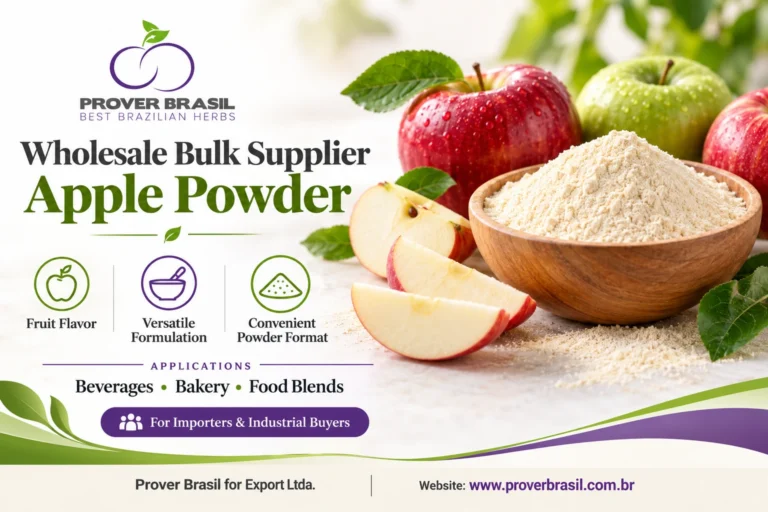
Choosing a Wholesale Bulk Supplier Apple Powder starts with one practical question: how will the ingredient perform in your finished product?
For international importers, distributors and food development teams, apple powder offers more than a familiar fruit flavor. It provides a convenient way to introduce apple into dry blends, prepared foods and culinary products while controlling how much ingredient enters each batch.
Prover Brasil for Export Ltda. offers Apple Powder 2:1 for international B2B supply. This article explores seven practical benefits, application testing priorities and three pilot recipes designed for professional evaluation.
Start with the Right Type of Apple Powder
Apple powders can differ considerably. Products made from juice, pulp, peel or pomace do not necessarily have the same flavor, fiber content or behavior in water.
Before comparing quotations, establish which type your project needs.
For example, a beverage developer may prioritize dispersion and a smooth mouthfeel. A bakery team may focus on flavor after heating. A seasoning business may place greater importance on particle size and adhesion to the snack surface.
For Apple Powder 2:1, request the current specification and confirm the complete ingredient composition. Ask how the stated ratio is defined. A ratio alone does not establish the fruit solids, sugar content, fiber level or recommended use rate.
7 Practical Benefits of Apple Powder for B2B Buyers
1. A Recognizable Fruit Profile
Apple can give consumers a familiar reference point in a new product.
It works with warm spices, citrus notes, roasted cereals and selected savory ingredients. This creates room for development beyond the usual apple-and-cinnamon combination.
An apple and rosemary cracker, for instance, explores a different eating occasion from a sweet breakfast product.
2. Convenient Weighing for Repeatable Trials
A powder can be measured directly into a laboratory formula.
Development teams can compare several inclusion levels while keeping the other ingredients constant. This makes it easier to identify the point where apple flavor becomes noticeable without overwhelming the recipe.
Record each addition as a percentage of the total batch so successful trials can be reproduced.
3. Integration into Dry Premixes
Apple powder can be evaluated in mixes that customers prepare later with water, milk or other liquids.
Potential formats include bakery bases, dessert preparations and culinary sachets. However, the blend still needs testing for segregation, clumping and changes during storage.
Uniform appearance does not always mean uniform ingredient distribution.
4. More Options for Savory Product Development
Apple is useful beyond sweet foods.
Its fruit character can complement mustard, rosemary, onion and smoked spices. Depending on the powder and the recipe, it may add a rounded fruit note to dressings, coatings and savory snacks.
The final balance should be established through tasting rather than assumed from the ingredient name.
5. Flexible Flavor Pairing
A single apple ingredient can be explored across several product concepts.
For example, an importer serving multiple food sectors could evaluate the same approved grade in a biscuit mix, a chilled dressing and a snack seasoning.
Each application will need its own inclusion level and performance checks.
6. Practical Portion Development
Powdered ingredients allow teams to calculate the amount used per serving.
This supports recipe costing and helps compare alternative formulations. It also makes it easier to evaluate whether a proposed fruit inclusion remains commercially viable at the intended retail portion.
Use the finished-product yield when calculating the final cost per serving.
7. Opportunities for Product Differentiation
Apple powder gives development teams a starting point for distinctive flavor combinations.
Instead of competing only through a familiar apple dessert, consider apple with toasted sesame, rosemary or mustard.
Differentiation comes from the complete recipe, texture and eating experience—not simply from adding another ingredient.
Industrial Uses: Match Each Application to a Test
Industry
Development opportunity
Main trial priority
Bakery
Crackers, biscuits and dry baking mixes
Flavor and browning after baking
Savory snacks
Fruit-and-spice coatings
Adhesion and moisture pickup
Foodservice
Dressings, sauces and culinary mixes
Hydration and flavor balance
Beverages
Fruit drink bases and blended drinks
Dispersion, sediment and mouthfeel
Dairy and alternatives
Chilled fruit preparations
Acidity and texture stability
Confectionery
Fruit centers and dessert layers
Moisture migration and flavor retention
For projects involving several fruit ingredients, explore the Prover Brasil product catalog and compare the relevant specifications before combining them.
What Scientific Research Can Tell Buyers
Scientific studies help explain why processing conditions matter. They do not replace testing of the ingredient being purchased.
A study in the International Journal of Food Science and Technology examined apple and other plant powders prepared under different drying conditions. Temperature and sample structure influenced measured quality characteristics, including color and antioxidant-related laboratory results.
For buyers, the practical lesson is that two products labeled “apple powder” may behave differently.
Another experimental study, published in Food & Function, investigated how processing affected compounds in red-fleshed apples and their availability after consumption. It further illustrates why findings from one apple preparation should not automatically be applied to another.
Neither study establishes the nutritional composition or health effects of Prover Brasil’s commercial powder. Any fiber, vitamin or polyphenol claim should be supported by suitable analytical data for the supplied ingredient and the finished product.
Three Apple Powder Recipes for Pilot Development
The following formulas are starting points for application trials. Each totals 1,000 g before processing.
Use the food-grade apple powder under evaluation. These are experimental recipes, so adjust the formula after checking flavor, texture and processing behavior. Commercial products require appropriate food safety, packaging and shelf-life validation.
Recipe 1: Apple, Rosemary and Sesame Crackers
A savory baked concept for snack and foodservice development.
Ingredient
Quantity
Wheat flour
470 g
Water
220 g
Apple powder
100 g
Olive oil
80 g
Sesame seeds
60 g
Rice flour
50 g
Fine salt
10 g
Baking powder
5 g
Finely ground dried rosemary
3 g
Ground black pepper
2 g
Total
1,000 g
Preparation
Mix the flours, apple powder, salt, baking powder, rosemary and pepper.
Add the sesame seeds.
Incorporate the oil and water to form a workable dough.
Rest briefly, then roll thinly and cut into crackers.
Bake in a preheated oven at approximately 170°C, checking frequently until crisp and evenly colored.
Cool completely before evaluating texture.
The baked yield will be lower because water evaporates. Adjust water if the dough is too firm or sticky.
Evaluate: apple flavor after baking, browning, crispness and moisture uptake during storage.
Allergens: wheat and sesame.
Recipe 2: Apple and Mustard Chilled Dressing
A fruit-forward dressing concept for salads, sandwiches and prepared-food applications.
Ingredient
Quantity
Water
420 g
Sunflower oil
250 g
Apple powder
140 g
Prepared Dijon mustard
100 g
Cider vinegar
60 g
Fine salt
10 g
Onion powder
8 g
Garlic powder
5 g
Xanthan gum
3 g
Ground black pepper
2 g
Dried dill
2 g
Total
1,000 g
Preparation
Dry-blend the apple powder, xanthan gum and powdered seasonings.
Add this blend gradually to the water under agitation.
Allow the mixture to hydrate.
Add the mustard and vinegar.
Slowly incorporate the oil using suitable mixing equipment.
Chill promptly for sensory evaluation.
This is a chilled laboratory concept. The vinegar quantity does not establish shelf stability.
Evaluate: separation, viscosity, acidity and flavor after refrigerated holding.
Allergens: mustard; check the declarations of all purchased ingredients.
Recipe 3: Apple and Smoked Paprika Snack Seasoning
A dry seasoning concept for application to plain popped corn or baked snacks.
Ingredient
Quantity
Apple powder
450 g
Rice flour, suitable for ready-to-eat seasoning use
250 g
Smoked paprika
100 g
Onion powder
80 g
Fine salt
70 g
Garlic powder
25 g
Ground black pepper
10 g
Ground ginger
10 g
Ground citric acid
5 g
Total
1,000 g
Preparation
Sieve the ingredients where appropriate.
Premix the salt, citric acid and spices with part of the rice flour.
Add the remaining rice flour and apple powder.
Blend until evenly distributed.
Test at 3 g, 5 g and 7 g per 100 g of plain popped corn, using a controlled amount of oil for adhesion.
Use ingredients with microbiological specifications suitable for the intended application.
Evaluate: coating uniformity, sweetness, acidity, dusting and flavor intensity.
How to Evaluate a Wholesale Bulk Supplier Apple Powder
Start with a written application brief. State the food category, destination market and expected purchasing volume.
Then request the information needed to approve the ingredient:
Complete ingredient declaration, including any carriers.
Current technical specification.
Available certificate of analysis.
Moisture and relevant microbiological limits.
Storage conditions and stated shelf life.
Packaging configuration and net weight.
Sample availability and minimum order quantity.
Lead time and proposed shipping terms.
Compare quotations on the same basis. A lower price per kilogram may not produce a lower recipe cost if a higher inclusion level is needed.
Approve the sample in the intended product before committing to a larger purchase.
Frequently Asked Questions
How do I choose a Wholesale Bulk Supplier Apple Powder?
Compare product identity, documentation, sample performance and commercial terms. Select the grade that meets your application requirements rather than relying only on price or the product name.
Is apple powder the same as apple pomace powder?
No. Pomace comes from material remaining after juice extraction. Its composition and performance can differ from juice- or pulp-based powders. Confirm the raw material and production details before substitution.
What quantity of apple powder should I use?
There is no single rate for every application. Test several inclusion levels while holding other ingredients constant. The recipes above provide starting points for specific trials.
Does Apple Powder 2:1 dissolve completely in water?
Do not assume complete dissolution. Evaluate dispersion, visible particles and sediment using the actual sample and your intended preparation method.
Can apple powder replace sugar?
It may contribute sweetness, but it is not automatically a direct substitute. Changes can affect flavor, browning, texture and the finished product’s sugar content.
Can I describe the powder as high in fiber?
Only when analytical evidence and destination-market rules support that claim. Findings about whole apples or apple pomace do not establish the fiber content of every apple powder.
How can international buyers request a quotation?
Provide your company details, destination country, required quantity, intended application and preferred delivery location. Include any technical requirements needed for purchasing approval.
Discuss Your Apple Powder Project
If you are evaluating a Wholesale Bulk Supplier Apple Powder, begin with the product you want to create and the performance it requires.
Discover 7 advantages of Aloe Vera Leaf Dry Extract 2:1 from Brazil. Explore spray-dried powder technology, industrial applications, research and international wholesale B2B sourcing.
Discover 7 advantages of Avocado Fruit Powder 2:1 from Brazil and 4 innovative savory recipes for dips, snack seasonings, crackers and sauces. Wholesale B2B sourcing by Prover Brasil.
Explore our full catalog of premium, certified Brazilian botanical ingredients. Select your required specifications and request a custom commercial quote directly from our export specialists.