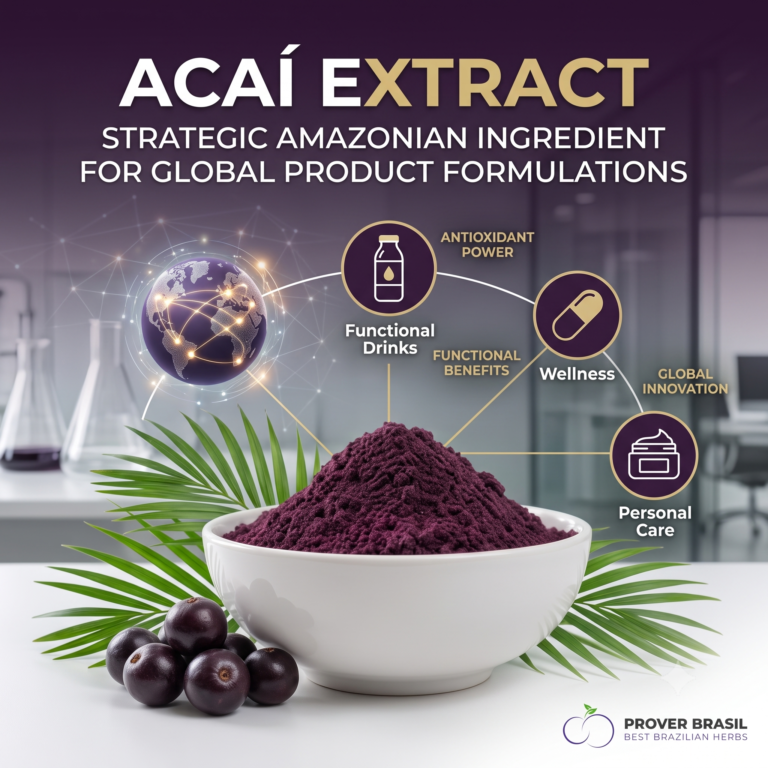
Acai Extract has gained strategic relevance among companies developing functional foods, beverages, supplements, wellness products, and cosmetic formulations. Its recognizable Amazonian origin, intense natural color, versatile positioning, and association with polyphenols make it an attractive ingredient for brands seeking differentiation in competitive international markets.
However, sourcing an acai-based ingredient requires more than choosing a product based on its commercial name. Concentration, botanical identity, processing method, carrier composition, solubility, particle size, microbiological parameters, packaging, and intended application can significantly affect the final formulation.
For this reason, professional buyers should evaluate Acai Extract according to technical and commercial requirements rather than relying only on general marketing descriptions.
As an experienced Brazilian export company serving the international B2B market, Prover Brasil supplies Brazilian botanical ingredients for global industries and supports buyers seeking structured commercial service, product information, export coordination, and reliable communication throughout the sourcing process.
What Is Acai Extract?
Acai Extract is an ingredient obtained from the fruit of Euterpe oleracea, a palm species strongly associated with the Brazilian Amazon region. Depending on the specification, the ingredient may be supplied as a dry powder, concentrated botanical preparation, spray-dried material, or another format designed for industrial use.
The term “extract” may describe different technical profiles. Two products carrying similar commercial names may vary considerably in concentration, color, taste, dispersibility, carrier system, moisture level, and recommended dosage.
This distinction is particularly important for international buyers. Before requesting a quotation, companies should establish whether they need:
- A concentrated fruit ingredient;
- A spray-dried acai powder;
- A water-dispersible format;
- A formulation suitable for food or beverage applications;
- A botanical ingredient intended for supplements;
- A specific concentration ratio;
- Particular microbiological or physicochemical parameters.
A clear specification reduces uncertainty, improves quotation accuracy, and helps prevent incompatibility during formulation tests.
Why Acai Extract Attracts International Industries
The global appeal of Acai Extract is connected to a combination of origin, functionality, visual identity, and consumer recognition.
Açaí has a distinctive dark purple appearance that can reinforce the sensory and commercial identity of finished products. It is also widely associated with Amazonian biodiversity, active lifestyles, wellness concepts, functional nutrition, and premium superfood positioning.
For companies, this creates opportunities beyond the ingredient itself. Acai Extract can contribute to product storytelling, category differentiation, visual appeal, and the development of formulations connected to Brazilian natural resources.
Its value is particularly relevant in markets where consumers look for:
- Recognizable botanical ingredients;
- Fruit-based functional formulations;
- Products with an Amazonian identity;
- Premium superfood concepts;
- Convenient powdered ingredients;
- Innovative nutritional and wellness experiences.
The commercial potential depends on responsible communication. Claims made on labels, websites, catalogs, or advertising materials must comply with the regulations of the destination market and be supported by the applicable technical documentation.
Acai Extract and Acai Powder: Understanding the Difference
The expressions Acai Extract and Acai Powder are sometimes used interchangeably, but they should not automatically be treated as identical.
Acai powder may describe a dehydrated fruit-based ingredient obtained through a process such as spray drying. An extract may indicate a more concentrated preparation or an ingredient developed according to specific extraction and standardization parameters.
The exact difference depends on the supplier’s technical specification.
For purchasing departments and formulation teams, the safest approach is to compare objective data rather than product names alone. Important questions include:
- What is the botanical source?
- Which part of the fruit is used?
- What is the concentration ratio?
- Is a carrier included?
- Which processing method is applied?
- Is the material soluble, dispersible, or intended for suspension?
- What are the recommended storage conditions?
- Which analyses are available for the batch?
Prover Brasil presents acai powder among its portfolio of superfoods and botanical ingredients, including a spray-dried 4:1 format intended for international commercial applications. Buyers should confirm the current specification, availability, and suitability for their projects directly with the company.
Main Industrial Applications of Acai Extract
Acai Extract can be evaluated for several product categories. The best format depends on the desired taste, color, texture, dosage, regulatory framework, and manufacturing process of the finished product.
Functional Foods
Food companies may evaluate Acai Extract for nutrition bars, powdered mixes, desserts, bakery formulations, breakfast products, fruit preparations, and premium snack concepts.
In dry applications, particle size and moisture control can affect blending uniformity and storage stability. In products exposed to heat, the development team should test color behavior, flavor, and ingredient performance under the actual processing conditions.
Beverages and Drink Mixes
Acai-based ingredients can be incorporated into smoothies, powdered beverages, functional drink mixes, sports nutrition products, fruit blends, and specialty beverage concepts.
Solubility and dispersibility require particular attention. A formulation intended for instant preparation may need different characteristics from an ingredient used in a thick smoothie, dairy alternative, or suspended fruit drink.
Sedimentation, foaming, acidity, color variation, and interaction with sweeteners should be assessed during formulation trials.
Nutraceutical and Supplement Formulations
Supplement companies may consider Acai Extract for capsules, tablets, sachets, powder blends, and combination formulas.
For these applications, technical teams commonly assess concentration, dosage, flow properties, bulk density, excipients, stability, and compatibility with other botanical ingredients.
The product name alone is not sufficient to define its suitability. The purchasing and quality teams should review the technical specification and applicable documentation before approving the ingredient.
Cosmetic and Personal Care Concepts
Acai-based botanical ingredients may also be considered for cosmetic formulations connected to antioxidant positioning, Brazilian biodiversity, natural-origin concepts, and premium personal care.
Compatibility tests remain essential. Color, odor, pH behavior, preservation systems, and interaction with the cosmetic base can influence the final result.
The applicable grade must always be confirmed. An ingredient suitable for one industrial category should not automatically be assumed to meet the requirements of another.
How to Select the Right Acai Extract Specification
Selecting an ingredient for industrial use involves technical, regulatory, logistical, and commercial analysis.
The first step is to define the final application. A dry drink mix, capsule, cosmetic cream, and nutrition bar have different formulation requirements. Without this information, a quotation may not reflect the most suitable product profile.
The company should also determine its expected purchasing volume, preferred packaging, destination country, required documents, delivery terms, and testing schedule.
Through the Brazilian botanical ingredients and superfoods catalog, buyers can review available product categories and identify ingredients relevant to their commercial projects.
Botanical Identity
The technical documentation should identify the botanical name associated with the ingredient. For açaí, the primary reference is generally Euterpe oleracea.
Botanical identity helps quality teams distinguish the requested material from ingredients with similar common names or regional variations.
Concentration Ratio
A ratio such as 4:1 indicates a relationship between the starting material and the resulting ingredient according to the processing specification.
This information should not be interpreted in isolation. Two materials with the same ratio may still differ in carrier composition, sensory profile, moisture, color, and formulation behavior.
Carrier System
Spray-dried fruit ingredients may contain a carrier to support processing, stability, flow, or drying performance.
Buyers should confirm whether a carrier is present, which substance is used, and how it affects ingredient declarations in the destination market.
This detail can be particularly important for clean-label strategies, allergen reviews, nutritional calculations, and product positioning.
Solubility and Dispersibility
Not every powdered botanical ingredient fully dissolves in water. Some products disperse, while others remain partially suspended.
The correct requirement depends on the application. Buyers should avoid assuming complete solubility without reviewing the specification and performing practical tests.
Color and Sensory Profile
The natural color of açaí is commercially valuable, but it may vary according to raw material characteristics, concentration, processing, storage, light exposure, temperature, and formulation pH.
Flavor and aroma also require evaluation. In some products, a stronger sensory profile is desirable. In others, formulators may prefer a more neutral ingredient that can be combined with additional flavors.
Quality Parameters Buyers Should Evaluate
Professional sourcing requires a structured quality assessment. The documentation needed may vary according to the product, destination country, application, and customer requirements.
Common evaluation points include:
- Product specification;
- Certificate of analysis;
- Botanical identification;
- Ingredient composition;
- Moisture parameters;
- Microbiological limits;
- Shelf life;
- Storage instructions;
- Packaging format;
- Batch traceability;
- Country-of-origin information;
- Allergen or GMO statements when applicable;
- Heavy metal or pesticide testing when required;
- Regulatory and shipping documentation.
These requirements should be communicated before commercial approval. Requesting documentation only after the order has advanced can cause delays, additional costs, or incompatibility with the importer’s quality system.
Processing Infrastructure and Traceability
Industrial buyers increasingly expect visibility over processing controls, hygiene standards, batch management, packaging, and traceability.
A reliable supply process should support the identification of product batches and the organization of technical and commercial records. This is important for internal quality procedures, customer audits, regulatory reviews, and supply-chain management.
Prover Brasil presents quality-controlled botanical processing infrastructure for food, nutrition, phytomedicine, and cosmetic ingredient categories, emphasizing international processing criteria and batch traceability.
Buyers should nevertheless submit their own qualification requirements. Every company has specific approval procedures, and every destination may impose different documentation and compliance obligations.
Benefits of Working with an Experienced Brazilian Export Company
International ingredient sourcing involves more than the physical product. Communication, document organization, packaging, lead time, shipping coordination, and responsiveness can influence the success of the transaction.
Working with an export-focused company can provide several commercial advantages:
- Direct communication about specifications and quantities;
- Support during product selection;
- Better alignment of documentation requirements;
- Commercial quotations based on project details;
- Coordination of bulk and wholesale requests;
- Assistance with packaging and international logistics information;
- Access to a broader portfolio of Brazilian botanicals.
Prover Brasil operates in the international B2B market with a catalog that includes acai powder, guarana products, herbs, superfoods, and botanical extracts. Its commercial structure is directed toward bulk and wholesale supply for companies in global markets.
Practical Examples of Acai Extract Projects
The following scenarios illustrate how different industries may approach the ingredient.
A beverage company developing an instant fruit blend may prioritize dispersibility, flavor balance, natural color, and convenient packaging for repetitive manufacturing.
A supplement company creating a botanical powder formula may focus on concentration, bulk density, flow, dosage, microbiological limits, and compatibility with other ingredients.
A food brand developing a premium snack may evaluate taste, color retention, labeling impact, and performance during processing.
A cosmetics company may prioritize ingredient grade, color stability, odor, preservation compatibility, and documentation for personal care applications.
In each case, the commercial name remains the same, but the required technical profile can be very different. This is why project-specific consultation is more effective than selecting an ingredient based only on a general description.
Important Considerations Before Requesting a Quote
A detailed inquiry allows the commercial team to provide a more accurate response.
Companies should include:
- Required product or expected specification;
- Intended industrial application;
- Estimated order quantity;
- Destination country and port;
- Preferred packaging;
- Required documentation;
- Target delivery schedule;
- Any regulatory or quality restrictions.
Buyers should also consider the time needed for internal testing, sample evaluation, regulatory review, contract approval, shipping, customs procedures, and final manufacturing validation.
Planning these stages in advance reduces the risk of urgent purchases and improves supply continuity.
Responsible Commercial Communication
Acai Extract is often marketed in categories connected to wellness, nutrition, natural ingredients, and antioxidants. However, commercial communication must remain accurate and compliant.
Companies should avoid unsupported medical claims or statements that imply guaranteed health outcomes. The ingredient’s composition does not automatically authorize a specific claim on a finished product.
Permitted language depends on several factors, including:
- Destination-country regulations;
- Product category;
- Final dosage;
- Available laboratory evidence;
- Approved labeling terminology;
- Intended consumer audience;
- Format of the finished product.
Legal, technical, and regulatory teams should review labels and promotional materials before market launch.
Frequently Asked Questions About Acai Extract
What is Acai Extract used for?
Acai Extract may be evaluated for functional foods, beverages, drink mixes, supplements, nutrition powders, wellness formulations, and certain cosmetic applications. Suitability depends on the ingredient specification and the requirements of the finished product.
Is Acai Extract the same as Acai Powder?
Not necessarily. The terms may refer to different processing methods, concentrations, compositions, and technical characteristics. Buyers should compare specifications instead of relying only on the commercial name.
Is Acai Extract completely water-soluble?
Complete solubility should not be assumed. Some formats may disperse in water rather than dissolve entirely. The supplier’s technical information and practical formulation tests should guide product selection.
What does a 4:1 concentration mean?
A 4:1 ratio generally describes the relationship between the quantity of starting material and the resulting ingredient under a defined process. It does not, by itself, describe all quality or performance characteristics.
Can Acai Extract be used in capsules?
Certain dry formats may be suitable for capsule formulations, subject to concentration, particle size, bulk density, flow, dosage, stability, and regulatory review.
Which documents should an importer request?
The required documents depend on the destination and application. Buyers commonly evaluate a specification sheet, certificate of analysis, composition, shelf life, storage instructions, microbiological parameters, packaging information, and relevant declarations.
Is a sample necessary before placing a commercial order?
Sampling and formulation testing are strongly recommended when technical compatibility is critical. A sample can help evaluate color, flavor, dispersibility, processing behavior, and interaction with other ingredients.
How should Acai Extract be stored?
Storage conditions must follow the product specification. Dry botanical ingredients are generally protected from excessive heat, humidity, light, contamination, and exposure to open environments.
Can specifications be requested according to the final application?
Buyers can communicate their application and required parameters during the commercial consultation. Availability and compatibility must then be assessed according to the current product portfolio and project conditions.
How can an international buyer request pricing?
The buyer should provide the desired ingredient, quantity, destination, application, packaging preference, and documentation requirements. This information allows the commercial team to prepare a more relevant quotation.
Conclusion
Acai Extract offers strong commercial potential for companies developing functional foods, beverages, supplements, wellness products, and innovative botanical formulations.
Its value lies not only in the global recognition of açaí, but also in the ability to combine Amazonian identity, natural visual appeal, formulation versatility, and premium positioning.
Successful sourcing depends on careful specification. Concentration, carrier composition, dispersibility, sensory profile, documentation, packaging, traceability, and intended application should be evaluated before commercial approval.
Prover Brasil supports international companies seeking Brazilian botanical ingredients through structured B2B service, commercial coordination, and access to a diversified product portfolio.
Companies planning a new formulation or evaluating an alternative ingredient supply can contact Prover Brasil for an Acai Extract quotation and submit their volume, destination, application, and technical requirements.