Wholesale Bulk Acai Berry Powder
Explore Wholesale Bulk Acai Berry Powder from Brazil for beverages, foods and nutrition products. Review its benefits, industrial uses, quality criteria and sourcing guidance for international buyers.


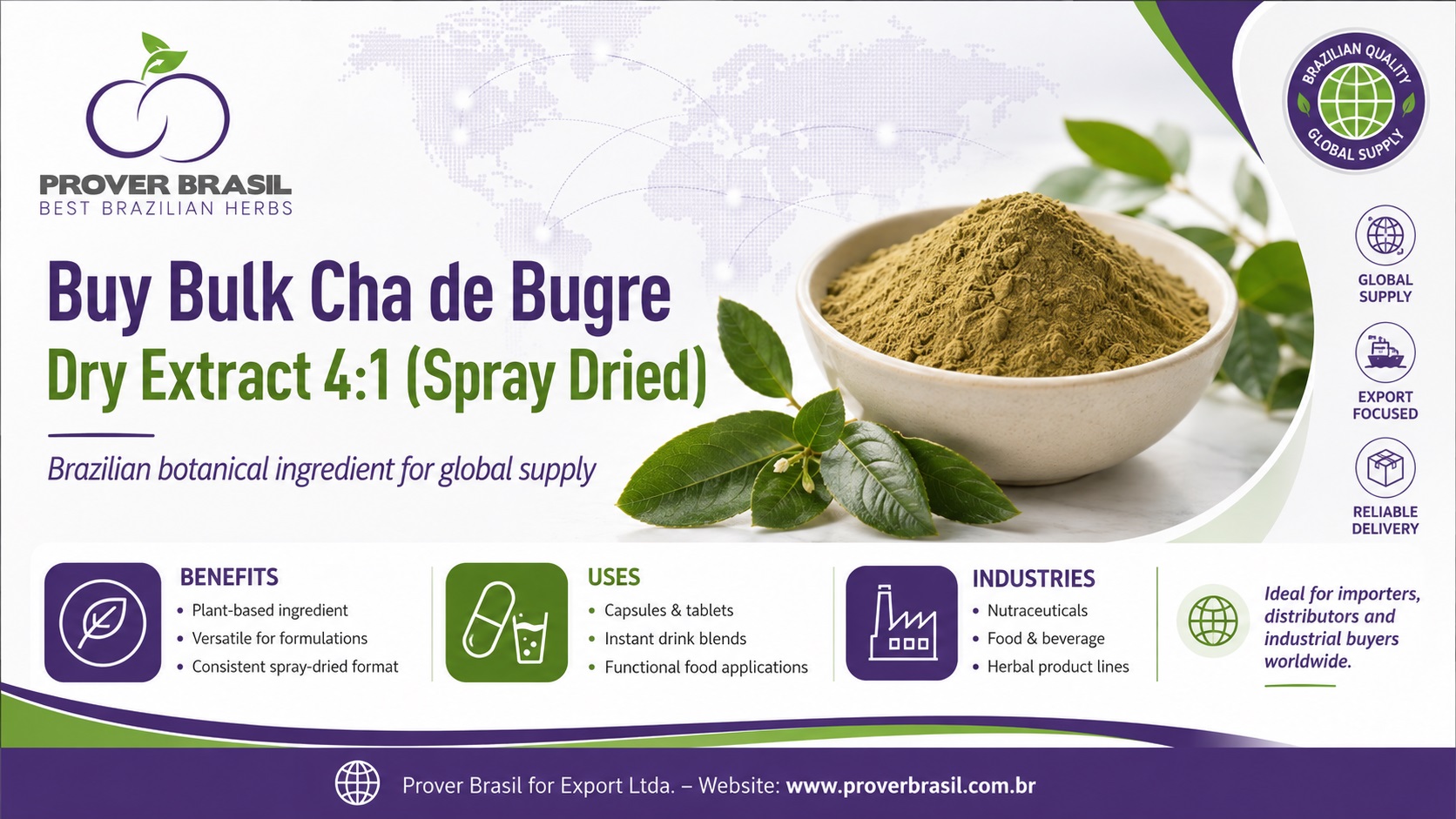
Companies planning to Buy Bulk Cha de Bugre Dry Extract 4:1 (spray dried) need more than a botanical name and a price per kilogram. Importers, distributors, formulation laboratories and product-development teams must evaluate extract concentration, powder characteristics, documentation, intended application and destination-market requirements.
Cha de Bugre is a Brazilian botanical also known as Porangaba, Cafe de Bugre and Cafe do Mato. The scientific name used for the product supplied by Prover Brasil for Export Ltda. is Cordia salicifolia Cham. Prover Brasil lists the ingredient as a concentrated 4:1 dry extract produced in spray-dried powder form.
Unlike an article focused mainly on traditional herbal preparations, this guide examines Cha de Bugre from the perspective of the professional buyer: formulation performance, industrial applications, quality evaluation, sourcing questions and responsible interpretation of scientific research.
International buyers can also review the Cha de Bugre product information from Prover Brasil before requesting a commercial quotation.
Cha de Bugre Dry Extract 4:1 is a concentrated botanical ingredient.
In general, a 4:1 extract ratio indicates that approximately four parts of the starting botanical material are used to obtain one part of dry extract, according to the applicable production specification.
However, professional buyers should never assume that the ratio alone describes every characteristic of an extract.
Two 4:1 botanical extracts can differ in:
Therefore, the current specification should always be reviewed before approving a commercial order.
Companies that Buy Bulk Cha de Bugre Dry Extract 4:1 (spray dried) often select this format because a concentrated dry powder can simplify several formulation and processing tasks.
A 4:1 extract allows formulators to work with a concentrated ingredient instead of relying only on directly milled botanical material.
This can be useful when formula space is limited or when developers want to compare different inclusion levels during laboratory trials.
A dry extract can be incorporated into powdered systems more easily than a liquid botanical preparation.
Nevertheless, blending performance should still be tested because botanical powders differ in particle size, flow and bulk density.
Spray drying converts an extracted liquid phase into powder. The resulting format can facilitate weighing, dry blending, packaging and transportation.
The finished formulation team should still evaluate hygroscopic behavior, flow and storage stability.
Cha de Bugre Dry Extract 4:1 can be evaluated for several product concepts where its use is permitted by local regulations.
The main commercial benefit is therefore not a guaranteed health effect. Instead, it is the flexibility of a concentrated Brazilian botanical ingredient for professional product development.
The versatility of the powdered extract opens several potential development routes.
Formulators may evaluate the ingredient in capsules, tablets and multi-botanical powder systems.
Important technical parameters include:
A pilot batch is recommended before moving to commercial-scale production.
Companies developing complex botanical formulas can investigate Cha de Bugre as one component of a broader botanical concept.
The intended amount, labeling and permitted claims should be established according to the destination market rather than based on traditional use alone.
The spray-dried format may be evaluated in botanical beverage powders.
Developers should examine:
A powder should not be described as completely soluble unless the finished formula has been tested and confirms that performance.
Where regulations permit, food-development laboratories can investigate Cha de Bugre in innovative botanical concepts.
Sensory testing is particularly important because botanical extracts may influence bitterness, aroma and color.
Ingredient distributors can offer a concentrated format to professional customers that require something different from conventional milled leaves.
Clear differentiation between a dry extract and leaf powder is essential in quotations, specifications and product documentation.
R&D teams can use Cha de Bugre Dry Extract 4:1 in prototype development involving:
Purchasing teams should establish a technical checklist before negotiating a large order.
The commercial documentation should identify the botanical accurately.
For the product supplied by Prover Brasil, the scientific name is:
Cordia salicifolia Cham.
Using the scientific name reduces confusion created by regional common names such as Cha de Bugre and Porangaba.
Check that the specification identifies the product as a 4:1 extract.
Do not assume that every Cha de Bugre powder offered commercially is concentrated. Some products may simply consist of milled botanical material.
International buyers requesting this specific format should confirm that the product is supplied as a spray-dried extract.
Depending on the intended application, review parameters such as:
These characteristics can affect commercial formulation performance.
Microbiological specifications are especially important for botanical ingredients intended for further processing.
Buyers should compare the available specification with the requirements of both their company and destination country.
Scientific research involving Cordia salicifolia has examined elements and pesticide residues in botanical material. These studies do not establish the specification of any particular commercial batch. However, they illustrate why analytical control matters when sourcing botanical ingredients internationally.
Botanical powders should normally be protected from excessive moisture, heat, sunlight and strong odors.
Always follow the storage conditions stated in the current product specification.
Botanical ingredients may be classified differently between countries.
Before importing, confirm:
This review should occur before commercial shipment, not after the goods reach the destination market.
Companies researching Buy Bulk Cha de Bugre Dry Extract 4:1 (spray dried) should distinguish scientific investigation of the botanical species from evidence about a specific commercial extract.
The studies below investigate Cordia salicifolia, its plant material or experimental extracts. They should not be interpreted as studies of Prover Brasil’s exact commercial 4:1 spray-dried specification unless a publication specifically states that formulation.
A 2026 study published in Revista Fitos evaluated aqueous and ethanolic extracts prepared from Cordia salicifolia leaves and stems against clinical isolates of Enterococcus faecium. The researchers did not observe antibacterial or anti-biofilm activity under the conditions tested. This is useful evidence because responsible botanical communication should include negative findings as well as positive experimental results.
Read the 2026 Cordia salicifolia study – Revista Fitos
A scientific investigation measured several elements in dried medicinal plants and decoctions that included Cordia salicifolia. The study reinforces an important purchasing principle: botanical products should be evaluated using appropriate contaminant specifications rather than relying solely on plant identity or traditional use.
Read the Cordia salicifolia elemental analysis study – PubMed
Researchers have also developed analytical methods to determine pesticide residues in Cordia salicifolia. This type of research is especially relevant to international ingredient purchasing because it demonstrates how botanical raw materials can be examined through analytical chemistry.
Read the pesticide-residue research – PubMed
Another published experimental study evaluated characteristics of a Cordia salicifolia extract and its effects in an experimental blood-cell radiolabeling model. The study reported concentration-related physical measurements and experimental biological effects, but it was not a human clinical trial and does not establish a consumer health benefit.
Read the experimental Cordia salicifolia extract study – PubMed
Scientific evidence for human clinical benefits of Cha de Bugre remains limited. Therefore, international companies should be cautious about disease, slimming or therapeutic claims.
A stronger B2B approach is to communicate characteristics that can actually be supported by product specifications.
Potential commercial and formulation benefits include:
Traditional use can be discussed as historical information, but it should not be presented as proof of clinical effectiveness.
The following concepts are intended for professional R&D work. They are not consumption instructions, clinical recommendations or finalized commercial formulas.
The final amount of Cha de Bugre extract should be established by a qualified formulator after reviewing safety information, technical specifications and destination-market regulations.
Ingredients:
Development method:
Prepare several small laboratory batches using different flavor balances.
Add the Cha de Bugre extract gradually while monitoring bitterness, color and dispersibility. Compare samples after preparation and again during stability testing.
This tropical profile offers a different sensory direction from traditional herbal tea concepts.
Ingredients:
Development method:
Premix the botanical extract with a small amount of the powdered base before incorporating it into the full blend.
Evaluate uniformity, aroma, bitterness, color and sedimentation.
Cocoa and vanilla can provide an interesting formulation route for R&D teams investigating stronger flavor-masking systems.
Ingredients:
Development method:
Create several prototypes with different levels of hibiscus and acerola.
Add the Cha de Bugre extract during dry blending and assess color, acidity, aroma, dispersibility and flavor balance.
Complete stability testing before defining the final commercial formula.
Specifications provide essential information, but they cannot predict every interaction inside a finished formula.
A sample allows the development team to evaluate the ingredient under its own processing conditions.
For example, buyers can examine:
This approach can reduce formulation problems before a larger commercial commitment.
Buyers evaluating Brazilian botanical ingredients can learn more about the exporter through the following Prover Brasil resources:
Learn more about Prover Brasil for Export Ltda.
Review Prover Brasil’s processing and quality information
Explore the Brazilian botanical ingredient catalog
View Cha de Bugre product information
These pages help purchasing teams review the company, ingredient range and available product information before requesting commercial conditions.
Brazilian botanical ingredients provide product developers with access to distinctive plant materials associated with the country’s botanical diversity and herbal traditions.
However, origin alone is not enough.
Professional sourcing requires:
Prover Brasil for Export Ltda. supplies Cha de Bugre Dry Extract 4:1 (spray dried) for evaluation by international importers, distributors, wholesalers and professional product-development companies.
International B2B buyers can request Cha de Bugre Dry Extract 4:1 from Prover Brasil for Export Ltda. in Brazil. Buyers should provide their required quantity, destination country, intended application and technical requirements when requesting a quotation.
The scientific name used for the Cha de Bugre supplied by Prover Brasil is Cordia salicifolia Cham.
The ratio generally indicates that approximately four parts of botanical starting material are used to obtain one part of dry extract, according to the applicable production specification.
Yes. Prover Brasil lists this product as Cha de Bugre Dry Extract 4:1 in spray-dried powder form.
Potential areas for professional evaluation include botanical supplements, nutraceutical development, capsules, tablets, powdered beverages, multi-botanical blends and research projects, subject to applicable regulations.
Available research does not justify presenting the ingredient as a clinically proven weight-loss treatment for people. Research includes laboratory and animal work, and results vary according to the extract and study design. Companies should use claims permitted by the regulations governing their finished products.
The scientific papers referenced in this article investigate Cordia salicifolia, plant material or experimental extracts. They should not automatically be treated as evidence for the exact commercial 4:1 spray-dried specification.
Request the current technical specification and confirm botanical identity, extract ratio, physical characteristics, microbiological parameters, storage requirements, packaging, available batch documentation and commercial conditions.
The powder may be evaluated in beverage-development projects where permitted. Formulators should test flavor, color, dispersibility, sedimentation and stability before commercialization.
Provide the requested product, estimated quantity, destination country, intended application and relevant technical requirements through the Prover Brasil contact page.
If your company plans to Buy Bulk Cha de Bugre Dry Extract 4:1 (spray dried) for product development, contact Prover Brasil for Export Ltda. with as much purchasing information as possible.
Include:
A detailed inquiry helps the export team prepare more useful commercial information.
Prover Brasil for Export Ltda.
Website: www.proverbrasil.com.br