

Wholesale Bulk Acai Berry Powder
Explore Wholesale Bulk Acai Berry Powder from Brazil for beverages, foods and nutrition products. Review its benefits, industrial uses, quality criteria and sourcing guidance for international buyers.
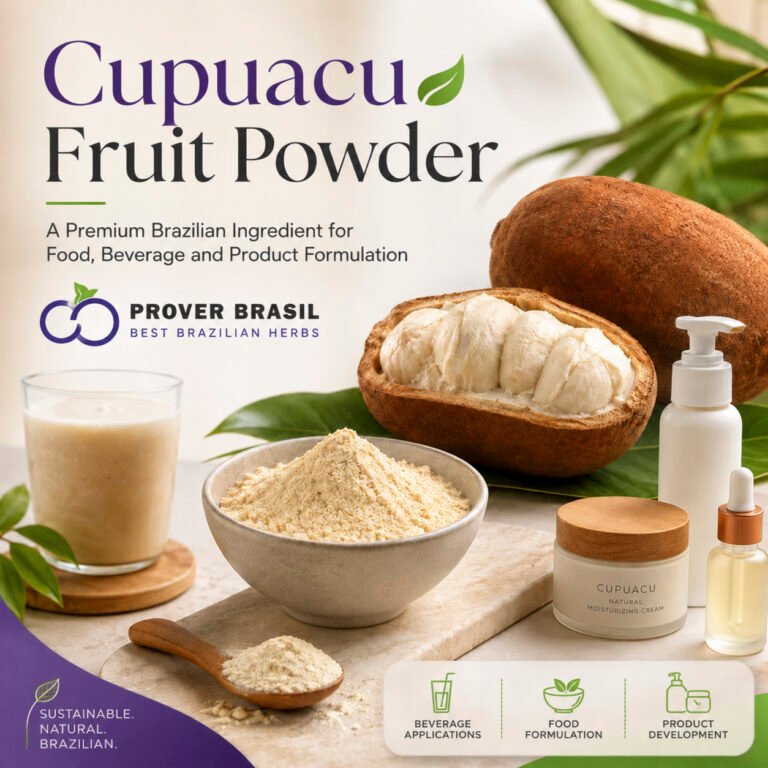
Cupuacu Fruit Powder is gaining attention among food developers, importers, distributors and brands looking for authentic Brazilian ingredients with distinctive sensory characteristics and a strong connection to the Amazon.
Derived from cupuaçu (Theobroma grandiflorum), a tropical fruit closely related botanically to cacao, cupuacu powder combines an exotic flavor profile with the convenience expected from a modern powdered ingredient. The fruit is native to the Amazon region and is particularly valued for its aromatic pulp, naturally pronounced acidity and distinctive tropical character.
For manufacturers and commercial buyers, the opportunity goes beyond novelty. Amazonian fruit powders can help differentiate product lines, introduce new flavor experiences and connect formulations with the growing international interest in Brazilian biodiversity and tropical ingredients.
As a Brazilian company specializing in herbs, botanical ingredients and superfoods for international markets, Prover Brasil – Brazilian superfoods and botanical ingredients provides access to cupuacu and a broad portfolio of ingredients designed for companies seeking Brazilian-origin raw materials.
Cupuacu, also written cupuaçu, is the fruit of Theobroma grandiflorum, a species from the same genus as cacao.
The fruit is particularly known for its creamy white pulp and unmistakable aroma. Its sensory profile is complex: tropical, aromatic and pleasantly acidic, with nuances that may recall combinations of cacao, passion fruit, pineapple, pear and other tropical fruits.
Scientific literature describes cupuaçu as an Amazonian fruit with considerable technological potential for food development. Its pulp contains sugars, organic acids, pectic polysaccharides, phenolic compounds and a diverse group of volatile substances responsible for its characteristic aroma.
Transforming the fruit into powder creates a versatile ingredient that can be easier to store, transport, formulate and incorporate into industrial applications than fresh fruit.
This is particularly relevant for companies outside Brazil that want to work with an authentic Amazonian flavor without depending exclusively on refrigerated or frozen fruit logistics.
One of the main commercial advantages of Cupuacu Fruit Powder is differentiation.
Product developers constantly compete for consumer attention in categories already crowded with familiar flavors such as strawberry, vanilla, chocolate, mango and banana.
Cupuaçu offers something different.
Its Amazonian origin creates an immediate storytelling opportunity, while its distinctive flavor gives formulators a sensory identity that can be difficult to reproduce with conventional tropical fruits.
This makes cupuacu particularly attractive for brands developing premium, tropical, Brazilian-inspired or Amazon-themed product concepts.
Instead of being used merely as another fruit ingredient, cupuacu can become part of the product’s identity, positioning and consumer experience.
The Amazon is home to an extraordinary diversity of fruits and botanical species, yet only a relatively small number have achieved widespread international commercial recognition.
Açaí is the clearest example of how a Brazilian fruit can move from regional consumption to international food, beverage and wellness markets.
Cupuaçu represents a different opportunity.
Rather than attempting to imitate açaí, cupuacu brings its own sensory proposition. Its aromatic, tangy and creamy-fruit profile allows it to occupy a different space in formulations.
For international brands, this provides room to create products that communicate Brazilian origin and Amazonian authenticity without relying exclusively on ingredients that are already established in highly competitive categories.
Companies researching a wider selection of Brazilian ingredients can explore the Prover Brasil product portfolio of superfoods, fruit powders and botanical ingredients to identify complementary raw materials for new formulations.
Flavor is one of cupuacu’s strongest commercial attributes.
Cupuaçu has an intense tropical aroma accompanied by noticeable acidity and a complex fruit character.
Scientific studies examining its volatile composition have identified compounds including esters, terpenes, alcohols, acids and other aromatic components. Among the compounds associated with its aroma are ethyl butanoate, linalool and ethyl hexanoate.
From a product-development perspective, this complexity is valuable because cupuacu does not taste like a generic tropical flavor.
Depending on the formulation and concentration, its profile can work particularly well alongside:
cacao, chocolate, coconut, banana, açaí, berries, passion fruit, vanilla, nuts and other tropical fruits.
This versatility creates opportunities for both standalone cupuacu products and more sophisticated flavor combinations.
Fresh or frozen cupuacu pulp remains an important format for many traditional applications, particularly juices, desserts and frozen products.
However, fruit powder can offer practical advantages for industrial buyers.
Powdered ingredients can simplify international transportation, inventory management, dry blending and product formulation. They may also be more convenient in applications where introducing large quantities of additional water is undesirable.
The appropriate choice depends on the intended product.
Fresh or frozen pulp may be preferable when a formulation depends heavily on the texture and characteristics of whole fruit pulp.
Cupuacu Fruit Powder, on the other hand, can be attractive where handling convenience, concentrated flavor delivery, dry formulation or international logistics are priorities.
Drying technology plays an important role in transforming fruit material into a practical powdered ingredient.
Prover Brasil lists Cupuacu Powder derived from Theobroma grandiflorum among its Brazilian fruit products, including spray-dried options for commercial sourcing.
Spray drying is widely used in the food industry because it can transform liquid or concentrated ingredients into powders suitable for storage, transportation and incorporation into different formulations.
For commercial buyers, specifications should always be evaluated according to the intended application.
Factors such as concentration, particle characteristics, moisture, sensory profile, recommended dosage, packaging and storage conditions may influence performance in the finished product.
Two ingredients carrying the same general name can behave differently in an industrial formulation.
A beverage manufacturer may prioritize solubility and flavor intensity, while a dry-mix company may be more concerned with flowability and compatibility with other powdered ingredients.
A confectionery developer may instead evaluate how cupuacu interacts with cacao, sugar, fats and dairy components.
For this reason, professional sourcing should go beyond simply asking for “cupuacu powder.”
Buyers should evaluate the exact product specification appropriate for their formulation and market.
Cupuacu is highly versatile from a culinary and industrial perspective.
Its fresh pulp has traditionally been used in Brazil in beverages, ice creams, desserts, sweets, jams and other preparations. Its conversion into powder expands the potential for applications where a dry ingredient is preferable.
Cupuacu Fruit Powder can be explored in tropical drink concepts, powdered beverage preparations, smoothies and blended fruit formulations.
Its naturally distinctive flavor can help create products positioned around Brazilian tropical fruits, Amazonian flavors or exotic fruit experiences.
Because acidity and flavor intensity can vary according to the ingredient and dosage, pilot formulation is essential before determining the final inclusion rate.
Cupuaçu can complement fruits such as açaí, banana, mango and passion fruit.
These combinations may be particularly useful when brands want to create a more layered tropical profile instead of relying on a single dominant flavor.
Cupuaçu is already strongly associated with frozen desserts in Brazil.
Its aromatic acidity can provide contrast to creamy and sweet bases, making it particularly interesting for ice creams, sorbets, frozen desserts and specialty dessert concepts.
The flavor profile of cupuacu can work well with creamy matrices.
It may be explored in yogurt preparations, dairy desserts and plant-based alternatives, depending on the technical compatibility of the formulation.
The botanical relationship between cupuacu and cacao makes the combination especially interesting from both a flavor and storytelling perspective.
Cupuacu’s acidity and tropical aroma can contrast with the richness of chocolate, opening possibilities for fillings, coatings, truffles, flavored chocolates and premium confectionery concepts.
Cupuacu Fruit Powder can also be evaluated for cakes, cookies, fillings, bakery mixes and specialty desserts where tropical flavor differentiation is desirable.
Brands developing superfood blends, powdered fruit mixtures and premium Brazilian ingredient concepts may also explore cupuacu alongside other Amazonian fruits.
The suitability of any ingredient for a specific nutritional or supplement application should always be evaluated against the formulation, analytical specifications and regulatory requirements of the destination market.
For many brands, the strongest reason to consider cupuacu is not a single nutrient or functional claim.
It is product differentiation.
International consumers already recognize several tropical ingredients. This creates an opportunity for food companies to introduce lesser-known fruits through familiar formats such as beverages, chocolates, desserts and smoothies.
Cupuaçu offers several characteristics that support this strategy:
It has a recognizable Amazonian origin, an unusual name, a distinctive flavor profile and a natural connection to cacao through the Theobroma genus.
These characteristics provide marketing teams with richer storytelling possibilities than a commodity ingredient with no geographical or cultural identity.
However, successful positioning should remain accurate.
Using Brazilian and Amazonian origin as part of a product story is different from making unsupported health claims. Commercial communication should emphasize origin, flavor, formulation possibilities, sensory experience and verified product specifications.
The scientific name of cupuacu is Theobroma grandiflorum.
The genus Theobroma is particularly notable because it also includes Theobroma cacao, the species from which cocoa and chocolate are produced.
This botanical relationship contributes to the commercial interest surrounding cupuacu but should not create the impression that cupuacu tastes exactly like chocolate.
It does not.
Cupuaçu pulp has its own strongly aromatic, acidic and tropical sensory identity.
This distinction is commercially valuable because it allows brands to create products that reference the broader cacao family while delivering an entirely different flavor experience.
The exact nutritional composition of cupuacu powder depends on several variables, including fruit characteristics and processing method.
Research on Theobroma grandiflorum pulp has identified carbohydrates, amino acids, phenolic components, pectic fractions and a diverse volatile composition. Researchers also note that composition can vary according to fruit maturity, environmental conditions, cultivation practices, storage and processing.
This variability is an important commercial consideration.
A general description of the fruit should never replace the technical documentation and analytical specifications of the actual batch or ingredient being purchased.
For manufacturers, importers and formulation professionals, the product specification should remain the primary reference when determining nutritional declarations, formulation calculations and permitted label claims.
International ingredient sourcing requires more than identifying an interesting fruit.
Commercial buyers need to consider:
This becomes especially important with ingredients originating from regions such as the Brazilian Amazon, where reliable sourcing and product identification are essential to building long-term commercial programs.
Prover Brasil works with Brazilian ingredients for international markets and lists Cupuacu Powder – Theobroma grandiflorum within its commercial product portfolio.
Companies considering bulk purchases should provide information about their required quantity and destination so that the appropriate commercial and logistical conditions can be evaluated.
Purchasing an ingredient based exclusively on price can create problems later in product development.
The first question should be: What does the final product need this ingredient to accomplish?
If flavor is the primary objective, sensory intensity and compatibility with the formulation are crucial.
If the ingredient will be incorporated into a powdered blend, particle behavior, dosage and mixing characteristics become more relevant.
If the finished product will be exported to multiple countries, regulatory compatibility and documentation may influence the purchasing decision.
Before approving a commercial order, buyers should confirm the relevant product specifications rather than assuming that all cupuacu powders are identical.
Bench testing and pilot production remain important.
An ingredient that performs well in a smoothie may behave differently in chocolate, bakery products or dry beverage mixes.
Price per kilogram is only one component of total cost.
Packaging, freight, import procedures, order volume and delivery method can materially influence the final landed cost.
Statements appearing on the finished product should be supported by appropriate technical data and comply with the rules of the market where the finished product will be sold.
This is especially important for nutritional and health-related claims.
Origin can be a meaningful competitive advantage when it is authentic and communicated accurately.
Cupuaçu is deeply associated with the Amazon region and Brazilian food culture.
For international manufacturers, working with ingredients sourced from Brazil can strengthen product narratives centered on Amazonian biodiversity, Brazilian flavors and tropical ingredient discovery.
This does not mean origin alone guarantees quality.
Professional buyers should still evaluate the supplier, product specifications, documentation and commercial conditions.
The strongest sourcing strategy combines authentic origin with technical consistency and reliable commercial support.
Cupuaçu does not need to compete with açaí, acerola, camu camu or guarana.
Each ingredient serves a different formulation and positioning purpose.
Açaí is widely recognized for its dark berry profile and established international superfood identity.
Camu camu is frequently positioned in formulations where its naturally high vitamin C profile is relevant.
Guarana is strongly associated with natural caffeine and energy-oriented applications.
Cupuaçu offers a distinctly different proposition centered heavily on Amazonian origin, complex tropical aroma and formulation versatility.
This allows product developers to combine ingredients strategically rather than treating all Brazilian superfoods as interchangeable.
The most successful use of cupuacu may come from products where its identity is visible rather than hidden.
A generic tropical blend containing an insignificant amount of cupuacu may gain little from the ingredient’s unique market appeal.
A more strategic approach is to build the product story around cupuacu itself or pair it deliberately with complementary flavors.
Examples may include:
Cupuacu & Cacao, combining two Theobroma species;
Cupuacu & Açaí, emphasizing Amazonian fruit origin;
Cupuacu & Passion Fruit, creating a vibrant tropical profile;
Cupuacu & Coconut, balancing acidity with creamy tropical notes;
or Cupuacu & Vanilla, creating a more approachable premium dessert profile.
These are formulation concepts rather than fixed recipes. Actual ingredient ratios must be established through product development and sensory testing.
Cupuacu Fruit Powder is a powdered ingredient derived from cupuaçu (Theobroma grandiflorum), an Amazonian fruit related botanically to cacao. It can be used as an ingredient in food, beverage and other formulations depending on its specification and processing method.
Cupuaçu is native to the Amazon region of South America and is strongly associated with Brazil and Amazonian food culture.
No.
Cupuaçu (Theobroma grandiflorum) and cacao (Theobroma cacao) belong to the same botanical genus, Theobroma, but they are different species with different sensory characteristics.
Cupuaçu has a distinctive tropical, aromatic and tangy flavor. Its complex profile can present sensory notes reminiscent of several tropical fruits and can pair particularly well with cacao, chocolate, coconut, banana, passion fruit and other fruit ingredients.
Potential applications include beverages, smoothies, ice creams, frozen desserts, confectionery, bakery products, yogurt-style products, fruit blends and specialty food formulations.
The best application depends on the exact powder specification and formulation requirements.
It can be, provided that the selected ingredient specifications meet the manufacturer’s technical and regulatory requirements.
Industrial buyers should evaluate processing method, concentration, packaging, formulation compatibility and documentation before commercial use.
Not necessarily.
Terms such as fruit powder, fruit extract and concentrated powder can refer to products with different compositions and processing methods.
Buyers should always review the individual specification rather than relying exclusively on the commercial product name.
The scientific name is Theobroma grandiflorum.
Yes, from a formulation standpoint cupuacu can be explored alongside açaí and other tropical fruits.
The combination can create an Amazonian-inspired flavor profile while balancing the distinct sensory characteristics of each ingredient.
Cupuaçu’s tropical acidity and aromatic profile can complement cacao and chocolate-based formulations, making it interesting for premium confectionery, desserts, fillings and specialty food concepts.
Commercial buyers should evaluate botanical identification, product specifications, processing method, documentation, packaging, quantities, logistics, destination-country requirements and the supplier’s ability to support international transactions.
Companies interested in evaluating quantities, specifications, international shipping or commercial conditions can contact Prover Brasil for Cupuacu Fruit Powder inquiries and quotations.
Cupuacu Fruit Powder offers food manufacturers, distributors and product developers an opportunity to work with one of Brazil’s most distinctive Amazonian fruits in a practical ingredient format.
Its value lies not only in its origin but also in its complex tropical flavor, botanical connection to cacao, formulation versatility and strong potential for differentiated product positioning.
From beverages and smoothies to confectionery, desserts and premium tropical formulations, cupuacu can help transform an ordinary product concept into something with a recognizable Brazilian and Amazonian identity.
For professional buyers, however, successful product development begins with the correct ingredient specification. Concentration, processing method, intended application, packaging, logistics and destination-market requirements should all be evaluated before placing a commercial order.
Prover Brasil connects international companies with Brazilian superfoods, fruit powders and botanical ingredients while offering a commercial channel for businesses interested in sourcing products directly from Brazil.
For your next formulation, private project or wholesale requirement, contact Prover Brasil for Brazilian ingredient sourcing and a commercial quotation and provide your required product, quantity and destination country.
When authentic Brazilian origin, distinctive flavor and commercial versatility are part of the product strategy, Cupuacu Fruit Powder can become much more than an exotic ingredient: it can become a defining element of the finished product.
Explore Wholesale Bulk Acai Berry Powder from Brazil for beverages, foods and nutrition products. Review its benefits, industrial uses, quality criteria and sourcing guidance for international buyers.
Explore how Brazilian guarana powder supports energy drink formulation, including caffeine verification, dispersion, flavor balancing, prototype development and bulk sourcing considerations.
Wholesale Bulk Cha de Bugre Leaves Powder offers international importers, botanical ingredient distributors, tea companies, supplement developers and formulation laboratories access to a distinctive plant
Explore our full catalog of premium, certified Brazilian botanical ingredients. Select your required specifications and request a custom commercial quote directly from our export specialists.