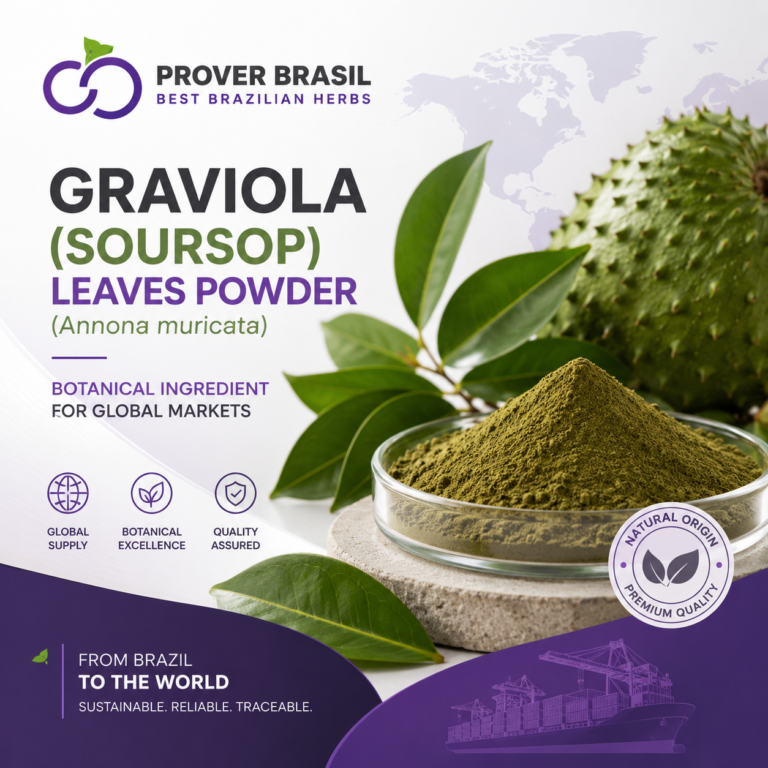
Graviola (Soursop) Leaves Powder (Annona muricata) is a botanical ingredient obtained from carefully processed leaves of the graviola tree, a tropical species widely recognized throughout Latin America and other warm-climate regions.
As global demand grows for plant-based ingredients, botanical powders, natural raw materials, and traditional tropical species, graviola leaf powder has gained increasing attention from companies operating in the herbal, botanical, food ingredient, tea, wellness, and natural product sectors.
For international buyers, the most important factors go beyond product availability. Consistency, processing quality, traceability, proper storage, documentation, particle size, moisture control, and commercial reliability are essential when evaluating a botanical ingredient for professional use.
Prover Brasil provides access to selected Brazilian botanical ingredients for international buyers, supporting companies looking for commercially relevant natural raw materials with professional communication and export-oriented service.
What Is Graviola (Soursop) Leaves Powder?
Graviola, also known as soursop, is the common name associated with Annona muricata, a tropical tree known for its distinctive fruit and aromatic leaves.
Graviola leaves can be harvested, cleaned, dried, and milled into a fine or controlled-particle botanical powder.
The resulting ingredient is generally green to brownish-green in appearance, depending on the drying process, leaf maturity, milling method, storage conditions, and natural variation of the botanical material.
Unlike fruit powders, which are primarily associated with flavor and food applications, soursop leaf powder belongs to a different commercial category and is typically evaluated according to botanical identity, purity, processing characteristics, granulometry, moisture level, storage stability, and intended industrial use.
Why Graviola Leaf Powder Attracts International Interest
The global botanical ingredients market continues to expand as companies search for distinctive plant materials that can support product differentiation.
Graviola offers strong commercial recognition because its name is already familiar in several international markets.
The ingredient also fits into broader trends involving:
- tropical botanicals;
- plant-based raw materials;
- herbal ingredients;
- powdered leaves;
- traditional botanical species;
- natural formulation concepts.
From a commercial perspective, this makes Annona muricata leaf powder relevant for companies developing botanical blends, herbal preparations, tea-based products, powdered formulations, research projects, specialty ingredient portfolios, and other applications permitted in their target markets.
Graviola Leaves Powder vs. Graviola Fruit Powder
One of the most important distinctions for buyers is the difference between graviola leaf powder and graviola fruit powder.
Although both materials come from the same species, they have different characteristics, compositions, sensory profiles, and applications.
Graviola Leaves Powder
Graviola leaf powder is made from dried leaves.
Its characteristics are primarily botanical and herbal, with a vegetal aroma, green-brown color, and composition naturally associated with the leaf material.
It is commonly considered for formulations where the leaf itself is the desired botanical component.
Graviola Fruit Powder
Graviola fruit powder is derived from the edible fruit pulp and is more commonly associated with beverages, flavor formulations, food preparations, and fruit-based applications.
Its sensory profile is significantly different from that of the leaves.
For this reason, buyers should always specify Annona muricata leaves powder when the leaf-derived ingredient is required.
How Graviola Leaves Are Processed Into Powder
The quality of botanical powders depends heavily on how the raw plant material is handled.
After harvesting, the leaves need to be cleaned and processed under controlled conditions to reduce unwanted moisture and preserve the physical characteristics of the plant material.
Once properly dried, the leaves can be milled into powder.
The final particle size may vary according to buyer requirements and available processing specifications.
A professional processing workflow typically considers factors such as:
- botanical identification;
- leaf selection;
- drying conditions;
- moisture control;
- milling;
- screening;
- packaging;
- storage;
- batch traceability.
These factors can significantly influence the appearance, handling behavior, stability, and commercial usability of the final powder.
Quality Matters in Botanical Raw Materials
Botanical ingredients are naturally subject to variation.
Climate, rainfall, soil conditions, harvest timing, drying temperature, raw material maturity, and storage can influence the physical characteristics of plant-based powders.
For professional buyers, quality assessment should therefore focus on repeatable parameters rather than appearance alone.
Depending on the commercial application, relevant specifications may include moisture content, particle size, microbiological parameters, botanical identity, foreign matter control, packaging format, batch identification, and supporting documentation.
This level of attention is especially important for importers, distributors, formulators, laboratories, and companies working with standardized internal purchasing requirements.
Applications of Graviola (Soursop) Leaves Powder
The potential application of Graviola Leaves Powder depends on local regulations, formulation objectives, and the product category in which the botanical material will be used.
Possible commercial uses may include botanical blends, herbal formulations, powdered plant mixtures, tea-related preparations, ingredient portfolios, research applications, and specialty natural products.
Companies should always confirm whether Annona muricata leaf powder is permitted for the intended use in the destination country before commercialization.
Botanical Blends
Graviola leaf powder can be combined with other botanical ingredients where complementary plant profiles are desired.
In these formulations, particle size and mixing compatibility become important considerations.
Herbal Tea and Infusion Concepts
Depending on local regulations and product design, graviola leaves may be incorporated into herbal preparations.
When the material is supplied as powder rather than whole or cut leaves, buyers should consider filtration requirements, dosage format, and the desired texture of the final product.
Powdered Botanical Formulations
Fine botanical powders can also be used in broader plant-based ingredient systems where powdered format is operationally convenient for blending and processing.
The appropriate specification will depend on the customer’s manufacturing process and final formulation.
Annona muricata as a Recognized Tropical Botanical Species
The botanical name Annona muricata L. helps distinguish graviola from other plants that may carry similar regional or commercial names.
Correct botanical identification is particularly important in international ingredient sourcing.
Common names can vary considerably between languages and markets.
The same species may be known as:
Graviola, Soursop, Guanábana, Guyabano, and other regional names.
Using the botanical name alongside the commercial name reduces ambiguity in purchase specifications, technical documents, labels, and international negotiations.
Why Botanical Identity Is Important
Ingredient buyers need confidence that the material being acquired corresponds to the requested plant species and plant part.
This is especially relevant because botanical products may be sourced as roots, bark, seeds, fruits, flowers, stems, or leaves.
For graviola, specifying Annona muricata leaves clearly differentiates the material from the fruit, seeds, bark, or other portions of the plant.
Accurate descriptions also help reduce purchasing errors and improve communication between procurement teams, technical departments, logistics providers, and suppliers.
What Buyers Should Evaluate Before Purchasing Graviola Leaf Powder
Commercial evaluation should begin with the intended use.
Different manufacturing processes may require different particle sizes, packaging formats, moisture limits, analytical documentation, or order quantities.
Buyers should discuss these requirements before confirming the order.
Important points may include:
- desired particle size;
- packaging requirements;
- intended destination;
- quantity;
- documentation requirements;
- technical specifications;
- logistics conditions;
- storage expectations;
- regulatory requirements in the destination market.
Clear technical communication helps prevent delays and specification mismatches.
Particle Size and Powder Characteristics
Particle size affects how botanical powder behaves during handling and formulation.
A finer powder may provide greater uniformity in some blends but may also generate more dust and require different handling precautions.
A coarser powder may be better suited for other processing methods.
Because different buyers use different manufacturing systems, there is no single ideal granulometry for every application.
The appropriate specification should be defined according to the final use.
Moisture and Storage Stability
Moisture is an important consideration for dried botanical ingredients.
Excess moisture may reduce storage stability and create undesirable conditions during transportation or warehousing.
For this reason, botanical powders should be stored in dry environments and protected from excessive heat, humidity, direct sunlight, and contamination.
Packaging should also be selected according to the transportation distance, destination climate, storage period, and commercial volume.
Packaging for International Supply
Packaging is not merely a logistical detail.
It plays a direct role in preserving the physical quality of botanical powders during storage and transportation.
Depending on commercial volume and buyer specifications, different packaging configurations may be considered.
The material should remain protected against humidity, contamination, foreign odors, and inappropriate handling.
For international shipments, packaging also needs to be compatible with logistics procedures and destination requirements.
Documentation and International Trade Requirements
Import requirements for botanical materials vary from country to country.
Depending on the destination and intended use, buyers may need commercial invoices, packing lists, certificates, product specifications, origin information, phytosanitary documentation, analytical documentation, or other supporting records.
The exact requirements should always be confirmed with the importer and the relevant authorities in the destination market.
Companies should also avoid assuming that botanical ingredients are regulated identically across different jurisdictions.
A product accepted for one application in one country may be subject to different requirements elsewhere.
Regulatory Responsibility for Graviola Leaf Powder
Companies purchasing soursop leaf powder for formulation or resale should confirm the legal status of the ingredient in their target market.
This is particularly important where the ingredient may be used in foods, teas, herbal preparations, cosmetics, supplements, or other regulated product categories.
Claims made about finished products must also comply with local advertising and labeling rules.
Responsible commercial positioning should avoid unsupported medical, therapeutic, or disease-related claims.
Why Prover Brasil Is Relevant for International Buyers
Companies sourcing botanical ingredients internationally need more than a product name and a price.
Efficient transactions depend on reliable communication, product understanding, commercial organization, specification alignment, and logistics coordination.
Prover Brasil works with a portfolio of Brazilian botanical and natural ingredients for companies seeking distinctive raw materials from Brazil.
Buyers can explore Brazilian botanical ingredients and natural raw materials available through Prover Brasil to identify additional materials that may complement their sourcing strategy.
This approach can be particularly useful for importers, distributors, laboratories, product developers, ingredient companies, and businesses looking to diversify their botanical portfolios.
Graviola Powder for B2B Ingredient Sourcing
Professional ingredient sourcing is different from retail purchasing.
B2B buyers often require larger volumes, technical specifications, consistent packaging, export documentation, logistics coordination, and structured commercial communication.
For this reason, companies purchasing Graviola (Soursop) Leaves Powder should communicate the required quantity, destination country, application, packaging needs, and technical requirements from the beginning of the negotiation.
This creates a more efficient purchasing process and allows feasibility to be evaluated more accurately.
Sourcing Tropical Botanical Ingredients From Brazil
Brazil has exceptional botanical diversity and a long tradition of using tropical plant materials in foods, herbal preparations, beverages, cosmetics, and regional products.
International buyers increasingly look to Brazil for distinctive botanical ingredients that can strengthen product portfolios and differentiate formulations.
Graviola is part of this broader group of internationally recognized tropical species.
Other Brazilian botanical materials can also be considered alongside graviola depending on the buyer’s market positioning and product strategy.
Traceability and Batch Consistency
Traceability is increasingly important in the natural ingredients industry.
Companies may need information about batch identification, processing, packaging, and material movement through the supply chain.
Even though natural botanical materials may present normal variation between harvests, good commercial practices help improve consistency and transparency.
Buyers should define which parameters are critical to their production process before placing larger orders.
This allows specifications to be aligned with actual operational requirements.
Natural Variation in Graviola Leaf Powder
Because graviola leaves are agricultural botanical materials, minor variations in color, aroma, texture, and other physical characteristics may occur.
These differences can result from harvest conditions, plant maturity, drying parameters, seasonal variation, and natural agricultural factors.
Natural variation does not necessarily indicate a quality problem.
However, significant deviations from agreed specifications should always be evaluated.
Professional buyers usually work with defined acceptance criteria to determine whether a batch is appropriate for their intended use.
Commercial Opportunities for Soursop Leaf Powder
The international natural ingredients sector continues to expand into increasingly specialized product categories.
Consumers and companies alike are showing interest in tropical botanicals, plant-derived ingredients, traditional species, and recognizable botanical names.
This creates opportunities for graviola leaf powder in markets where Annona muricata can be legally incorporated into relevant product categories.
For businesses, differentiation may come from formulation concept, ingredient combinations, traceability, sourcing story, quality standards, and responsible positioning.
Avoiding Unsupported Claims in Graviola Products
Graviola is frequently discussed online in connection with a wide range of health-related claims.
Commercial companies should approach these claims carefully.
Scientific interest in botanical compounds does not automatically authorize medical or therapeutic marketing claims.
Businesses should avoid presenting graviola leaf powder as a treatment, cure, or substitute for medical care.
The safer and more professional approach is to describe the ingredient accurately according to its botanical identity, physical characteristics, processing, intended permitted use, and available documentation.
This protects both the buyer and the integrity of the final product.
How to Request a Commercial Quote
A detailed inquiry helps streamline the quotation process.
When contacting Prover Brasil regarding Graviola (Soursop) Leaves Powder (Annona muricata), buyers should ideally provide information such as required quantity, destination country, intended use, preferred packaging, technical requirements, and expected purchasing schedule.
Providing these details allows the commercial team to evaluate the request more efficiently and discuss the available supply conditions.
Frequently Asked Questions About Graviola (Soursop) Leaves Powder (Annona muricata)
What is Graviola Leaves Powder?
Graviola Leaves Powder is a botanical powder obtained from dried and milled leaves of Annona muricata, a tropical species also widely known as soursop or guanábana.
Is Graviola Leaves Powder the same as Soursop Fruit Powder?
No. Graviola leaf powder is made from the leaves, while soursop fruit powder is obtained from the fruit pulp. Their composition, appearance, sensory profile, and potential applications are different.
What is the botanical name of graviola?
The botanical name is Annona muricata L.
What color is soursop leaf powder?
Its color typically ranges from green to brownish-green, although natural variation may occur according to leaf maturity, drying, processing, and storage conditions.
What applications can use Graviola Leaves Powder?
Potential applications may include botanical blends, herbal preparations, powdered formulations, research projects, and other uses allowed under the regulations of the destination market.
Can Graviola Leaves Powder be used in food products?
This depends on the regulations of the destination country and the specific product category. Buyers should verify regulatory acceptance before formulation or commercialization.
Can Graviola Leaves Powder be used in supplements?
Regulatory status varies by country. Companies should confirm whether Annona muricata leaves are permitted in supplements or related product categories in their target jurisdiction.
Is graviola leaf powder available for international orders?
Commercial availability depends on quantity, specifications, documentation requirements, destination, and current supply conditions. International buyers can contact Prover Brasil to discuss their specific requirements.
What information should I provide when requesting a quote?
It is helpful to provide the required quantity, destination country, intended application, preferred packaging, technical specifications, and any required documentation.
How should Graviola Leaves Powder be stored?
The powder should generally be stored in a cool, dry environment, protected from moisture, direct sunlight, contamination, excessive heat, and strong external odors.
Does natural graviola powder vary between batches?
Some natural variation can occur because it is a botanical agricultural material. Harvest conditions, seasonality, drying, and plant maturity may influence color and other physical characteristics.
Where can companies find other Brazilian botanical ingredients?
Prover Brasil offers access to a broader portfolio of botanical and natural materials for companies interested in sourcing Brazilian ingredients for international markets.
Graviola Leaves Powder and the Growing Botanical Ingredient Market
The commercial relevance of Graviola (Soursop) Leaves Powder reflects a broader movement toward plant-derived ingredients and greater diversity in botanical sourcing.
For buyers, however, selecting the right ingredient requires more than following market trends.
The product must match the company’s technical requirements, regulatory environment, formulation objectives, logistics structure, and quality expectations.
When these factors are aligned, graviola leaf powder can become a valuable addition to a broader botanical ingredient portfolio.
Conclusion
Graviola (Soursop) Leaves Powder (Annona muricata) is a distinctive tropical botanical ingredient with growing commercial visibility in international natural product markets.
Its value for professional buyers lies in the combination of recognizable botanical identity, powdered format, formulation versatility, and the broader commercial interest surrounding tropical plant ingredients.
Successful sourcing depends on clear specifications, appropriate processing, moisture control, suitable packaging, documentation, traceability, regulatory verification, and reliable commercial communication.
Prover Brasil supports international companies seeking Brazilian botanical ingredients and natural raw materials for professional applications.
If your company is evaluating Annona muricata leaf powder for its ingredient portfolio, formulation development, distribution strategy, or international sourcing requirements, contact Prover Brasil to request commercial information and discuss your Graviola Leaves Powder requirements.