

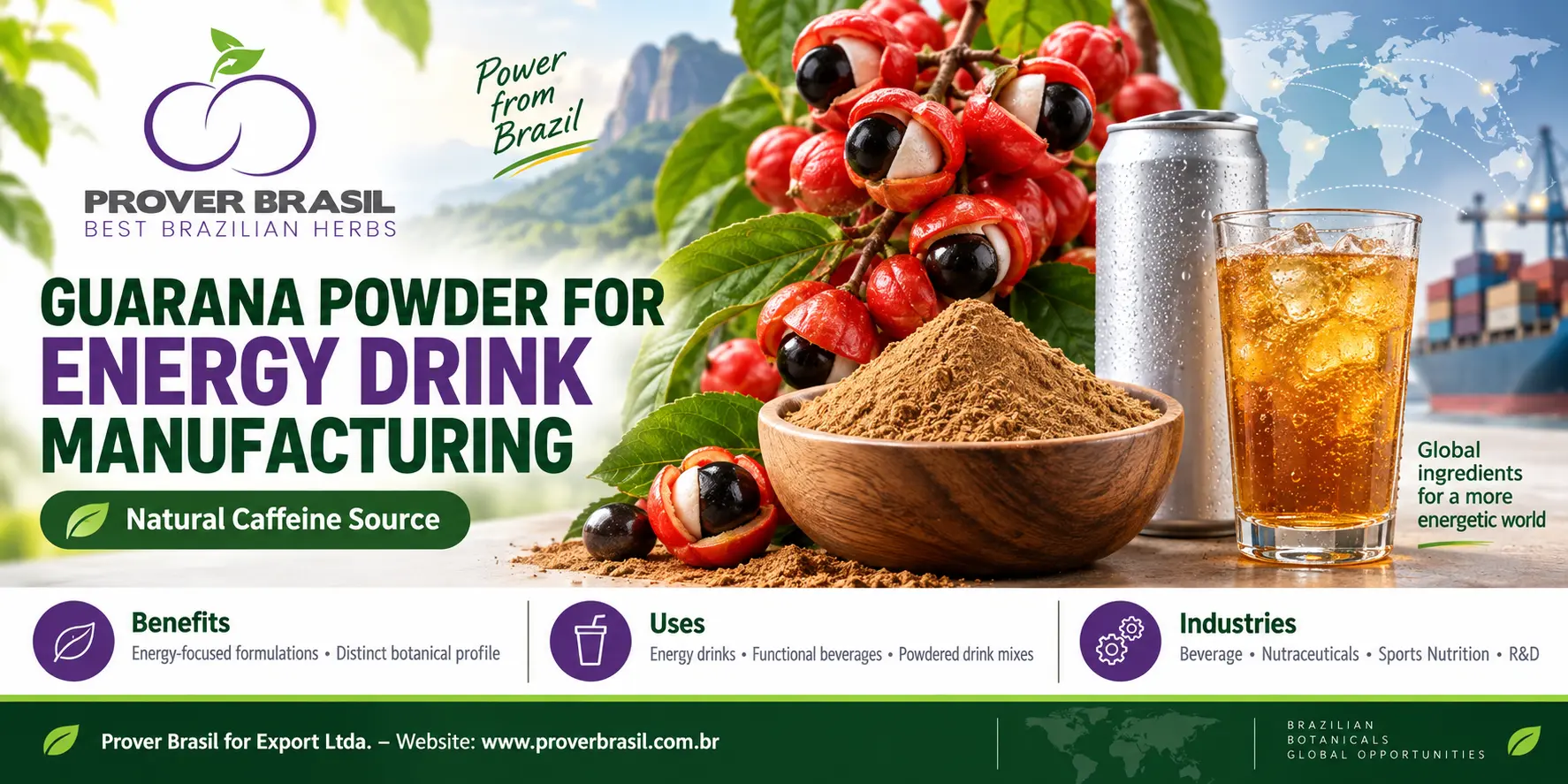
Guarana Powder for Energy Drink Manufacturing gives beverage companies access to a distinctive Brazilian botanical ingredient with naturally occurring caffeine, recognizable origin and strong consumer awareness.
Obtained from the seeds of Paullinia cupana, guarana powder can be evaluated for carbonated beverages, energy shots, powdered drink mixes, sports nutrition products and beverage concentrates.
However, developing a successful product requires more than adding guarana powder to an existing formula. Beverage developers must consider caffeine concentration, flavor, astringency, particle size, suspension, color, stability and the regulations of the destination market.
For international buyers, the commercial opportunity lies in combining Brazilian identity with careful formulation and reliable technical documentation.
Companies can view the complete Guarana product line supplied by Prover Brasil before requesting specifications and commercial information.
Guarana powder is produced from processed and finely milled guarana seeds. Unlike a concentrated extract, the powder retains more of the natural seed matrix.
This distinction matters in beverage development.
Guarana powder may contribute:
The powder should not be treated as if every batch contained exactly the same percentage of caffeine. The actual concentration must be confirmed through the applicable specification and Certificate of Analysis.
This information allows formulators to calculate the quantity required for the intended beverage while considering local caffeine limits and labeling rules.
The modern energy beverage market includes much more than traditional carbonated drinks. Companies now develop energy waters, concentrated shots, powdered sachets, pre-workout beverages and products designed for active lifestyles.
Guarana can help create a differentiated identity in these categories.
Guarana is strongly associated with Brazil. This origin can support tropical beverage concepts and product stories that are different from formulas based only on isolated caffeine.
Caffeine is one of the best-known compounds in guarana seeds. Nevertheless, its concentration can vary. Each commercial formulation should therefore be based on verified analytical results.
Guarana powder is not simply caffeine in powdered form. The seed also contains other naturally occurring compounds, including methylxanthines and phenolic constituents.
The commercial ingredient must still be evaluated according to its own analytical documentation. Results from scientific studies should not automatically be applied to every batch or finished drink.
Guarana powder can be tested in:
Companies developing several botanical products can also explore the complete Brazilian ingredients catalog.
The principal benefits of Guarana Powder for Energy Drink Manufacturing are related to product positioning, formulation flexibility and botanical identity.
Guarana provides a more recognizable botanical story than a beverage described only as caffeinated. Its Brazilian origin can support tropical, active-lifestyle and sports-oriented concepts.
The characteristic taste of guarana can work with stronger flavor systems, including:
Acidic fruits, aromatic herbs and carefully selected sweetening systems can help balance the natural bitterness and astringency of the seed powder.
The powdered format can be weighed into dry premixes. It can also be dispersed into liquid prototypes during beverage development.
Its behavior will depend on particle size, processing, mixing conditions and the other ingredients in the formula.
Beverage businesses can use guarana to develop product families rather than a single drink. For example, the same ingredient may be evaluated in a carbonated beverage, a concentrated shot and a powdered sachet.
Guarana powder and guarana extract are not automatically interchangeable.
Guarana powder generally represents finely milled seed material. A guarana extract is processed to concentrate selected soluble components and may be supplied with a defined caffeine specification.
This difference can affect:
A beverage developer should select the ingredient according to the intended product.
A transparent beverage may require a different technical approach from an opaque fruit drink or powdered premix. Companies should conduct bench and pilot testing before confirming the commercial formula.
The correct amount of guarana powder depends on the verified caffeine content of the specific batch and the desired caffeine quantity per serving.
A practical calculation is:
Guarana powder required in grams = total caffeine required in milligrams ÷ caffeine supplied by each gram of powder
If a guarana powder contains 4% caffeine, each gram theoretically provides 40 milligrams of caffeine.
For a one-liter pilot containing four servings, a developer targeting 40 milligrams of caffeine per serving would require:
This is only a calculation example. It is not a universal dosage recommendation.
The calculation must be adjusted according to:
A successful formula must address the physical and sensory behavior of the ingredient.
Guarana powder can bring bitterness and a drying sensation. Sweetness alone may not provide complete balance.
Formulators can test acidity, fruit aroma, salt at very low levels and flavor layering. Tropical fruits and aromatic herbs can create a more rounded sensory profile.
Complete solubility should not be assumed. Finely milled particles may remain suspended for a period and later settle.
Development teams should evaluate:
A “shake before use” instruction may be relevant for some products, subject to local rules and consumer expectations.
Guarana powder can influence beverage color and visual clarity. This effect may be appropriate in opaque tropical drinks but less suitable in crystal-clear energy waters.
The ingredient should be tested in the complete formula rather than only in water.
Pasteurization, hot filling and other processing conditions may influence flavor, color and physical stability. Pilot testing should reproduce the intended commercial process as closely as possible.
Caffeine must be calculated using analytical data rather than assumptions. Finished-product testing can help confirm whether the beverage meets its declared specification.
Scientific research helps product developers understand guarana, but individual studies do not authorize unrestricted health claims.
A 2026 randomized crossover study evaluated acute guarana supplementation in amateur soccer players. The researchers observed improvement in a basic attention test and pre-exercise technical performance. However, the technical advantage did not remain after intense exercise. Changes in heart rate and recovery were also reported.
Read the 2026 study on guarana, attention and sports performance.
This research supports continued investigation, but it should not be interpreted as proof that every guarana beverage will produce the same results.
A 2024 double-blind crossover study compared guarana, caffeine and placebo. The trial did not find consistent improvements in the tested cognitive, mood or workload measures.
Read the controlled study comparing guarana and caffeine.
This result is important for responsible product communication. Scientific findings can differ according to dose, preparation, study population and research design.
Another controlled study evaluated guarana before a cycling trial. The researchers reported a small improvement in work performance compared with placebo. However, they could not determine whether the effect extended beyond the caffeine supplied by the guarana preparation.
Read the study on guarana and cycling performance.
A 2026 analytical study developed a screening approach to distinguish authentic guarana samples from samples containing undeclared synthetic caffeine.
Read the study on guarana authentication and caffeine analysis.
For importers, this reinforces the commercial importance of traceability, supplier qualification and analytical documentation.
The following formulas are starting points for research and development. They must undergo sensory, microbiological, stability and regulatory evaluation before commercial use.
The liquid prototypes use guarana powder containing 4% caffeine as an example. Recalculate the quantity when the actual caffeine result is different.
At 4% caffeine, this example supplies approximately 50 milligrams of caffeine from guarana in each 25-gram serving. Laboratory confirmation is still required.
Guarana Powder for Energy Drink Manufacturing may be relevant to several professional sectors:
Each company must evaluate the ingredient according to its intended application, technical process and local regulations.
Professional buyers should request clear technical and commercial information before purchasing guarana powder.
Important points include:
A sample should be tested in the buyer’s actual formulation before a larger commercial order is confirmed.
Buyers may also learn more about Prover Brasil’s processing and supply capabilities on the factory information page.
Raw-material documentation is only one part of beverage development.
Once guarana powder is combined with acids, fruit ingredients, sweeteners, flavors and other botanical components, the finished product may behave differently.
A complete evaluation should consider:
The commercial formula should be approved only after the necessary technical and regulatory checks have been completed.
Prover Brasil for Export Ltda. supplies Brazilian guarana products to importers, distributors, beverage businesses and ingredient companies in international markets.
Professional buyers evaluating Guarana Powder for Energy Drink Manufacturing can request:
To receive a more accurate commercial proposal, inform the required quantity, destination country, intended beverage application and preferred shipping method.
Contact Prover Brasil for a commercial quotation.
It is finely processed Brazilian guarana seed powder evaluated as a botanical ingredient for energy drinks, powdered mixes, concentrated shots and related beverage products.
Yes. Guarana seeds naturally contain caffeine. However, the concentration can vary, so formulators should use the analytical result stated in the current Certificate of Analysis.
No. Guarana powder generally retains more of the milled seed material. Extracts undergo additional processing and may be supplied according to a defined concentration. Their flavor, dispersibility and required quantities can differ.
Complete solubility should not be assumed. The powder may contain particles that disperse temporarily and later settle. Beverage developers should test mixing, suspension and shelf-life behavior.
The quantity depends on the verified caffeine content, target caffeine per serving, serving size, other caffeine sources and applicable regulations. The amount should be calculated from the Certificate of Analysis and confirmed in the finished beverage.
Yes, it can be evaluated in carbonated formulas. However, developers must test dispersion, foaming, sediment, flavor and stability under the intended processing conditions.
Guarana can be evaluated with passion fruit, pineapple, lime, peach, grapefruit, ginger, hibiscus, cacao and other strong flavor systems. The ideal combination depends on the sensory objective.
Importers should request the product specification, Certificate of Analysis, caffeine result, packing details, storage conditions, shelf life, commercial availability and applicable export documents.
Not automatically. Research findings depend on the preparation, dose, population and study design. Claims must comply with the regulations of the country where the finished product will be sold.
International companies can contact Prover Brasil for Export Ltda. to request technical documents, availability, commercial pricing and export information for Brazilian guarana products.
Guarana Powder for Energy Drink Manufacturing offers beverage developers an opportunity to combine Brazilian origin, naturally occurring caffeine and flexible product positioning.
Successful development depends on accurate caffeine calculations, sensory balancing, physical stability, pilot testing and regulatory review.
Contact Prover Brasil for Export Ltda. to discuss your required quantity, destination market and intended application.
Prover Brasil for Export Ltda.
Website: www.proverbrasil.com.br