

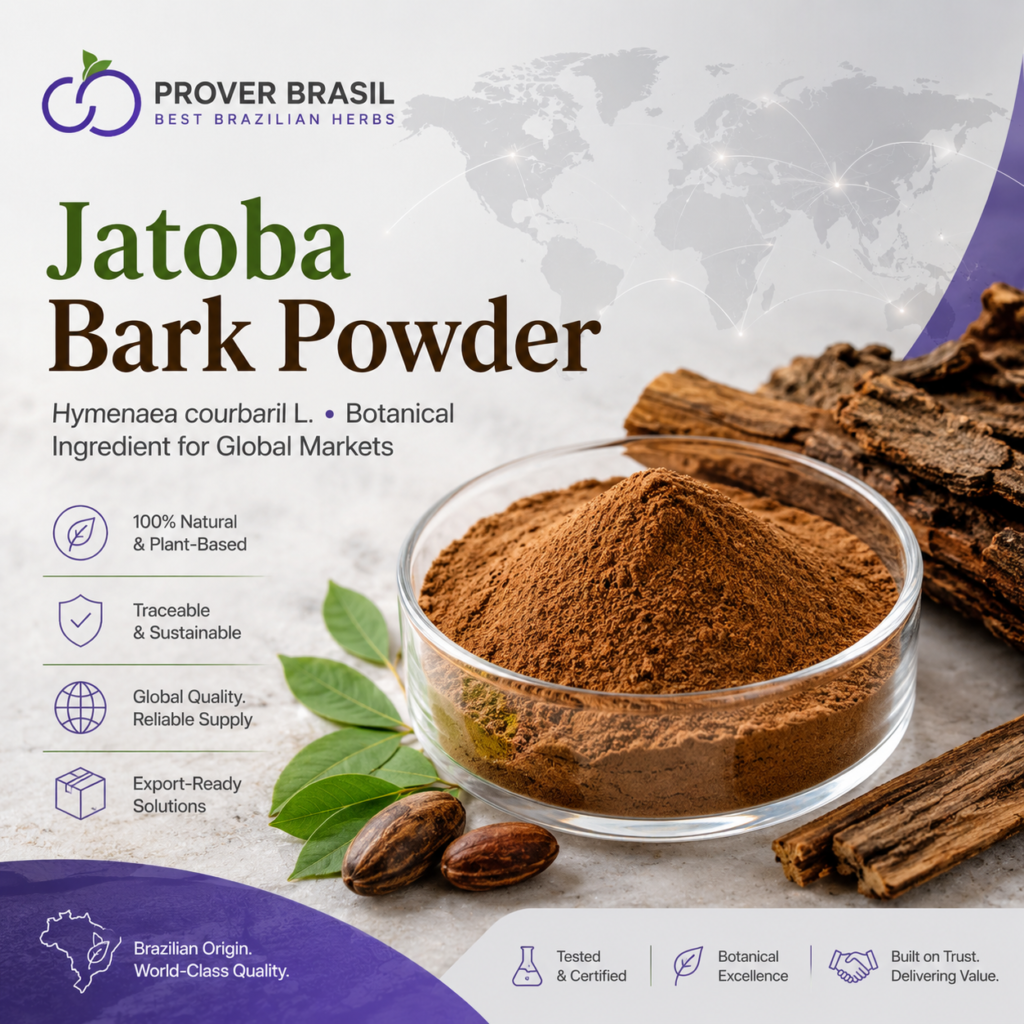
Jatoba Bark Powder (Hymenaea courbaril L.) is a botanical ingredient derived from the bark of a remarkable tree native to tropical regions of the Americas, particularly the Amazon and other Brazilian biomes. Known internationally as Jatoba, West Indian locust, Brazilian cherry, or courbaril, Hymenaea courbaril L. has a long history of traditional use and growing commercial relevance within the global botanical ingredients sector.
For importers, distributors, formulation companies, botanical laboratories, natural product businesses, and industrial buyers, sourcing Jatoba bark in a standardized powdered format can simplify processing, storage, transportation, and integration into different product development strategies.
Prover Brasil, a Brazilian supplier of botanical ingredients for international markets connects buyers with selected natural materials from Brazil, supporting commercial sourcing requirements for companies seeking botanical powders and raw materials with clear identification and export-oriented service.
As demand for Amazonian and South American botanicals continues to expand, understanding the botanical identity, sourcing considerations, processing characteristics, and commercial applications of Jatoba bark powder becomes increasingly important for professional buyers.
Jatoba Bark Powder is obtained from the bark of Hymenaea courbaril L., a large tropical tree belonging to the Fabaceae family.
The species occurs naturally across parts of Central and South America and is particularly associated with tropical forest ecosystems in Brazil.
After appropriate sourcing and processing, the bark can be cleaned, dried, milled, and transformed into a fine botanical powder suitable for commercial handling.
The powdered format offers practical advantages for industrial buyers because it facilitates weighing, blending, packaging, inventory management, and subsequent processing.
For international markets, botanical identity is particularly important. Commercial documentation should clearly indicate the scientific name Hymenaea courbaril L. to reduce ambiguity between regional names and other species that may also be marketed under similar common names.
Hymenaea courbaril is a tropical tree traditionally valued for multiple parts of the plant, including its wood, resin, fruit, and bark.
Its wide geographical distribution has resulted in several common names depending on the country and region.
Among them are:
For commercial botanical sourcing, however, common names should never replace scientific identification.
Using the Latin botanical nomenclature helps buyers, quality teams, laboratories, and regulatory professionals confirm exactly which raw material is being evaluated.
Botanical raw materials can vary considerably according to species, plant part, harvest location, processing method, particle size, and storage conditions.
A professional purchasing process should therefore begin with clear specifications.
For Jatoba Bark Powder, buyers should confirm that the material corresponds to the bark of Hymenaea courbaril L., rather than assuming that every product marketed simply as “Jatoba powder” is equivalent.
This level of precision improves communication throughout the supply chain and supports technical evaluation before commercial use.
The global botanical ingredients sector increasingly values materials with strong geographical identity, traceable botanical origin, and versatility for product development.
Brazil occupies a strategic position in this market because of its exceptional biodiversity and extensive tradition surrounding native plant materials.
Jatoba is one of the species that attracts attention because it combines cultural recognition, botanical identity, and potential relevance for companies researching South American natural ingredients.
Its powdered bark format may be considered by businesses operating in botanical preparations, natural product development, traditional herbal markets, ingredient distribution, research, and other specialized sectors.
The final application, however, must always comply with the regulations applicable in the destination country.
Processing bark into powder provides several practical benefits for professional buyers.
Compared with large pieces of dried bark, powder can be easier to handle in industrial and laboratory environments.
It can simplify batch measurement, formulation testing, repacking, blending, and storage.
Uniform particle size can also improve operational consistency when a botanical material needs to be incorporated into subsequent manufacturing processes.
Another advantage is logistical efficiency.
Properly packed botanical powders occupy standardized packaging formats and can be prepared according to commercial quantities required by importers, distributors, and industrial customers.
Professional buyers should evaluate Jatoba bark powder from both a botanical and commercial perspective.
Price is only one factor.
Consistency between batches, correct botanical identification, packaging, moisture control, processing conditions, documentation, minimum order requirements, and export logistics can all influence purchasing decisions.
Companies seeking Brazilian natural materials can explore botanical ingredients and products available from Prover Brasil to identify materials compatible with their sourcing strategies.
A specialized supplier can also help clarify specifications before the buyer places an order, reducing the risk of misunderstandings regarding plant part, powder characteristics, packaging, or destination requirements.
Jatoba Bark Powder may attract interest from different segments of the botanical market.
Potential commercial applications depend on the buyer’s formulation objective and applicable regulatory framework.
The material may be evaluated for use in areas such as botanical product development, traditional herbal preparations, research formulations, natural ingredient portfolios, specialty raw material distribution, and other non-standardized botanical applications.
It is important to distinguish commercial potential from permitted regulatory use.
A botanical ingredient accepted for one application in one country may require additional evaluation, documentation, notification, registration, or restrictions elsewhere.
Therefore, importers and manufacturers should determine regulatory suitability before introducing the material into any finished product.
The quality of a botanical powder depends heavily on the raw plant material from which it originates.
Harvesting practices, drying conditions, storage environment, contamination control, and milling procedures can all affect the final ingredient.
Professional sourcing should therefore prioritize consistency and clear communication.
For international buyers, specifications may include characteristics such as:
Not every market or customer requires the same specification.
The correct commercial approach is therefore to establish requirements before shipment.
One of the most important details in botanical sourcing is identifying exactly which part of the plant is being supplied.
A tree may produce several commercially distinct botanical materials.
Bark, leaves, seeds, fruit, resin, roots, and wood are not interchangeable ingredients.
When sourcing Jatoba Bark Powder, the specification should clearly reference the bark.
This prevents confusion during procurement and supports more accurate technical documentation.
Commercial botanical powders generally undergo several processing stages before becoming suitable for shipment.
These may include selection of raw material, cleaning, controlled drying, size reduction, milling, sieving, and packaging.
The exact manufacturing process can vary according to the required specification.
Particle size is particularly relevant because buyers may require coarse, medium, or finer powder depending on the intended downstream operation.
A buyer planning extraction, for example, may have different technical requirements from a distributor repacking the material for another industrial customer.
Packaging is an important component of botanical ingredient quality.
The material should be protected from unnecessary exposure to moisture, contamination, excessive heat, and other environmental conditions capable of affecting stability during storage or transportation.
Commercial packaging requirements can differ based on quantity and customer specifications.
For this reason, buyers should discuss packaging, net weight, labeling, and shipment conditions before placing an international order.
Amazonian and Brazilian botanicals have gained visibility in international markets because companies increasingly seek distinctive ingredients linked to biodiversity and regional botanical traditions.
However, responsible commercialization requires more than simply attaching “Amazon” to a product description.
Professional buyers increasingly expect accurate species identification, clear sourcing information, responsible communication, and reliable commercial documentation.
This is particularly important for companies building long-term botanical ingredient portfolios rather than making occasional spot purchases.
Prover Brasil works within this international sourcing environment by presenting Brazilian ingredients to buyers seeking commercial opportunities in natural raw materials.
Before purchasing Jatoba Bark Powder, buyers should define the specification required for their market.
This can include desired particle size, packaging format, quantity, destination, documentation needs, and intended commercial application.
Clarifying these points before quotation improves efficiency for both supplier and buyer.
Import requirements should also be checked before shipment.
Depending on the destination and final application, authorities may require specific documentation, customs classifications, botanical declarations, certificates, analytical information, or other supporting records.
Importers remain responsible for confirming the regulatory requirements applicable to their jurisdiction.
Botanical distributors often require ingredients that can be incorporated into a broader portfolio of natural raw materials.
For these buyers, commercial consistency is particularly important.
The distributor may subsequently supply laboratories, formulators, retailers, manufacturers, or specialized botanical companies.
Clear product naming and specification therefore help maintain consistency throughout the downstream supply chain.
Jatoba Bark Powder can complement portfolios focused on Brazilian botanicals, Amazonian ingredients, traditional plant materials, and specialty botanical powders.
Research and formulation businesses may evaluate botanical powders as starting materials for product development or technical investigation.
The powdered format makes Jatoba bark convenient for laboratory-scale testing and controlled measurement.
However, formulation companies should establish their own specifications and perform whatever testing is appropriate for the intended application.
A botanical ingredient should never be assumed to possess standardized characteristics unless those characteristics are specifically defined and supported by relevant analysis.
Regulatory compliance is essential when introducing botanical ingredients into international markets.
Rules differ between countries and between product categories.
A material used in cosmetics may be subject to one regulatory framework, while foods, supplements, traditional herbal products, pharmaceuticals, and research materials may follow entirely different requirements.
For this reason, companies considering Jatoba Bark Powder should verify:
Professional sourcing and regulatory validation should work together.
Botanical ingredients are often associated with long histories of traditional use.
However, traditional use should not automatically be converted into medical or therapeutic claims.
Businesses developing products containing Jatoba Bark Powder should ensure that marketing statements comply with local regulations and are supported by appropriate evidence.
Claims related to preventing, treating, curing, or diagnosing diseases are particularly sensitive and may place a finished product within a different regulatory category.
A responsible commercial approach focuses on botanical identity, quality, sourcing, processing, and intended application rather than exaggerated health promises.
Brazil contains one of the richest concentrations of plant biodiversity in the world.
This creates opportunities for companies seeking distinctive botanical raw materials for international product portfolios.
At the same time, biodiversity requires responsible sourcing practices.
Professional buyers increasingly consider origin, documentation, environmental responsibility, and supply continuity when selecting partners.
Working with companies familiar with Brazilian botanicals can simplify communication between local supply chains and international buyers.
Successful botanical sourcing depends on more than completing one transaction.
Companies developing long-term product lines need supply relationships capable of maintaining communication, specifications, logistics, and commercial consistency over time.
Before establishing recurring purchases, buyers may wish to discuss anticipated volumes, frequency of orders, packaging requirements, destination countries, and documentation.
These conversations help determine whether a botanical ingredient can be integrated into a scalable sourcing strategy.
Powder and extract should not be treated as equivalent ingredients.
Jatoba Bark Powder generally represents mechanically processed botanical material obtained from dried bark.
An extract, by contrast, involves an extraction process designed to transfer certain constituents into a different preparation.
Extracts may also be concentrated or standardized according to specific parameters.
Buyers should therefore specify whether they require raw botanical powder or an extracted ingredient.
Using the correct terminology is essential when requesting quotations and technical information.
Botanical powders should generally be stored under conditions that protect them from moisture, excessive heat, direct sunlight, contamination, and strong odors.
Exact storage requirements should follow the supplier’s specifications and any applicable quality protocols.
Proper warehouse management can help maintain the characteristics of the material until it is used in downstream processing.
Inventory rotation and clearly identified batch records are also useful practices for professional importers and distributors.
A detailed inquiry allows suppliers to respond more accurately.
International buyers should ideally provide information such as required quantity, destination country, desired packaging, intended commercial application, preferred specifications, and documentation requirements.
For larger commercial projects, expected annual volume may also help suppliers evaluate sourcing and logistics.
Providing these details from the beginning can accelerate the quotation process and reduce unnecessary exchanges during procurement.
Jatoba Bark Powder is a botanical material produced from dried and milled bark of Hymenaea courbaril L., a tropical tree found in Brazil and other parts of the Americas.
The species discussed in this ingredient is Hymenaea courbaril L., belonging to the Fabaceae botanical family.
No. Bark powder consists primarily of processed dried plant material, while an extract undergoes an additional extraction process. Buyers should confirm which type of ingredient they require.
Hymenaea courbaril occurs naturally in tropical regions of Central and South America, including Brazil.
Potential buyers include botanical ingredient distributors, formulation companies, natural product businesses, laboratories, wholesalers, research organizations, and companies developing specialized botanical portfolios.
International trade is possible, subject to commercial availability and compliance with the customs, botanical, regulatory, and import requirements of the destination country.
Important information may include botanical identification, plant part, origin, particle size, packaging, available documentation, storage requirements, minimum order quantity, and shipping conditions.
Permitted use depends on the regulations of the destination country and the specific product category. Manufacturers and importers should verify regulatory eligibility before formulation or commercialization.
Jatoba has a history of traditional botanical use, but commercial ingredients should not be marketed with unsupported medical claims. Any health or therapeutic claims must comply with applicable regulations and be supported by appropriate evidence.
It should generally be kept in appropriate packaging in a dry, clean environment protected from excessive humidity, heat, direct sunlight, and contamination, according to the supplier’s storage instructions.
Jatoba Bark Powder (Hymenaea courbaril L.) represents an interesting Brazilian botanical raw material for companies seeking distinctive ingredients for international markets.
Its botanical identity, powdered format, regional origin, and compatibility with different commercial sourcing strategies make it relevant to distributors, wholesalers, formulation companies, laboratories, and businesses building portfolios of Brazilian natural ingredients.
Successful sourcing, however, depends on professional evaluation. Botanical identification, plant part, processing, packaging, documentation, regulatory requirements, and intended application should all be established before commercial use.
Prover Brasil supports international buyers interested in Brazilian botanical ingredients by connecting commercial demand with sourcing opportunities and export-oriented communication.
Companies evaluating Jatoba Bark Powder for distribution, formulation, research, or other professional applications can contact Prover Brasil for botanical ingredient sourcing and quotations to discuss quantities, specifications, destination requirements, and commercial opportunities.
For buyers seeking to expand their portfolio with authentic Brazilian botanical materials, a clear sourcing strategy is the foundation for building reliable, scalable, and commercially sustainable supply relationships.