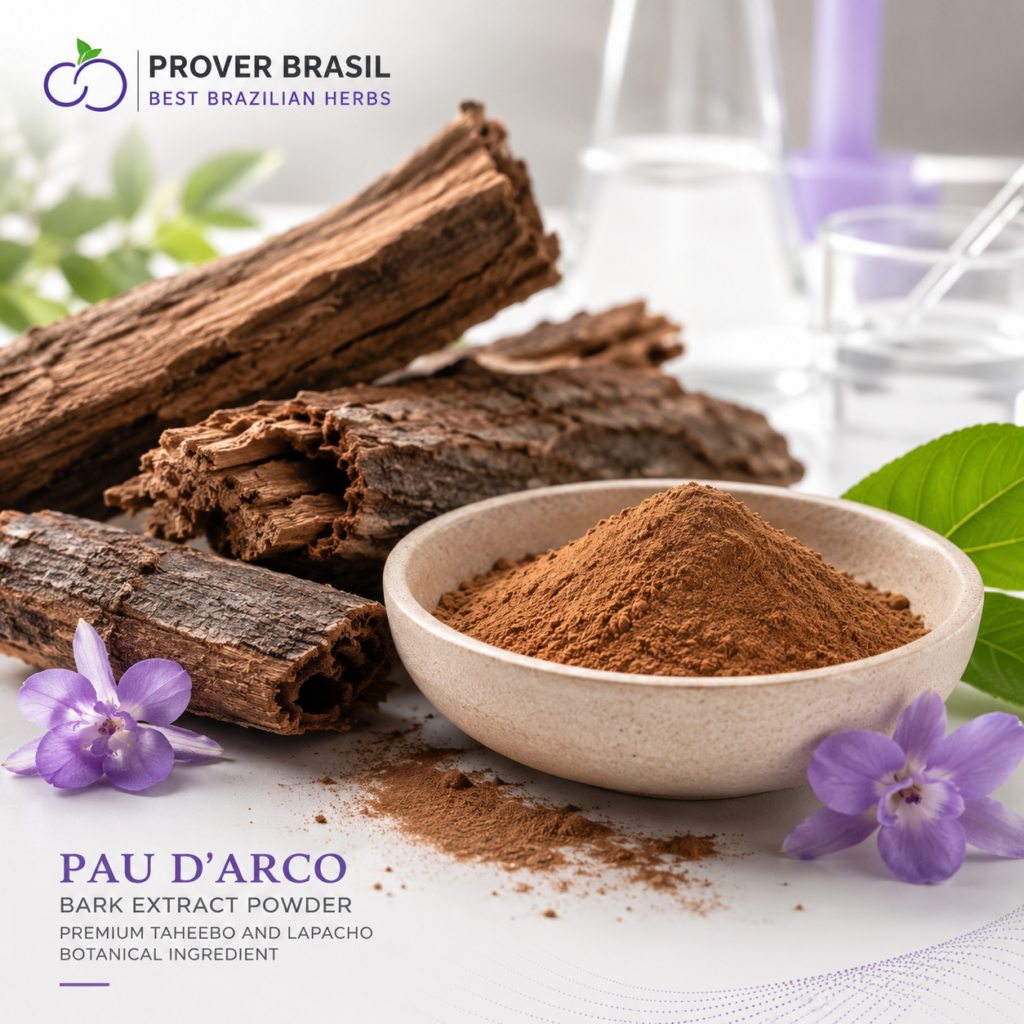
Pau D’Arco Bark Extract Powder is a distinctive botanical ingredient obtained from the bark of Tabebuia avellanedae Lor., a South American tree also commercially known as Taheebo and Lapacho.
Its traditional identity, recognizable botanical origin, and versatile powder format make it an attractive option for companies developing herbal teas, botanical blends, capsules, functional powders, wellness products, and other plant-based formulations.
However, sourcing Pau D’Arco requires more than selecting a product by its common name. Several botanical species may be marketed under similar names, even though they can differ in identity, composition, sourcing characteristics, and commercial suitability.
Prover Brasil supplies and exports Pau D’Arco derived specifically from Tabebuia avellanedae Lor. This botanical specification is an essential consideration for buyers seeking greater clarity, traceability, and consistency when evaluating Lapacho or Taheebo ingredients for international markets.
Through Brazilian botanical ingredient sourcing with Prover Brasil, companies can access professional commercial support, export coordination, product information, and customized quotations based on volume, destination, packaging, and logistical requirements.
What Is Pau D’Arco Bark Extract Powder?
Pau D’Arco Bark Extract Powder is a concentrated botanical powder prepared from the bark of the Pau D’Arco tree. The ingredient is also widely recognized by the names Taheebo Bark Extract Powder and Lapacho Bark Extract Powder.
The botanical name associated with the material supplied by Prover Brasil is Tabebuia avellanedae Lor. This distinction is important because the expression “Pau D’Arco” may be applied to different trees and botanical varieties in commercial contexts.
By clearly identifying the species, buyers gain a more precise understanding of the ingredient being evaluated. Botanical identity can influence documentation, formulation decisions, import procedures, labeling requirements, and quality-control protocols.
The extract powder format also offers practical advantages for industrial use. Compared with raw bark pieces, a powdered extract can be easier to measure, incorporate, package, transport, and apply in standardized formulation processes.
Pau D’Arco, Taheebo, and Lapacho: Are They the Same Ingredient?
The names Pau D’Arco, Taheebo, and Lapacho are frequently used to describe related botanical materials obtained from trees native to South America.
In international trade, these names may appear interchangeably. However, common names alone do not always confirm the exact botanical species.
For this reason, professional buyers should verify the scientific identification of the material before purchasing. Prover Brasil supplies Pau D’Arco Bark Extract Powder from Tabebuia avellanedae Lor. and does not represent other Pau D’Arco species as equivalent to this specific material.
This transparent botanical positioning helps reduce ambiguity during procurement and allows companies to evaluate the ingredient according to their own quality, regulatory, technical, and formulation criteria.
Why Scientific Identification Matters
Scientific identification helps distinguish one botanical raw material from another, particularly when several species share similar regional or commercial names.
For importers, distributors, formulators, and quality-control teams, the botanical name may be relevant when reviewing:
product specifications;
technical documentation;
ingredient labels;
import classification;
formulation records;
internal quality standards;
regulatory requirements in the destination market.
Using the complete identification Tabebuia avellanedae Lor. also supports clearer communication among suppliers, laboratories, commercial departments, and international buyers.
Strategic Advantages of Pau D’Arco Bark Extract Powder
Pau D’Arco extract powder offers a compelling combination of traditional botanical identity and modern formulation practicality.
Its powder format can facilitate handling and incorporation into dry blends, capsules, sachets, herbal preparations, and other applications. It also allows commercial buyers to work with a more convenient ingredient than whole or fragmented bark.
Another advantage is its strong market narrative. Taheebo and Lapacho are names already recognized by consumers interested in South American botanicals, traditional plant ingredients, and naturally sourced wellness products.
When presented responsibly, Pau D’Arco can add authenticity, botanical differentiation, and a clear South American origin story to finished formulations.
Its commercial value is particularly relevant for companies seeking:
distinctive botanical ingredients;
South American plant-based materials;
powder-format herbal inputs;
formulation flexibility;
recognizable traditional ingredient names;
export-ready commercial support.
Common Applications for Taheebo Bark Extract Powder
Pau D’Arco Bark Extract Powder can be evaluated for several product categories, depending on the formulation, destination market, regulatory framework, and intended positioning.
Herbal Tea and Instant Botanical Blends
Taheebo and Lapacho have a long-standing association with herbal beverage traditions. The extract powder may be considered for powdered tea blends, instant botanical beverages, sachets, and complementary herbal combinations.
Formulators should carefully evaluate flavor, color, solubility, concentration, and the desired sensory profile before defining the final inclusion level.
Capsules and Botanical Supplements
The powdered format may be suitable for encapsulated botanical products and multi-ingredient supplement formulas.
Final dosage, claims, labeling, and ingredient combinations must be assessed by the company responsible for the finished product and aligned with the regulations applicable in the destination country.
Functional Powders and Wellness Formulations
Pau D’Arco extract may also be incorporated into botanical wellness blends designed for consumers seeking distinctive plant-based ingredients.
It can be combined with other herbs, fruits, roots, leaves, or natural powders, provided that compatibility, stability, sensory performance, and regulatory requirements are properly evaluated.
Customized Botanical Formulations
Companies may use Lapacho Bark Extract Powder as part of more complex formulations developed for regional markets, specialty retailers, wellness portfolios, or professional distribution channels.
Before commercial launch, product development teams should perform appropriate technical tests to confirm stability, dosage, taste, appearance, and overall formulation performance.
The Importance of Botanical Traceability
Traceability is a central consideration when sourcing botanical ingredients for commercial use.
A clear supply process should allow the buyer to understand what material is being offered, how it is identified, which product format is available, and what documentation can be discussed for the intended transaction.
For Pau D’Arco, traceability is particularly important because multiple species may be associated with the same common name.
Prover Brasil emphasizes that the Pau D’Arco material offered for export is derived from Tabebuia avellanedae Lor. This helps buyers distinguish the ingredient from other botanical species that the company does not export.
Companies seeking additional ingredients can explore the Prover Brasil botanical and natural product portfolio to identify complementary materials for industrial, wholesale, formulation, and distribution projects.
Quality Considerations for Commercial Buyers
Purchasing a botanical extract requires a structured evaluation process. Price is important, but it should not be the only criterion.
Professional buyers should also analyze the product specification, botanical identity, extract format, packaging, storage conditions, shelf-life information, minimum order requirements, documentation availability, and logistical feasibility.
Botanical Name Confirmation
The scientific name should be reviewed before the order is confirmed. For the Pau D’Arco supplied by Prover Brasil, the declared species is Tabebuia avellanedae Lor.
This information should be evaluated alongside the buyer’s internal specifications and destination-market requirements.
Powder Characteristics
Color, aroma, texture, particle size, density, dispersibility, and flavor can influence the ingredient’s performance in the final formulation.
Because botanical materials may present natural variations, companies should establish acceptable parameters according to the intended application.
Packaging and Storage
Appropriate packaging helps protect botanical powders against moisture, contamination, light exposure, and environmental conditions during transportation and storage.
The final packaging configuration may depend on order volume, commercial availability, destination, and logistical conditions.
Once received, the ingredient should be stored according to the applicable product instructions and the buyer’s quality-control procedures.
Regulatory Responsibility
Regulations for botanical extracts vary by country and product category.
An ingredient accepted for use in one market may be subject to different conditions, restrictions, labeling rules, or documentation requirements in another.
Importers and finished-product companies remain responsible for confirming that Pau D’Arco Bark Extract Powder is suitable and legally permitted for their intended application before purchase, formulation, importation, advertising, and commercialization.
Why Source Pau D’Arco Bark Extract Powder from Brazil?
Brazil has significant botanical diversity and a strong commercial connection with plant ingredients traditionally found in South America.
Sourcing Pau D’Arco from Brazil provides buyers with access to a market familiar with the regional identity of Taheebo and Lapacho. It also creates an opportunity to develop product narratives based on authentic geographic origin and recognized botanical heritage.
For international companies, working with an experienced Brazilian export partner can simplify communication regarding commercial conditions, documentation, packaging possibilities, shipping arrangements, and destination-specific requirements.
Prover Brasil supports international buyers by evaluating each project individually. Factors such as requested volume, destination country, intended application, shipping method, packaging requirements, and commercial schedule are considered before the quotation is prepared.
Prover Brasil as a Strategic Export Partner
Prover Brasil connects international buyers with Brazilian botanical ingredients and export solutions.
The company’s role extends beyond simply presenting a product. Each inquiry is evaluated according to the buyer’s commercial and logistical requirements, helping create a more organized procurement process.
For Pau D’Arco Bark Extract Powder, Prover Brasil clearly identifies the exported botanical species as Tabebuia avellanedae Lor. This specific positioning improves transparency and helps buyers avoid assumptions based only on the names Pau D’Arco, Taheebo, or Lapacho.
Commercial support may include discussions regarding:
available product specifications;
requested order volume;
packaging possibilities;
export documentation;
destination country;
shipping conditions;
lead times;
customized commercial quotations.
This structured approach is particularly valuable for importers, ingredient distributors, supplement companies, food businesses, herbal product brands, and formulation specialists seeking reliable communication throughout the sourcing process.
How to Request a Pau D’Arco Extract Quotation
To receive a more accurate quotation, the buyer should provide detailed information about the intended order.
Relevant details may include:
company name and country;
estimated quantity;
intended product application;
preferred packaging format;
destination city or port;
required documentation;
expected purchase schedule;
specific technical requirements.
Providing complete information at the beginning of the inquiry helps reduce delays and allows the commercial team to evaluate the request more efficiently.
Quotation conditions may vary according to volume, availability, packaging, freight, destination, documentation, and international logistics.
Important Care When Marketing Pau D’Arco Products
Pau D’Arco is a traditional botanical ingredient, but its historical use should not be converted into unsupported medical promises.
Companies should avoid presenting the ingredient as a treatment, cure, or guaranteed method for preventing diseases unless such statements are specifically authorized under the applicable laws and supported by appropriate evidence.
Marketing content should focus on responsible attributes such as:
botanical identity;
traditional use context;
South American origin;
ingredient format;
formulation versatility;
quality specifications;
traceability;
intended commercial applications.
The finished-product company should also review all labels, advertising materials, websites, packaging claims, and promotional content before launch.
Frequently Asked Questions About Pau D’Arco Bark Extract Powder
What is Pau D’Arco Bark Extract Powder?
Pau D’Arco Bark Extract Powder is a concentrated botanical ingredient made from the bark of the Pau D’Arco tree. It is commonly associated with the names Taheebo and Lapacho and may be used in herbal, wellness, beverage, capsule, and botanical powder formulations.
What species does Prover Brasil export?
Prover Brasil exports Pau D’Arco Bark Extract Powder from Tabebuia avellanedae Lor. The company does not export other species that may also be commercially described as Pau D’Arco.
Is Pau D’Arco the same as Taheebo?
Taheebo is one of the common commercial names used for Pau D’Arco bark ingredients. However, buyers should always confirm the scientific name because common names may be associated with more than one botanical species.
Is Lapacho another name for Pau D’Arco?
Yes. Lapacho is another widely used name for Pau D’Arco in botanical and herbal markets. Scientific identification remains necessary to confirm the exact species being offered.
Why is the scientific name important?
The scientific name helps establish the botanical identity of the ingredient. This information may be important for technical documentation, formulation records, quality control, labeling, and regulatory assessment.
What is the botanical name of the exported material?
The botanical name of the Pau D’Arco supplied by Prover Brasil is Tabebuia avellanedae Lor.
What products can contain Pau D’Arco extract powder?
Potential applications include herbal tea blends, instant botanical beverages, capsules, powdered supplements, wellness formulas, and multi-ingredient botanical products. Suitability depends on technical testing and local regulations.
Can the powder be used directly in a final formulation?
Its suitability depends on the product category, dosage, sensory requirements, processing conditions, and applicable regulations. The buyer should conduct formulation, stability, safety, and compliance assessments before commercial use.
Does Pau D’Arco Bark Extract Powder have a strong flavor?
Botanical bark extracts may have distinctive earthy, woody, or bitter sensory characteristics. The exact profile should be evaluated during product development, particularly for beverages and flavored formulations.
Can Prover Brasil assist with international orders?
Yes. Prover Brasil evaluates international inquiries according to quantity, destination, packaging, application, documentation, freight, and other commercial requirements.
Are medical claims permitted for Pau D’Arco products?
Health and medical claims depend on the laws of the destination country and the scientific evidence accepted by the relevant authorities. Buyers should obtain regulatory guidance before making claims on labels, websites, advertisements, or packaging.
How can I request commercial information?
Buyers should send details about the company, destination country, required volume, intended application, packaging expectations, and purchasing schedule. This information allows the commercial team to prepare a more precise evaluation.
Conclusion
Pau D’Arco Bark Extract Powder offers international companies a distinctive botanical ingredient with a strong South American identity, versatile powder format, and recognized commercial names such as Taheebo and Lapacho.
The most important factor in a professional sourcing process is precise botanical identification. Prover Brasil supplies Pau D’Arco derived specifically from Tabebuia avellanedae Lor. and clearly distinguishes this material from other species that may be marketed under similar common names.
With organized commercial support, transparent product positioning, and experience in Brazilian export solutions, Prover Brasil assists buyers seeking botanical ingredients for distribution, formulation, wholesale supply, and international product development.
Looking for a Wholesale Bulk Supplier Yerba Mate Extract? Discover Brazilian Yerba Mate Extract, its composition, industrial applications, formulation opportunities and sourcing considerations for international B2B buyers.
Brazil Guarana Seed Powder is a Brazilian botanical ingredient used by beverage, food, nutrition and supplement companies seeking a distinctive source of naturally occurring
Explore Wholesale Bulk Acai Berry Powder from Brazil for beverages, foods and nutrition products. Review its benefits, industrial uses, quality criteria and sourcing guidance for international buyers.
Explore our full catalog of premium, certified Brazilian botanical ingredients. Select your required specifications and request a custom commercial quote directly from our export specialists.