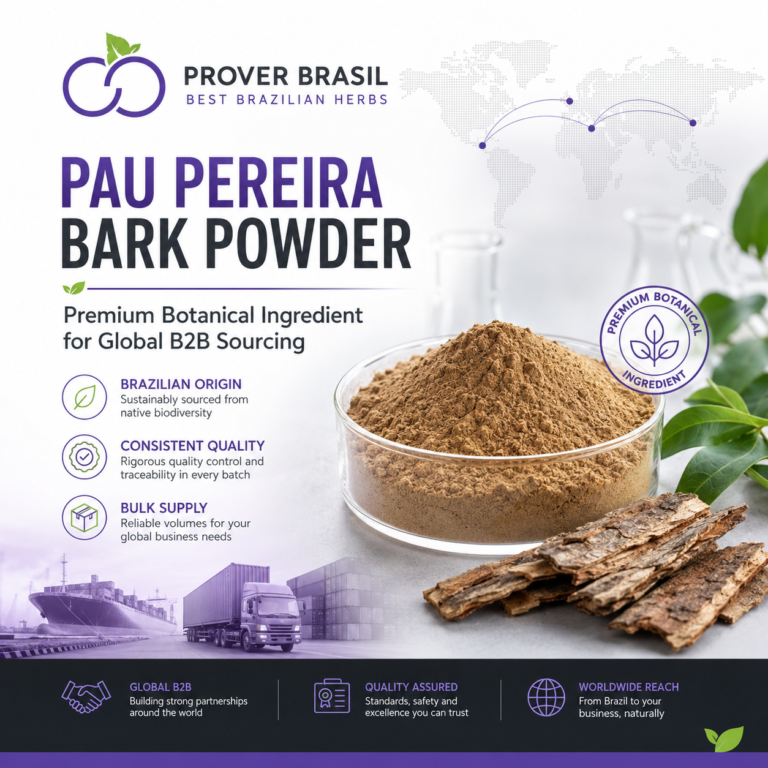
Pau Pereira Bark Powder is a distinctive botanical raw material associated with Brazil’s rich plant biodiversity and increasingly relevant to companies searching for differentiated natural ingredients for international commercial applications.
For importers, distributors, botanical ingredient companies, laboratories, formulators and businesses developing plant-based product lines, sourcing Pau Pereira requires much more than simply finding availability. Botanical identification, processing consistency, documentation, traceability, packaging and commercial reliability are essential factors when evaluating a supply partner.
Prover Brasil connects international buyers with carefully selected Brazilian botanical ingredients, supporting companies that value structured sourcing, professional communication and export-oriented service. Buyers looking for Brazilian botanical ingredients from Prover Brasil can access a diversified portfolio designed for international B2B opportunities.
Understanding the characteristics of Pau Pereira Bark Powder, its commercial potential and the criteria that should guide purchasing decisions is essential before incorporating this ingredient into a business strategy.
What Is Pau Pereira Bark Powder?
Pau Pereira Bark Powder is obtained from bark material that undergoes preparation, drying and milling until reaching a powdered form suitable for subsequent commercial or industrial processing, depending on the buyer’s intended application.
The name Pau Pereira has historically been associated with botanical species found in Brazil, including references within the Geissospermum genus. Because popular plant names can sometimes refer to different species depending on the region, botanical identification is particularly important in professional sourcing.
For this reason, companies purchasing Pau Pereira Bark Powder should not rely exclusively on the common name.
Documentation should clearly establish the botanical identification associated with the supplied material whenever this information is required for the intended market or application.
This level of attention becomes especially important for companies importing botanical ingredients across different jurisdictions, where documentation and product classification requirements can vary significantly.
Why Pau Pereira Bark Powder Attracts International Interest
Global demand for botanical ingredients continues to create opportunities for materials connected to distinctive plant origins and well-defined sourcing channels.
Companies developing natural ingredient portfolios are increasingly interested in ingredients that offer:
- recognizable botanical origin;
- differentiated positioning;
- consistent physical presentation;
- commercial scalability;
- documentation suitable for B2B transactions;
- reliable sourcing communication.
Pau Pereira Bark Powder can fit into this broader botanical ingredient market when supplied with professional standards and clear specifications.
Rather than approaching the material exclusively through traditional narratives, international businesses generally need practical information about identity, particle characteristics, moisture parameters, packaging, storage, documentation and commercial availability.
That is where specialized sourcing becomes relevant.
Pau Pereira Bark Powder for B2B Buyers
Commercial buyers have different priorities from individual consumers.
An importer considering Pau Pereira Bark Powder may need to understand whether the material is suitable for distribution in its target market. A laboratory may require specific technical information before evaluating the ingredient. A botanical company may need consistent batches for future development.
For these businesses, the purchasing process commonly involves questions about:
Botanical identification
The scientific identity associated with the material should be clearly understood before commercial use.
Common names are useful for market recognition but are not always sufficient for technical identification.
Powder characteristics
Particle size, visual appearance, natural color, aroma and other physical attributes can influence handling and processing.
Requirements may vary according to the intended use.
Documentation
International buyers may request technical or commercial documentation based on their internal quality procedures and destination-country requirements.
The required documentation should therefore be discussed before completing an order.
Packaging
Packaging must be appropriate for transportation, storage and preservation of the botanical material.
Different purchasing volumes can require different configurations.
Quantity
A company testing a botanical ingredient may have different purchasing requirements from an established distributor planning recurring shipments.
Commercial discussions should take expected volumes into consideration from the beginning.
Understanding the Botanical Identity of Pau Pereira
One of the most important aspects of botanical sourcing is correct identification.
Popular plant names can vary across Brazil and other countries. In some cases, the same common name may be associated with more than one plant.
Pau Pereira is a good example of why professional buyers should request precise information instead of relying only on commercial terminology.
Scientific literature has associated Pau Pereira with Geissospermum species, particularly Geissospermum laeve, with Geissospermum vellosii appearing historically as a related botanical designation.
However, other Brazilian plants have also been referred to by similar popular names.
For a B2B transaction, the practical lesson is straightforward: confirm the botanical identity of the material being quoted and supplied.
This protects both buyer and supplier from misunderstandings and helps companies maintain accurate internal records.
How Pau Pereira Bark Powder Is Prepared
Botanical powders require controlled preparation if they are to maintain predictable commercial characteristics.
The process begins with properly identified botanical material.
The bark is then prepared according to the processing specifications established for the ingredient.
Drying
Moisture management is an important stage because botanical raw materials naturally contain water.
Appropriate drying helps create material suitable for milling and subsequent storage.
Milling
Once sufficiently prepared, the bark can be milled into powder.
The desired granulation can depend on processing capabilities, customer requirements and the intended application.
A finer powder may behave differently during blending or manufacturing compared with a coarser botanical material.
Handling and packaging
After milling, careful handling helps protect the material from unnecessary exposure to moisture and contaminants.
Suitable packaging is therefore an important part of the commercial process.
Quality Considerations When Buying Pau Pereira Bark Powder
Selecting botanical ingredients requires more than comparing prices.
International buyers should consider the overall supply structure behind the material.
Several criteria are particularly relevant.
Consistency
Commercial clients usually expect future orders to maintain reasonably consistent characteristics.
Natural materials inevitably present some variation, but professional processing and specification control can help establish clearer purchasing expectations.
Traceability
Knowing the origin and identification of botanical materials is valuable throughout a supply chain.
Traceability contributes to better internal documentation and simplifies communication between suppliers, importers and commercial customers.
Documentation
Technical documentation allows companies to evaluate ingredients according to their own quality procedures.
Before purchasing, buyers should communicate which documentation their organization or market requires.
Storage conditions
Botanical powders should generally be protected from excessive humidity, heat and inappropriate environmental exposure.
Storage recommendations should be incorporated into inventory procedures after arrival.
Packaging integrity
International transportation can expose materials to extended handling periods.
Packaging must therefore be suitable for the type of ingredient and commercial journey involved.
Pau Pereira Bark Powder and the Natural Ingredients Market
The natural ingredients sector has evolved significantly.
Buyers increasingly require more than an interesting botanical story. They expect operational professionalism.
A successful botanical product portfolio depends on the ability to combine origin, quality criteria, documentation, logistical planning and commercial positioning.
Pau Pereira offers an opportunity for companies looking to expand a catalog of distinctive Brazilian botanicals.
Its value for a B2B buyer is therefore connected not only to the plant itself, but also to how effectively the ingredient can be incorporated into an existing commercial supply chain.
Applications and Product Development Considerations
The suitability of Pau Pereira Bark Powder for a specific application should always be evaluated by the company responsible for developing or marketing the final product.
Regulatory requirements can vary substantially between countries and product categories.
An ingredient acceptable for one industrial category or jurisdiction may require additional documentation, evaluation or authorization elsewhere.
For that reason, buyers should avoid assuming that botanical origin automatically determines permitted use.
Before launching a commercial project involving Pau Pereira Bark Powder, companies should evaluate:
- intended product category;
- destination market;
- applicable botanical regulations;
- labeling requirements;
- internal quality specifications;
- documentation requirements;
- formulation compatibility.
This approach reduces commercial risk and creates a more professional product-development process.
Regulatory Compliance for Botanical Ingredients
International botanical trade involves multiple regulatory environments.
Requirements in the United States may differ from those applicable in the European Union, Asia, Latin America or other markets.
Furthermore, classification can depend on the intended use of the ingredient.
A botanical material intended for cosmetics, research, manufacturing, industrial processing or another category may be regulated differently.
Therefore, international buyers remain responsible for verifying the legal and regulatory suitability of the ingredient for their intended application and destination.
A professional supplier should provide available product information transparently while avoiding unsupported claims about uses that depend on the buyer’s regulatory environment.
Avoiding Unsupported Health Claims
Pau Pereira has a long history of ethnobotanical interest and has been examined in scientific research.
However, historical use and preliminary research should not automatically be translated into commercial claims about treating, preventing or curing diseases.
This distinction is particularly important for companies operating internationally.
Claims that appear in historical literature may not be authorized for marketing finished products.
Responsible B2B communication therefore focuses on the identity, origin, characteristics and commercial quality of the botanical ingredient, while leaving medical or therapeutic determinations to properly established scientific and regulatory processes.
This approach protects brands, importers and distributors while contributing to a more credible botanical market.
Choosing a Reliable Pau Pereira Bark Powder Supplier
Supplier selection can have a significant impact on the success of an international botanical project.
A low quotation is rarely the only relevant factor.
Companies should also assess communication, responsiveness, documentation, botanical knowledge, export capability and the ability to discuss commercial requirements clearly.
Prover Brasil works with Brazilian botanical ingredients for international business opportunities, helping buyers evaluate products according to their purchasing and sourcing requirements.
Companies seeking to expand their natural ingredient catalog can explore botanical products available from Prover Brasil and identify other ingredients that may complement Pau Pereira Bark Powder within their portfolio.
Why Professional B2B Communication Matters
International ingredient transactions often involve several participants.
Procurement teams, quality departments, logistics providers, import specialists and product-development professionals may all require different information.
Miscommunication at an early stage can delay an entire project.
An organized quotation process should therefore establish important details such as:
Requested quantity
Purchase volume directly influences commercial and logistical planning.
Destination
Country and delivery location affect shipping arrangements and import considerations.
Required documentation
Documentation needs should be identified as early as possible.
Packaging expectations
The buyer should indicate relevant packaging or handling requirements when applicable.
Product specifications
Any critical characteristic required by the buyer should be discussed before the order is finalized.
Providing this information from the beginning helps suppliers prepare more accurate commercial proposals.
Pau Pereira Bark Powder for Importers and Distributors
Importers require ingredients that can integrate efficiently into their purchasing operations.
Their concerns frequently extend beyond the physical product.
Reliable communication, shipment coordination, documentation and predictable commercial procedures can be just as important as the botanical material itself.
Distributors may also need to understand how Pau Pereira Bark Powder fits within a broader catalog.
Brazilian botanicals can be positioned as part of a differentiated ingredient portfolio, particularly when buyers are searching for products with distinctive geographical and botanical origins.
A diversified catalog can also enable distributors to consolidate sourcing discussions around multiple ingredients.
Building a Brazilian Botanical Ingredients Portfolio
Pau Pereira Bark Powder does not necessarily need to be sourced as an isolated product.
Companies working with natural raw materials often develop broader portfolios that include roots, bark powders, fruit powders, plant extracts and other botanical ingredients.
Creating a more diversified Brazilian ingredient portfolio can provide several commercial advantages.
It allows buyers to explore multiple product opportunities within the same sourcing relationship and can make procurement planning more efficient.
For distributors, diversity also creates opportunities to serve different customer segments.
The key is to select ingredients based on market demand, technical feasibility and regulatory suitability rather than simply adding products without a defined strategy.
Packaging and International Logistics
Botanical powders require appropriate logistics planning.
Packaging needs to protect the ingredient during storage and transportation while remaining practical for commercial handling.
International shipping decisions may depend on:
- shipment volume;
- destination country;
- transportation method;
- packaging format;
- import procedures;
- buyer requirements.
Larger commercial orders should be planned in coordination with logistics and procurement teams.
Importers should also verify documentation and clearance requirements before shipment whenever possible.
This reduces the likelihood of unnecessary delays after the goods reach the destination country.
Storage of Pau Pereira Bark Powder
Correct storage contributes to preserving the physical characteristics of botanical powders.
Products should generally be maintained in suitable conditions according to the specifications and recommendations provided for the material.
Excessive humidity is particularly important to avoid when handling dry botanical powders.
Containers should remain properly closed, and inventory should be kept in an appropriate environment.
Companies receiving commercial quantities should also implement suitable stock rotation and internal traceability procedures.
What Information Should Buyers Request?
Before purchasing Pau Pereira Bark Powder, procurement teams should obtain enough information to evaluate whether the material meets their requirements.
Rather than relying solely on a product name and price, buyers can request relevant information about botanical identification, physical characteristics, packaging, available documentation, order quantities and commercial conditions.
When specific analytical parameters are required, those expectations should be communicated before the purchase.
Clear specifications reduce uncertainty for both parties.
Samples and Product Evaluation
Depending on commercial conditions and availability, companies developing a new botanical project may wish to evaluate material before progressing to larger purchases.
The evaluation process allows technical teams to examine relevant characteristics according to their internal criteria.
However, a sample should be considered part of a broader qualification process.
Future commercial orders must still follow the agreed specifications and documentation requirements.
Companies planning substantial or recurring demand should communicate their estimated volumes early so that sourcing discussions can consider longer-term requirements.
Why Brazilian Botanicals Stand Out in Global Markets
Brazil is internationally recognized for extraordinary biodiversity.
This creates substantial commercial interest in botanical ingredients associated with the country’s diverse ecosystems and traditional plant knowledge.
However, biodiversity alone is not enough to create a competitive ingredient.
International markets increasingly value professional sourcing, accurate botanical information, quality documentation and responsible commercial positioning.
Companies that combine these factors can transform botanical diversity into differentiated international business opportunities.
Pau Pereira Bark Powder fits naturally into this context as a distinctive ingredient for buyers researching Brazilian botanical materials.
Prover Brasil and International Botanical Sourcing
Prover Brasil serves companies seeking access to Brazilian natural ingredients through professional B2B communication.
The company’s approach is particularly relevant for importers, distributors and businesses that need structured information before making purchasing decisions.
Rather than treating botanical sourcing as a simple product transaction, the process considers the practical requirements involved in international business.
This includes product information, commercial quantities, destination, documentation expectations and logistics planning.
For international buyers, having a clear point of contact can significantly simplify the early stages of a botanical sourcing project.
Frequently Asked Questions About Pau Pereira Bark Powder
What is Pau Pereira Bark Powder?
Pau Pereira Bark Powder is a powdered botanical material obtained from prepared and milled bark associated with the plant commercially identified as Pau Pereira. Professional buyers should verify the scientific botanical identity associated with the specific material being offered.
What is the botanical name of Pau Pereira?
Scientific references frequently associate Pau Pereira with Geissospermum laeve, while Geissospermum vellosii also appears in historical botanical literature. Because common plant names can vary, buyers should confirm the botanical identification listed for the specific commercial material.
Can Pau Pereira Bark Powder be purchased in bulk?
Commercial availability depends on current sourcing conditions, specifications and requested quantities. B2B buyers should provide their estimated volume, destination and product requirements when requesting a quotation.
Who buys Pau Pereira Bark Powder?
Potential commercial buyers may include botanical ingredient distributors, importers, laboratories, research companies, natural-product businesses and organizations developing specialized plant-based portfolios.
Is Pau Pereira Bark Powder intended to treat diseases?
A botanical ingredient should not automatically be considered a treatment for any health condition. Although Pau Pereira appears in ethnobotanical and scientific literature, commercial claims must comply with applicable scientific evidence and regulations in the destination market.
What documents are available for Pau Pereira Bark Powder?
Available documentation can depend on the material, shipment and buyer requirements. Companies should specify the technical and regulatory documents needed when requesting commercial information.
Can Pau Pereira Bark Powder be exported internationally?
International supply depends on destination-country requirements, shipment conditions, product classification and applicable import rules. Buyers should verify local regulations before ordering.
How should Pau Pereira Bark Powder be stored?
Botanical powders should generally be stored according to product specifications in appropriate conditions, protected from excessive moisture, heat and unsuitable environmental exposure. Packaging should remain properly sealed during storage.
Can companies request specific product characteristics?
Companies with particular requirements should communicate their specifications during the quotation process. Feasibility can then be evaluated according to the material and commercial conditions.
Why source Pau Pereira through Prover Brasil?
Prover Brasil provides international buyers with access to Brazilian botanical ingredients supported by professional commercial communication and an export-oriented sourcing process designed for B2B transactions.
Conclusion
Pau Pereira Bark Powder represents an interesting opportunity for businesses looking to expand their portfolio with distinctive Brazilian botanical ingredients.
Successful sourcing, however, depends on much more than product availability.
Botanical identification, specification, documentation, processing characteristics, packaging, logistics and regulatory suitability should all be considered before an international purchase.
For importers, distributors and companies developing natural ingredient portfolios, working with a specialized Brazilian sourcing partner can make this process significantly more organized.
Prover Brasil combines access to Brazilian botanicals with professional support for international B2B buyers, helping companies evaluate ingredients according to their commercial requirements.
If your company is interested in Pau Pereira Bark Powder, bulk botanical ingredients or other natural materials from Brazil, contact Prover Brasil for product information and a commercial quotation.