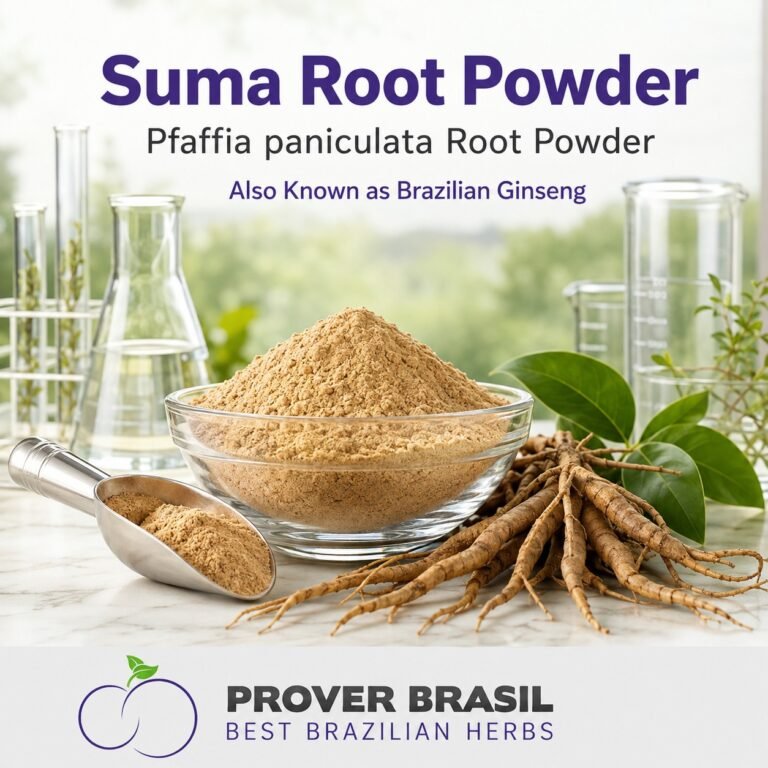
Suma Root Powder, Pfaffia paniculata Root Powder, and Brazilian Ginseng are names frequently used for the same botanical ingredient in international commercial searches. However, each term communicates a different aspect of the material: “Suma” is the established common name, Pfaffia paniculata identifies the botanical source, and “Brazilian Ginseng” reflects its popular market positioning.
This variety of names creates opportunities, but it also requires accuracy. Importers, distributors, formulation teams, and botanical ingredient buyers need to confirm the species, plant part, format, specifications, and documentation before approving any shipment.
Prover Brasil has operated from Belo Horizonte, Brazil, since 2001, serving international B2B buyers with herbs, superfoods, botanical extracts, and raw materials. Companies seeking Brazilian botanical ingredients for international wholesale sourcing can consult the available options and request information according to their destination and commercial requirements.
What Is Suma Root Powder?
Suma Root Powder is obtained from the dried and milled root commercially identified as Pfaffia paniculata, a botanical associated with South America and classified within the Amaranthaceae family.
The material generally has a natural beige-to-brown appearance and an earthy botanical profile. Color, aroma, particle size, and sensory characteristics may vary according to the root, processing method, harvest, moisture level, and batch specifications.
The ingredient is known internationally under several names, including:
- Suma Root Powder;
- Pfaffia paniculata Root Powder;
- Brazilian Ginseng Powder;
- Suma Powder;
- Suma Root;
- Brazilian Suma;
- Pfaffia Root Powder.
These expressions may help buyers locate the ingredient, but the botanical name and plant part should remain the primary references during technical evaluation.
Why botanical identity matters
Common names are not always exclusive to one species. Similar expressions may be applied to different botanicals depending on the country, commercial tradition, or catalog.
The name Pfaffia paniculata (Mart.) Kuntze is documented by Kew Science’s Plants of the World Online, which also illustrates why botanical taxonomy may require careful interpretation across technical databases.
For commercial approval, buyers should not rely only on the phrase “Brazilian Ginseng.” Documentation should clearly identify the botanical, root as the plant part, ingredient format, batch, and analytical specifications.
Are Suma Root Powder and Brazilian Ginseng the Same Ingredient?
In common commercial usage, Suma Root Powder, Pfaffia paniculata Root Powder, and Brazilian Ginseng often refer to the same root-based ingredient.
However, “Brazilian Ginseng” is a popular name rather than proof of botanical identity. The expression can create confusion because other plants may be presented under similar wording.
The safest approach is to treat the three terms as related search expressions while confirming the exact material through documentation.
A commercial specification should answer several basic questions:
- What is the declared botanical name?
- Which plant part is used?
- Is the material a milled root or an extract?
- What is the country of origin?
- What particle size is supplied?
- Which quality parameters are tested?
- What packaging and storage conditions apply?
- Which documents accompany the batch?
This process protects formulation consistency and helps prevent substitution between materials that may appear similar but possess different technical profiles.
Brazilian Ginseng Is Not Panax Ginseng
Despite the popular name, Suma does not belong to the same botanical genus as Asian ginseng or American ginseng.
Asian ginseng is generally identified as Panax ginseng, while American ginseng is known as Panax quinquefolius. Suma is commercially associated with Pfaffia paniculata and belongs to a different botanical family.
The word “ginseng” should therefore be understood as part of a common market name, not as evidence that the ingredients are botanically interchangeable.
This distinction is important for:
- technical specifications;
- ingredient declarations;
- regulatory submissions;
- customs documentation;
- scientific communication;
- finished-product labels;
- marketing content.
A formulation developed with Panax ginseng should not automatically replace that ingredient with Suma Root Powder. The reverse is equally true. Any substitution requires a new technical, sensory, regulatory, and formulation assessment.
Suma Root Powder | 5 Essential Benefits for Global Buyers
Suma Root Powder (Pfaffia paniculata), also known commercially as Brazilian Ginseng, offers practical advantages for international importers, wholesalers, distributors, and companies developing botanical ingredient portfolios.
Beyond its Brazilian origin, Suma Root Powder provides opportunities for ingredient sourcing, product development, and specialized botanical applications.
1. Versatile Botanical Ingredient
Suma Root Powder can be evaluated for herbal blends, botanical preparations, powdered ingredient mixtures, and specialized formulations. Its suitability depends on product specifications, safety assessments, and the regulations of each destination market.
2. Convenient Powder Format for Industrial Applications
The powdered form facilitates weighing, handling, blending, and incorporation into suitable manufacturing processes. International buyers can evaluate particle size, moisture content, packaging, and other technical characteristics according to their production requirements.
3. Distinctive Brazilian Botanical Origin
Suma Root Powder is associated with South American botanical diversity and offers international companies an opportunity to source a distinctive Brazilian plant ingredient.
Botanical identity and traceability are important considerations when evaluating raw materials for international trade.
4. Opportunities for Bulk Purchasing and Distribution
Suma Root Powder may be considered by importers, wholesalers, and botanical ingredient distributors seeking commercial quantities for their supply chains.
Professional buyers should confirm available quantities, packaging options, technical documentation, and shipping arrangements before placing orders.
5. Potential for Botanical Product Development
Suma Root Powder can be evaluated by formulation teams, botanical ingredient companies, and research departments exploring plant-based raw materials.
Its commercial potential includes applications in suitable herbal preparations and specialized botanical product lines, subject to technical validation and applicable regulatory requirements.
Source Suma Root Powder from Brazil
For international buyers, selecting a reliable sourcing partner involves more than identifying an available ingredient. Botanical identification, processing characteristics, documentation, packaging, and commercial communication all contribute to successful purchasing decisions.
Prover Brasil for Export Ltda. supports international companies interested in Brazilian botanical ingredients, including Suma Root Powder (Pfaffia paniculata).
Contact Prover Brasil to discuss product specifications, commercial quantities, packaging requirements, and export quotations.
Exporter: Prover Brasil for Export Ltda.
Website: https://www.proverbrasil.com.br
Why Suma Root Powder Attracts International Interest
Suma has a distinctive Brazilian botanical identity and a recognizable story within the global natural ingredients sector.
Its appeal is linked to the combination of regional origin, established common names, powdered-root format, and versatility across different botanical concepts. For commercial teams, this can support differentiated product positioning without depending on exaggerated claims.
Recognizable Brazilian origin
Brazil has strong international recognition for its biodiversity, Amazonian ingredients, tropical fruits, herbs, roots, and botanical traditions.
Suma Root Powder fits naturally within portfolios that emphasize Brazilian origin, South American botanicals, plant-based ingredients, and internationally sourced herbal materials.
Origin alone, however, does not determine quality. Identity, cleanliness, batch control, analytical testing, documentation, storage, and logistics remain essential.
Flexible powdered-root format
A root powder can be evaluated for use in dry formulations, botanical blends, capsules, tablets, powdered beverages, and other applications permitted in the destination market.
Its practical value depends on characteristics such as particle size, flow, density, moisture, flavor, color, and compatibility with other ingredients.
Commercial storytelling without unsupported promises
Suma may be positioned through its botanical identity, root format, Brazilian origin, traditional market recognition, and formulation versatility.
These elements offer a strong commercial narrative without claiming that the ingredient treats, prevents, or cures medical conditions.
Suma Root Powder Versus Suma Root Extract
Root powder and root extract are not the same material.
Suma Root Powder generally refers to dried root that has been milled to a defined particle size. It retains the broader physical matrix of the botanical material and normally has the characteristic color and flavor of the root.
A Suma Root Extract undergoes an extraction process intended to concentrate selected soluble components. Its ratio, carrier, solvent system, analytical profile, color, solubility, and recommended use may differ significantly from those of the original powder.
Why they should not be substituted automatically
Replacing a root powder with an extract on a one-to-one basis can alter:
- concentration;
- sensory profile;
- serving calculations;
- bulk density;
- flow characteristics;
- solubility;
- finished-product color;
- regulatory classification;
- label declarations;
- total formulation cost.
Buyers should confirm whether their project requires a traditional powdered root or a concentrated extract before requesting a quotation.
Potential Commercial Applications
The suitability of Suma Root Powder depends on local regulations, formulation objectives, processing conditions, and the desired consumer experience.
Capsules and tablets
Powdered botanicals are commonly evaluated for capsule and tablet concepts. In these applications, particle size, flow, density, compression behavior, moisture, and compatibility with other materials deserve particular attention.
A formulation team may need excipients or additional processing to achieve consistent filling or compression.
Botanical powder blends
Suma can be considered for multi-ingredient botanical concepts where its Brazilian identity complements other roots, fruits, herbs, or plant-based materials.
The finished blend should be assessed for flavor balance, color uniformity, flow, stability, and label compliance.
Powdered drink concepts
The earthy profile of a root powder can create flavor challenges in beverages. Cocoa, spices, fruits, or other compatible ingredients may help create a more balanced sensory experience.
Dispersibility should be tested in the intended liquid. A powdered root should not be assumed to dissolve like a clarified or water-soluble ingredient.
Functional food concepts
Depending on the legal status of the ingredient in the destination market, Suma Root Powder may be evaluated for selected food or nutrition concepts.
Regulatory acceptance must be confirmed before formulation, importation, labeling, advertising, or sale.
Herbal combinations
Botanical companies may consider Suma within formulas built around Brazilian heritage or diverse plant ingredients.
Each component should be evaluated individually and as part of the complete blend, particularly when the finished product combines several botanicals with different regulatory or safety considerations.
Practical Formulation Examples
A capsule concept may prioritize a fine, consistent particle size and controlled moisture to support repeatable filling. The buyer should still conduct flow and compatibility tests using the actual formulation.
A powdered beverage may require sensory masking because roots can contribute earthy or bitter notes. Bench trials help determine whether the ingredient works with cocoa, fruit, spice, or other flavor systems.
A Brazilian botanical blend may combine Suma with ingredients selected for origin, color, flavor, or market positioning. The final wording should describe the composition accurately without extending traditional associations into unapproved health claims.
These examples illustrate practical development directions. They do not guarantee technical compatibility or regulatory authorization.
Quality Criteria for Suma Root Powder
A professional purchasing decision should consider more than appearance or price.
Botanical name and plant part
The documentation should clearly state the botanical identity and confirm that the supplied material is derived from the root.
Physical specifications
Useful parameters may include:
- appearance;
- color;
- odor;
- taste;
- particle size;
- moisture;
- bulk density;
- foreign-matter limits.
The required parameters depend on the intended application and the buyer’s internal quality system.
Microbiological profile
Botanical powders should be evaluated against microbiological criteria appropriate to the intended use and destination.
The exact testing panel and limits should be agreed upon before commercial approval.
Contaminant controls
Depending on the market and product category, buyers may request information concerning heavy metals, pesticide residues, mycotoxins, residual solvents, allergens, or other relevant contaminants.
Not every analytical panel is automatically included with every material. Required tests should be discussed during the quotation and technical review.
Batch documentation
Documents may include a specification sheet, Certificate of Analysis, commercial invoice, packing list, origin information, and logistics paperwork required for the destination.
Availability and format should be confirmed for the specific order.
Packaging and storage
Packaging must protect the powder against moisture, contamination, odor transfer, and unnecessary exposure during storage and transportation.
After receipt, the material should remain sealed and stored according to the documented conditions. Warehouse temperature, humidity, handling practices, and stock rotation can influence stability.
How to Evaluate a Commercial Sample
A representative sample allows technical teams to examine the ingredient before approving a larger order.
The evaluation should reproduce the intended application whenever possible. Looking at the powder alone does not reveal how it will behave in a capsule, tablet, blend, beverage, or food matrix.
A structured sample review may include:
- confirmation of identity and documentation;
- visual and sensory examination;
- moisture and particle-size review;
- formulation compatibility testing;
- stability observations;
- packaging evaluation;
- regulatory assessment;
- comparison against the approved specification.
Once the material is approved, purchasing teams should ensure that subsequent batches continue to meet the agreed parameters.
International Regulatory Considerations
The legal status of Suma Root Powder can vary by country, application, serving format, and finished-product category.
A botanical accepted in one market may require additional review, notification, registration, or documentation in another. Rules for foods, supplements, beverages, cosmetics, traditional herbal products, and animal products can be different.
Before placing an order, the buyer should verify:
- whether the ingredient is permitted for the intended use;
- whether any maximum level or restriction applies;
- how the botanical must appear on the label;
- whether the common name is acceptable;
- which warnings may be required;
- which claims are permitted;
- whether import authorization is necessary;
- which analytical documents customs or authorities may request.
Prover Brasil can provide available commercial and technical information related to the supplied material. Final legal approval remains the responsibility of the importer and the company placing the finished product on the destination market.
Responsible Communication About Suma
Scientific interest in Pfaffia paniculata does not automatically authorize health claims.
Laboratory, animal, traditional-use, or preliminary research should not be presented as proof that a finished consumer product delivers a clinical result. Claims concerning disease prevention, treatment, hormones, immunity, sexual performance, physical performance, stress, or other health outcomes require appropriate evidence and legal authorization.
A responsible commercial description can focus on:
- botanical identity;
- Brazilian origin;
- powdered-root format;
- sensory characteristics;
- formulation possibilities;
- quality specifications;
- documented B2B supply;
- packaging and international logistics.
This approach supports credibility and reduces regulatory risk.
Sourcing Brazilian Botanical Ingredients with Prover Brasil
Prover Brasil has worked with international B2B supply since 2001. Based in Belo Horizonte, the company serves buyers seeking Brazilian herbs, superfoods, botanical extracts, and related raw materials for wholesale orders.
The Prover Brasil catalog of Brazilian herbs, superfoods, and botanical extracts allows commercial buyers to explore different ingredient categories and request a quotation according to their required specifications.
For a Suma Root Powder inquiry, it is helpful to provide:
- destination country;
- expected quantity;
- required ingredient format;
- target particle size, if applicable;
- packaging requirements;
- required analytical documents;
- preferred shipping method;
- destination port or airport;
- expected purchasing schedule.
Detailed inquiries allow the commercial team to verify availability, documentation, freight options, and quotation conditions more efficiently.
Frequently Asked Questions About Suma Root Powder, Pfaffia paniculata Root Powder, and Brazilian Ginseng
What is Suma Root Powder?
It is a powdered botanical root commercially associated with Pfaffia paniculata. It is also widely searched under the common name Brazilian Ginseng.
Are Suma Root Powder and Pfaffia paniculata Root Powder the same?
They are commonly used as equivalent commercial expressions. Buyers should still confirm the botanical identity, plant part, format, and batch documentation.
Is Brazilian Ginseng the same as Asian ginseng?
No. Suma is not Panax ginseng. “Brazilian Ginseng” is a popular name and should not be interpreted as botanical equivalence with plants in the Panax genus.
Is Suma Root Powder the same as an extract?
No. Root powder is generally dried and milled botanical material. An extract undergoes an additional process and may have a different concentration, composition, carrier, solubility, and technical specification.
What does Suma Root Powder taste like?
It generally has an earthy botanical profile. The exact flavor, aroma, and color may vary by batch and processing conditions.
Can it be used in beverages?
It may be evaluated for powdered beverage concepts where legally permitted. Formulation teams should test dispersibility, sedimentation, flavor, color, stability, and compatibility with other ingredients.
Can Suma Root Powder be used in capsules?
It may be considered for capsule concepts, subject to regulatory approval and technical testing. Particle size, flow, density, moisture, and serving calculations should be evaluated.
Does Suma Root Powder dissolve completely in water?
A milled root powder should not automatically be expected to dissolve completely. Dispersibility and sedimentation need to be tested in the intended application.
What documentation should buyers request?
Depending on the order and destination, buyers may request a specification sheet, Certificate of Analysis, origin information, commercial documents, and relevant analytical reports.
Can health claims be made for Brazilian Ginseng?
Only claims permitted by the destination market and supported by appropriate evidence should be used. Traditional reputation or preliminary research does not automatically authorize a claim.
How should the ingredient be stored?
The material should remain sealed and be stored according to the documented conditions, generally in a clean, dry environment protected from excessive heat, moisture, direct light, and strong odors.
Does Prover Brasil ship internationally?
Prover Brasil serves international B2B buyers and organizes commercial quotations according to destination, quantity, documentation, and freight requirements. Specific conditions should be confirmed directly with the commercial team.
Conclusion
Suma Root Powder, Pfaffia paniculata Root Powder, and Brazilian Ginseng are closely connected commercial terms, but professional purchasing begins with precise botanical identification.
The common name may support market recognition, while the scientific name, plant part, ingredient format, specifications, and batch documents provide the technical foundation required for responsible trade and formulation.
Suma offers an attractive Brazilian botanical story and versatile powdered-root format. Its commercial value is strongest when supported by accurate descriptions, realistic applications, quality controls, regulatory review, and responsible communication.
Prover Brasil combines long-standing international B2B experience with a diversified portfolio of Brazilian herbs, superfoods, and botanical ingredients. To discuss availability, documentation, quantities, packaging, or freight, contact Prover Brasil and request a commercial quotation for Suma Root Powder.