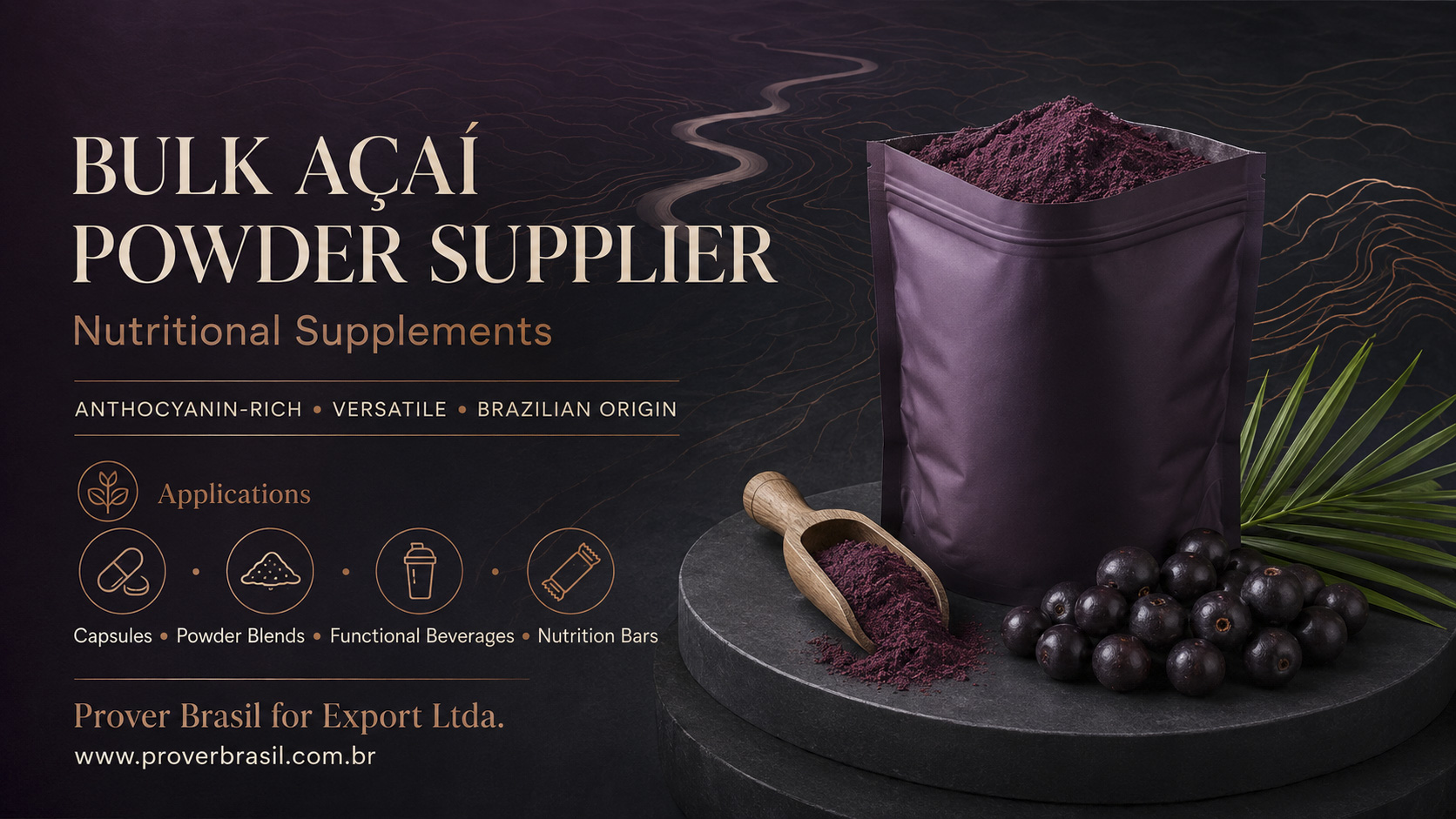
Acai Powder for Product Development: From Purple Identity to Finished Formulation
For product developers, Acai Powder is more than a recognizable Brazilian fruit ingredient. It is a formulation component that can influence color, flavor, powder handling, visual identity and the overall consumer experience.
Derived from the fruit of Euterpe oleracea Mart., acai has become familiar in global markets through smoothie bowls and fruit beverages. However, its industrial potential extends well beyond these established categories.
The most effective commercial use of Acai Powder begins with a practical question: what role should the ingredient perform in the finished product?
In some formulations, acai provides the central flavor identity. In others, it contributes a dark fruit note, reinforces a purple visual profile or supports a broader Brazilian ingredient story. Defining this role before development helps formulation teams select the appropriate inclusion level, complementary ingredients and processing conditions.
Understanding Acai Powder as a Formulation Ingredient
Acai has a flavor profile that differs from many conventional berries. Rather than being intensely sweet or sharply acidic, it can present earthy, subtly fruity and slightly cocoa-like notes, depending on the raw material, processing method and formulation.
This distinction creates interesting opportunities for companies seeking products that do not taste like conventional strawberry, raspberry or blueberry blends.
Spray drying converts liquid acai material into a more practical powdered format. Because fruit solids can be difficult to dry independently, carrier ingredients may be used during processing. Their type and proportion can influence:
- Dispersibility;
- Hygroscopicity;
- Powder flow;
- Color intensity;
- Flavor delivery;
- Bulk density;
- Storage behavior.
Consequently, formulators should evaluate the complete technical specification instead of selecting an ingredient based only on the product name or concentration statement.
Picture: Processing Acai Powder 4:1 (spray dried)

Why the Technical Specification Matters
Two Acai Powder samples can behave differently even when their commercial descriptions appear similar.
Before approving a material, buyers should review available documentation for information such as:
- Botanical identity;
- Fruit-to-powder concentration;
- Processing method;
- Carrier composition;
- Moisture level;
- Particle-size range;
- Microbiological parameters;
- Color and sensory characteristics;
- Recommended storage conditions;
- Shelf life;
- Packaging format.
A Certificate of Analysis provides batch-specific results, while a specification sheet defines the parameters expected for the product. Both documents are useful during supplier qualification and formulation testing.
Designing Products Around Acai’s Natural Color
The dark purple appearance of acai is connected to its anthocyanin profile. Research has identified cyanidin derivatives among the pigments present in the fruit.
From a development perspective, this color can be a valuable part of a product’s identity. Nevertheless, anthocyanins are sensitive compounds. Their stability can be influenced by temperature, water activity, oxygen, light, pH and storage time.
Research on spray-dried acai has shown that temperature and water activity can affect anthocyanin stability. This makes packaging and storage conditions relevant not only to shelf life but also to the visual consistency of the finished product.
Formulation Factors That Can Affect Purple Color
Product developers should examine the following variables during pilot testing:
- pH: Acidic environments may produce a brighter red-purple appearance, while other conditions can shift or weaken the color.
- Heat exposure: Extended heating may reduce pigment intensity.
- Light: Transparent packaging can expose the product to conditions that accelerate color changes.
- Oxygen: Headspace and packaging permeability can influence oxidative reactions.
- Water activity: Moisture management is particularly important in dry mixes and powdered supplements.
- Other ingredients: Minerals, proteins, botanical extracts and acidity regulators may alter the final shade.
Acai Powder should therefore be tested inside the complete formulation. A powder’s appearance before use does not necessarily predict its color after hydration, processing or storage.
Building a Balanced Acai Flavor Profile
Acai does not need to work alone. Its less-sweet sensory profile makes it suitable for layered combinations in which different ingredients perform specific functions.
Fruit Pairings
Banana can add body and sweetness, while berry ingredients can strengthen familiar fruit notes. Mango or passion fruit may introduce brighter tropical acidity. Cocoa can complement acai’s deeper flavor characteristics.
Botanical Pairings
Acai can also be evaluated alongside Brazilian botanical ingredients when the concept calls for a more distinctive regional identity. However, bitterness, astringency and naturally occurring stimulant compounds must be considered when applicable.
Texture and Mouthfeel
The perceived richness of an acai formulation depends partly on its base. Proteins, fibers, gums and plant-based beverage ingredients can change how the fruit notes are experienced.
A small bench trial should therefore evaluate more than flavor alone. Color, aroma, mouthfeel, aftertaste and dispersibility should be recorded together.
Commercial Applications for Acai Powder
The value of Acai Powder comes from its ability to serve several product-development strategies.
Instant Beverage and Smoothie Mixes
In dry beverage systems, acai can provide fruit identity and visual differentiation. Developers should evaluate sedimentation, foam formation, dissolution time and color after hydration.
Agglomeration or the use of complementary soluble ingredients may improve dispersion, depending on the formulation.
Powdered Nutrition Blends
Acai can be incorporated into multi-ingredient blends containing plant proteins, carbohydrates, fibers, minerals or other fruit powders.
Because minerals and proteins may influence flavor and color, compatibility tests are essential. The development team should also verify whether the powder remains evenly distributed during filling and transport.
Snack Bars and Fruit-Based Products
Acai can support the positioning of cereal bars, fruit preparations, filled snacks and compact nutrition formats.
Its flavor may combine particularly well with cocoa, nuts, seeds and other dark-fruit ingredients. Developers should assess whether moisture migration changes the color or sensory profile during storage.
Capsules and Tablets
For solid-dose applications, the relevant properties include particle size, powder flow, compressibility and compatibility with the rest of the formulation.
Published research has examined the preparation of tablets containing dried acai extract, demonstrating that technological properties are an important part of development—not merely the fruit’s chemical composition.
Bakery and Confectionery Concepts
Acai can be evaluated in fillings, coatings, cereal clusters and selected baked products. However, heat exposure can alter pigments and flavor.
For products subjected to elevated temperatures, the preferred inclusion point and processing duration should be determined through trials.
Beauty-from-Within and Lifestyle Products
Acai’s Brazilian origin, color and consumer recognition can support lifestyle-oriented product concepts. Any nutritional or functional statement must be supported by the finished product’s composition and comply with the regulations of the destination market.
Benefits of Acai Powder for Product Developers
The principal commercial benefits should be described responsibly and separately from unproven medical promises.
Recognizable Brazilian Ingredient
Acai has an established connection with Brazil and offers a clear geographical story for international product concepts.
Distinctive Visual Character
Its dark purple profile can help products stand apart from conventional citrus, tropical-yellow and green botanical formulations.
Flexible Product Positioning
Acai can appear as the central ingredient or as part of a wider fruit, nutrition or Brazilian botanical blend.
Compatibility With Multiple Formats
The powder format can be evaluated in beverages, foods, dry blends, tablets, capsules and snack applications.
Documented Phytochemical Interest
Scientific investigations have reported polyphenols and anthocyanins in acai preparations. However, exact levels vary with fruit origin, processing, formulation and storage. Laboratory results for a particular ingredient should not be assumed without batch-specific analysis.
A Practical Acai Powder Development Protocol
Before commercial scale-up, development teams can follow a structured evaluation process.
Step 1: Define the Ingredient’s Function
Decide whether acai will provide the primary flavor, secondary flavor, color contribution or regional product identity.
Step 2: Establish a Starting Inclusion Range
Test several inclusion levels instead of relying on one formula. The ideal amount depends on the base, sweetness, acidity and desired color intensity.
Step 3: Prepare a Control Sample
Create a version without Acai Powder. A control makes it easier to understand the ingredient’s actual contribution to flavor, color and texture.
Step 4: Evaluate Immediate Performance
Record:
- Dispersion time;
- Visible sediment;
- Aroma;
- Color;
- Sweetness balance;
- Acidity;
- Mouthfeel;
- Aftertaste.
Step 5: Conduct Stability Testing
Observe the product under appropriate storage conditions. Color, aroma, texture, moisture behavior and microbiological stability may change over time.
Step 6: Repeat the Trial With Production Equipment
Laboratory performance does not always predict industrial behavior. Mixing energy, heating time, filling operations and packaging can change the finished result.
Quality Questions to Ask Before Purchasing Acai Powder
Commercial buyers can improve supplier discussions by asking precise technical questions:
- What is the botanical identity of the raw material?
- Which part of the fruit is used?
- How is the concentration defined?
- What drying process is applied?
- Does the formula contain a carrier ingredient?
- Which microbiological parameters are tested?
- Is batch-specific analysis available?
- What packaging protects the powder from moisture and light?
- What storage conditions are recommended?
- Can a sample be evaluated before a commercial order?
These questions help connect purchasing decisions with the needs of research, quality control, regulatory and production teams.
What Scientific Research Says About Acai
Research has examined the fruit’s nutrient profile, phytochemical composition, pigments and antioxidant activity. Studies have also investigated biological effects in humans, but the evidence should be interpreted carefully.
Some human trials used acai pulp rather than the exact commercial powder included in a finished product. Results from pulp, extracts, laboratory experiments or specific research preparations cannot automatically be transferred to every Acai Powder.
For commercial communication, it is more accurate to state that acai contains researched plant compounds than to claim that a finished product prevents, treats or cures a medical condition.
Frequently Asked Questions About Acai Powder
Is every Acai Powder commercially identical?
No. Processing conditions, concentration, carrier system, moisture, fruit composition and particle characteristics may vary. Buyers should compare specifications and samples.
Can Acai Powder provide color to a finished product?
It can contribute a purple or reddish-purple appearance, but the final result depends on the inclusion rate, pH, processing conditions and other ingredients.
Is Acai Powder soluble in water?
Performance varies by product and formulation. Some powders disperse more readily than others, and a completely clear solution should not be expected from every fruit-based ingredient. Bench testing is recommended.
Which industries can evaluate Acai Powder?
Relevant sectors include food, beverages, powdered nutrition, supplements, snacks, confectionery and selected lifestyle formulations.
Does Acai Powder have a naturally sweet flavor?
Acai is generally less sweet than many familiar berries. Depending on the application, developers may combine it with fruits, sweeteners or flavor components.
How should Acai Powder be stored?
It should generally be kept sealed in a cool, dry place and protected from moisture, heat and direct light. The supplier’s specification and label instructions should always be followed.
Brazilian Acai Powder for International Product Development
A successful acai product is not created simply by adding purple powder to an existing formula. It results from understanding the ingredient’s technical characteristics and testing how it interacts with the complete product system.
Prover Brasil for Export Ltda. supplies Brazilian Acai Powder for international B2B customers. Importers, distributors and product-development teams can request commercial information, available specifications, packaging details and quotation conditions.
Contact Prover Brasil for Export Ltda. to discuss Acai Powder for your next food, beverage or supplement development project.
Suggested Internal Links
Use approximately 3 to 5 internal links in this article. Avoid linking the same phrase repeatedly.
- Anchor: Brazilian Acai Powder product information
URL: Acai Berry Products
- Anchor: Brazilian botanical ingredients
URL: Products
- Anchor: learn about Prover Brasil
URL: https://proverbrasil.com.br/about-us/
Confirm the exact URL before publishing.
- Anchor: request Acai Powder specifications
URL: https://proverbrasil.com.br/contact/
Confirm the exact contact-page URL before publishing.
- Anchor: Acai Powder procurement guide
URL: Bulk Acai Powder Procurement Guide
Do not link to numerous competing açaí posts from the same article. Two product-related links plus one company and one contact link are sufficient.
Scientific References
- Schauss AG et al. Phytochemical and nutrient composition of the freeze-dried Amazonian palm berry, Euterpe oleracea Mart. Journal of Agricultural and Food Chemistry, 2006. PubMed
- Schauss AG et al. Antioxidant capacity and other bioactivities of the freeze-dried Amazonian palm berry. Journal of Agricultural and Food Chemistry, 2006. PubMed
- Tonon RV, Brabet C, Hubinger MD. Anthocyanin stability and antioxidant activity of spray-dried acai juice produced with different carrier agents. Food Research International, 2010. ScienceDirect
- Tonon RV, Brabet C, Hubinger MD. Influence of process conditions on the physicochemical properties of acai powder produced by spray drying. Journal of Food Engineering, 2008. ScienceDirect
- Arellano LF et al. Tablets containing açaí dried extract for dietary supplementation: a study of functional properties. Food Science and Technology, 2024. Full study PDF
- Aranha LN et al. Effects of a hypoenergetic diet associated with açaí pulp consumption on antioxidant status, oxidative stress and inflammatory biomarkers. Clinical Nutrition, 2020. PubMed