

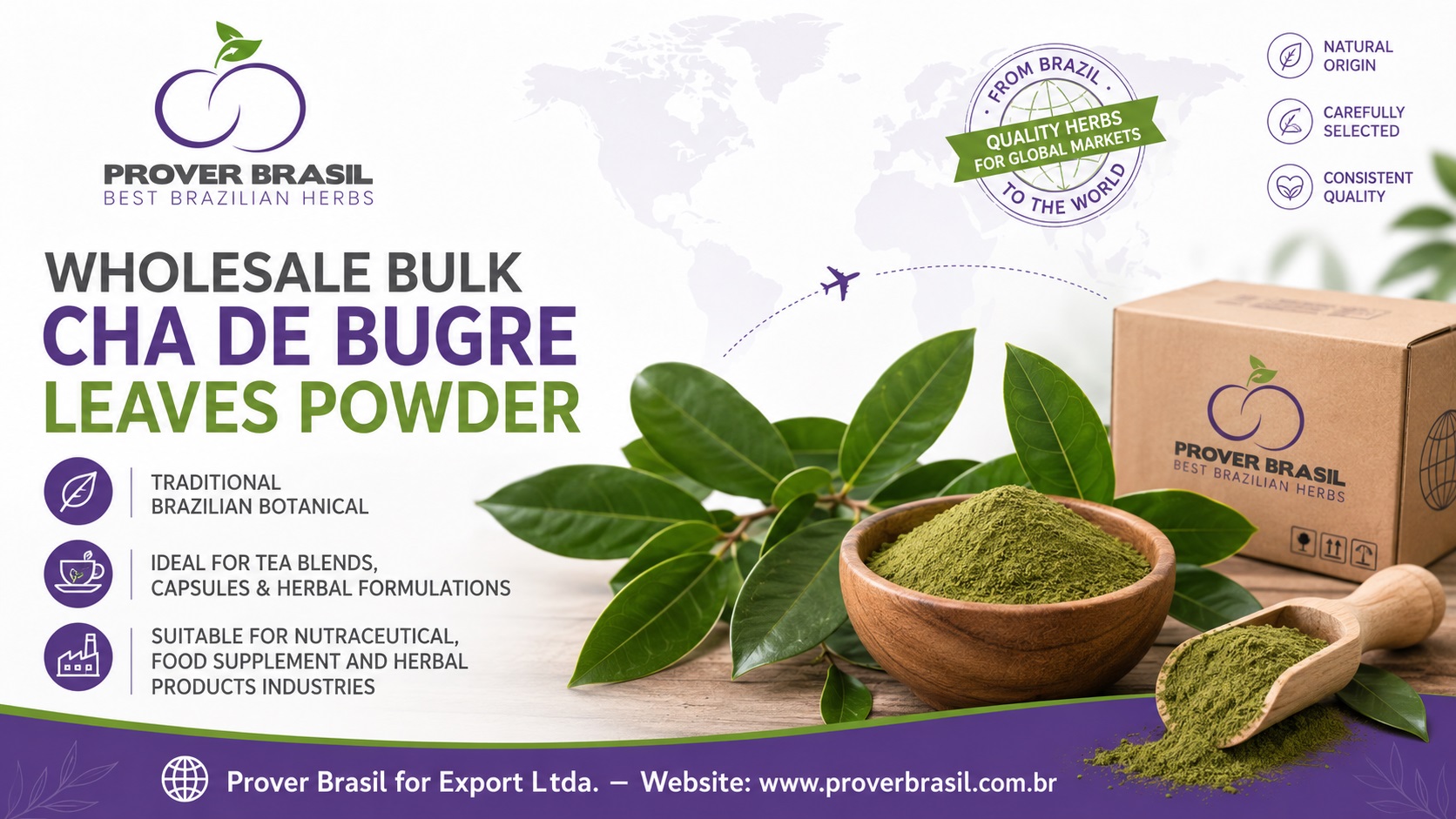
Known locally as Cha de Bugre and Porangaba, the botanical supplied by Prover Brasil for Export Ltda. is identified as Cordia salicifolia Cham. The leaves are dried and milled to create a botanical powder suitable for professional evaluation in a variety of product-development projects.
However, professional sourcing requires much more than simply finding a botanical name and requesting a price per kilogram.
For international buyers, important questions include botanical identity, plant part, particle size, sensory characteristics, moisture, microbiological parameters, contaminant controls, packaging, storage and compatibility with the intended finished product.
This guide explains how buyers can evaluate Cha de Bugre Leaves Powder from a commercial and formulation perspective.
Cha de Bugre Leaves Powder is produced from dried and milled leaves of Cordia salicifolia Cham.
Unlike a concentrated botanical extract, the leaf powder maintains the physical characteristics of ground botanical material. Therefore, formulators should expect its behavior in blending, filtration and dispersion to differ from that of a concentrated extract.
The product supplied by Prover Brasil is intended for international B2B buyers evaluating Brazilian botanical ingredients for permitted commercial applications.
Buyers interested in comparing available formats can also visit the Prover Brasil Cha de Bugre product page and review the company’s broader Brazilian botanical ingredient catalog.
Cha de Bugre Products – Prover Brasil
Brazilian Botanical Ingredients Catalog
The commercial value of Wholesale Bulk Cha de Bugre Leaves Powder should be considered primarily from an ingredient and product-development perspective.
Potential advantages include:
The most appropriate application depends on the specifications of the supplied batch and the regulations of the destination market.
Cha de Bugre has a history of use in Brazilian herbal preparations.
The powdered leaf can therefore be evaluated for filtered botanical beverages and multi-herb infusion concepts.
Particle size deserves special attention. A very fine powder may behave differently inside a filter compared with a larger botanical particle.
Product developers should test filtration, sediment formation, flavor intensity, aroma and final appearance before selecting a commercial formulation.
Cha de Bugre leaf powder may also be assessed for powdered botanical blends and capsule concepts where its use is permitted.
Important technical factors include:
A pilot batch is preferable before moving to commercial quantities.
Ingredient distributors can include Cha de Bugre among specialized Brazilian botanical products intended for professional customers searching for less-common South American plant ingredients.
In this market, clear botanical identification and supporting technical documentation can be more valuable than unsupported promotional claims.
Formulation teams may explore Cha de Bugre powder in complex botanical beverage concepts.
However, developers need to evaluate whether the finished beverage should be filtered or whether visible botanical sediment is acceptable.
Flavor masking, suspension behavior and storage stability should also be tested.
Research teams can use the powdered leaves when evaluating botanical combinations, sensory characteristics, extraction systems, filtration behavior or new commercial concepts.
Research use is particularly relevant because the scientific literature on Cha de Bugre remains limited and should be interpreted carefully.
For a professional buyer, a botanical powder has value when it fits the technical requirements of the planned product.
Cha de Bugre Leaves Powder can provide several formulation-oriented benefits.
Cha de Bugre is strongly associated with Brazilian herbal traditions. This gives companies an opportunity to develop products or ingredient portfolios around a less-common Brazilian botanical.
Companies specifically looking for ground botanical material may prefer leaves powder rather than a concentrated extract.
This distinction matters in tea development, botanical blends and products where the physical presence of the plant material is part of the concept.
The leaf powder can be evaluated alongside complementary botanical ingredients to develop distinctive flavor, aroma and positioning.
The same raw material can be assessed in filtered beverages, dry botanical mixtures, capsules and laboratory-scale formulations, subject to applicable rules.
Price should never be the only criterion used when sourcing a botanical ingredient internationally.
Before placing a commercial order for Wholesale Bulk Cha de Bugre Leaves Powder, purchasing teams should verify the specification carefully.
Confirm the botanical identification stated on the commercial documents.
For Prover Brasil’s product, the botanical name is Cordia salicifolia Cham.
Common names alone should not replace botanical identification because different plants can sometimes circulate under similar traditional names.
Confirm that the ingredient consists of the intended leaf material.
The plant part can significantly influence composition, appearance and formulation behavior.
Particle size affects:
Tell the supplier the intended application when requesting commercial information.
Botanical powders naturally have characteristic sensory profiles.
A purchasing team should evaluate a representative sample before incorporating a new botanical into a finished product.
Moisture control is important for botanical powders because excessive humidity can influence powder handling and shelf stability.
Storage requirements should follow the current specification supplied with the product.
Importers should confirm which microbiological parameters are included in the applicable specification and whether additional requirements apply in the destination country.
Professional botanical sourcing can also require evaluation of heavy metals and other contaminants according to product category and destination-market regulations.
A published study investigating medicinal plant materials, including Cordia salicifolia, illustrates why contaminant assessment is an important part of botanical quality control.
Before shipment, buyers should confirm which commercial and technical documents are required for their country, customs process and intended application.
A structured sample evaluation can help prevent problems after the commercial shipment arrives.
Start by checking the botanical name, plant part and product description against the requested specification.
Next, inspect the powder visually. Record its color, aroma, apparent fineness and general uniformity.
Then perform the intended application test.
For a filtered beverage concept, check filtration rate, color, sediment and flavor.
For a powdered blend, examine mixing uniformity and separation.
For a capsule project, evaluate powder flow and filling behavior.
Finally, store a laboratory sample under the intended packaging conditions and observe whether the sensory and physical characteristics remain acceptable during the development period.
This approach gives purchasing and R&D teams far more useful information than price comparison alone.
Scientific research involving Cha de Bugre is still developing, and responsible commercial communication should clearly distinguish between traditional use, laboratory research, animal studies and demonstrated human outcomes.
A study published in the Brazilian Archives of Biology and Technology evaluated powdered Cordia salicifolia leaves in rats. Under the experimental conditions, researchers did not confirm the traditional anti-obesity, appetite-suppressing or diuretic effects investigated. A lipid-related effect was observed in the animal model, but this does not establish the same benefit in humans.
Read the Cordia salicifolia study at SciELO
A phytochemical investigation of Cordia salicifolia leaf extract reported chemical constituents including spathulenol. This type of research is useful for understanding botanical chemistry, but laboratory findings should not be transformed into unsupported finished-product health claims.
View the phytochemical study on PubMed
More recently, research published by Revista Fitos, an open-access scientific journal associated with Farmanguinhos/Fiocruz, evaluated aqueous and ethanolic preparations of Cordia salicifolia against Enterococcus faecium biofilms. The researchers did not observe antibacterial or anti-biofilm activity under the conditions tested. This is an important example of why botanical claims should remain evidence-based.
Read the 2026 Cordia salicifolia research at Revista Fitos
These publications are best used as scientific background rather than as evidence that Cha de Bugre prevents, treats or cures disease.
The concepts below are designed as starting points for professional R&D evaluation. Final ingredient levels, preparation instructions, safety assessment and labeling must be established according to the intended market.
Development ingredients:
Development method:
Prepare several small pilot blends using different proportions.
Evaluate the balance between hibiscus acidity, apple aroma, cinnamon notes and the botanical character of Cha de Bugre.
Place the trial blend in an appropriate filtration system and compare color, aroma, sediment and sensory profile.
This concept can provide a distinctive red botanical infusion without repeating the citrus-based combinations previously published by Prover Brasil.
Development ingredients:
Development method:
Prepare the base mixture first. Add Cha de Bugre gradually during laboratory trials.
Evaluate bitterness, aroma, suspension and compatibility with the cocoa and carob profile.
The concept should undergo appropriate stability and sensory testing before commercial development.
Development ingredients:
Development method:
Prepare several pilot formulations with different botanical ratios.
Mix until uniform, prepare the intended beverage system and evaluate color, aroma, sedimentation and flavor balance.
This formulation offers a different tropical direction from the lemon and ginger combinations commonly used with botanical powders.
Development ingredients:
Development method:
Blend at laboratory scale and assess the effect of the botanical powder on color, aroma, flavor and dispersion.
Adjust the formulation only after sensory evaluation and technical stability testing.
Companies purchasing botanical ingredients internationally should send as much information as possible with their inquiry.
Useful details include:
Providing this information helps the export team understand the project and prepare the appropriate commercial response.
Prover Brasil for Export Ltda. supplies Brazilian botanical ingredients to importers, wholesalers, distributors and professional product-development companies worldwide.
Explore the Prover Brasil Products Catalog
Prover Brasil for Export Ltda. is based in Belo Horizonte, Brazil and has been operating in international trade since 2001. Its product portfolio includes Brazilian herbs, botanical extracts and superfood ingredients for professional international buyers.
Companies interested in Cha de Bugre can request current information concerning product specifications, quantity, packaging, documentation and export conditions.
Wholesale Bulk Cha de Bugre Leaves Powder is dried and milled leaf material identified by Prover Brasil as Cordia salicifolia Cham. It is supplied for professional B2B evaluation and permitted commercial applications.
The leaves powder consists of dried and milled botanical leaf material. The 4:1 product is a concentrated dry extract. Their physical characteristics, concentration and formulation behavior are therefore different.
Potential sectors include botanical tea products, herbal blends, supplement development, ingredient distribution, beverage R&D and botanical formulation research, subject to destination-market regulations.
A direct milled leaf powder should not automatically be described as instantly soluble. Dispersibility and sedimentation need to be evaluated in the intended finished formulation.
Important factors include botanical identity, plant part, particle size, moisture, sensory characteristics, applicable microbiological parameters, contaminant specifications, packaging, shelf life and available documentation.
Available research does not provide sufficient evidence to make such a conclusion for humans. Published research includes laboratory and animal studies, and these findings should not be presented as guaranteed human outcomes.
International B2B buyers can contact Prover Brasil for Export Ltda. and provide the required quantity, destination country, intended application and technical requirements.
Looking for Wholesale Bulk Cha de Bugre Leaves Powder for your company?
Contact Prover Brasil for Export Ltda. with your estimated quantity, destination country, intended application and required specifications.
Prover Brasil for Export Ltda.
Brazilian Botanical Ingredients for International B2B Supply