

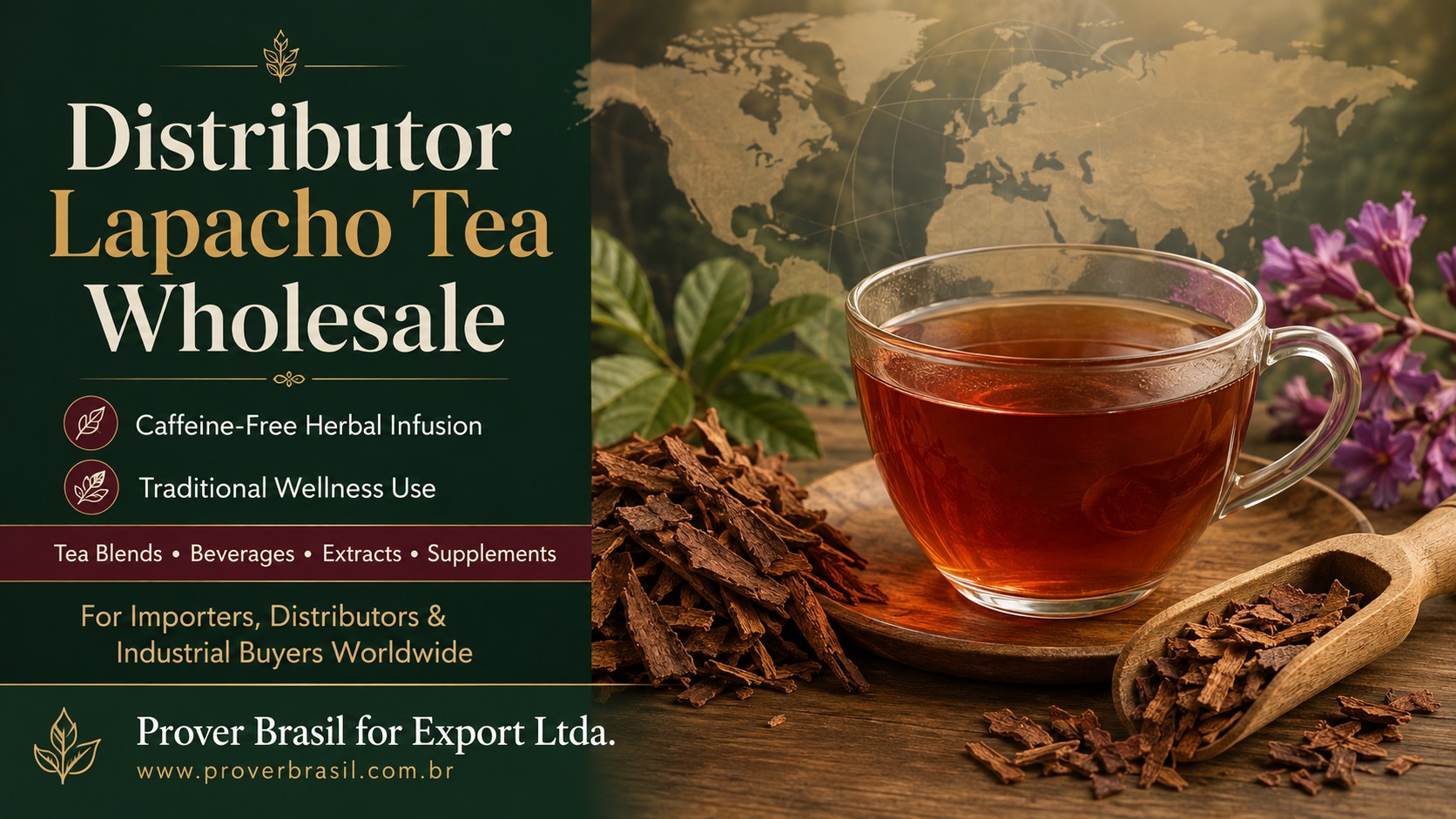
Lapacho Tea is a traditional South American infusion prepared from the bark of the Pau D’Arco tree. The botanical is also known internationally as Taheebo, Pau D’Arco, and Ipê Roxo.
Its distinctive botanical identity, mild woody character, and long history of traditional use make it relevant to tea companies, ingredient distributors, herbal product developers, and international importers.
Prover Brasil for Export Ltda. supplies Brazilian Pau D’Arco bark in formats suited to different commercial applications. Buyers can evaluate cut bark for infusion products, bark powder for dry blends, and concentrated extract for selected formulations.
Lapacho Tea is an herbal infusion generally prepared from the inner bark associated with Tabebuia avellanedae Lor. The botanical may also appear in scientific literature under related names, including Tabebuia impetiginosa.
Unlike traditional black or green tea, Lapacho does not come from Camellia sinensis. Therefore, it is naturally caffeine-free when supplied as a single botanical ingredient without caffeine-containing additions.
The prepared infusion usually has:
International buyers should confirm the scientific name, plant part, particle size, processing method, and technical specifications before placing an order.
Demand for distinctive botanical beverages continues to create opportunities for South American ingredients. Lapacho offers a recognizable regional identity and can support product concepts based on traditional herbal infusions.
It may interest commercial buyers because it provides:
Commercial suitability depends on the formulation, processing conditions, intended use, and legislation in the destination country.
Pau D’Arco bark has a history of traditional use in South America. Researchers have investigated its naturally occurring compounds, including lapachol, beta-lapachone, flavonoids, and other plant constituents.
Laboratory and animal research has examined antioxidant, antimicrobial, anti-inflammatory, and metabolic activities associated with bark extracts or isolated compounds. However, these findings do not establish that drinking Lapacho Tea prevents, treats, or cures a disease.
A scientific review of Tabebuia impetiginosa discusses the plant’s traditional uses, phytochemistry, biological activities, and areas requiring further investigation.
Another study indexed by PubMed evaluated Lapacho tea extract in an animal model involving pancreatic lipase activity and post-meal triglyceride response. These results are preliminary and should not be presented as proven human benefits.
For responsible commercial communication, companies should distinguish among:
This distinction helps buyers develop accurate labels, product descriptions, and promotional materials.
Cut bark is the most direct format for herbal infusion products. A controlled particle size can support efficient filling, blending, steeping, and packaging.
Possible applications include:
Fine bark powder may be considered for dry botanical blends and encapsulated formats. Because powder behaves differently from cut bark in water, buyers should conduct sedimentation, filtration, flavor, and dispersibility tests.
A concentrated bark extract can be assessed for powdered beverage systems and other specialized applications. Formulators should evaluate solubility, flavor intensity, color, serving level, and compatibility with additional ingredients.
Visit the Pau D’Arco Bark Products page to review the product formats offered by Prover Brasil.
Cut bark can be packed as a single-ingredient infusion or combined with complementary botanicals. Particle-size consistency is important for filling equipment and infusion performance.
Lapacho may be tested in hot beverages, chilled herbal drinks, concentrates, and botanical beverage bases. Pilot trials help determine the best extraction time, flavor balance, and filtration method.
Importers and distributors may add Pau D’Arco bark to product portfolios serving tea packers, wellness brands, specialty stores, and formulation companies.
Pre-portioned sachets can provide restaurants, cafés, hotels, and wellness centers with a consistent preparation method.
Laboratories can examine different ratios, temperatures, steeping periods, and ingredient combinations. These tests help define sensory quality and processing requirements.
Lapacho has an earthy and woody profile that can be balanced with aromatic, citrus, spicy, or naturally sweet ingredients.
Potential pairings include:
Before commercial production, developers should conduct stability and sensory trials. The final formula must also comply with food and botanical regulations in the intended market.
Ingredients
Preparation
Bring the water to a gentle boil. Add the cut bark and simmer for approximately 5 minutes. Remove from the heat, cover, and allow it to infuse for another 10 minutes. Strain before serving.
The quantity and preparation method should be adjusted according to the supplier’s specifications and applicable local guidance.
Ingredients
Preparation
Add the cinnamon and orange peel during the final minutes of infusion. Strain and serve warm. This combination softens the woody profile and adds citrus aroma.
Ingredients
Preparation
Allow the infusion to cool. Refrigerate it, then serve with ice, lemon slices, and mint. Commercial developers should perform microbiological and shelf-life assessments before offering a ready-to-drink version.
Ingredients
Preparation
Blend the dry ingredients in proportions selected through sensory testing. Pack the mixture in infusion sachets or loose-tea containers. Preparation directions should reflect the final particle size and blend composition.
Before importing Lapacho Tea ingredients, buyers should request information that supports identity, handling, and regulatory review.
Important purchasing criteria include:
Requirements can vary considerably among countries. Importers should confirm whether the botanical and its intended use are accepted by the relevant authority in their market.
Scientific research provides useful background, but it must be interpreted carefully. Findings involving isolated compounds, concentrated extracts, cells, or animals cannot automatically be applied to a cup of herbal infusion.
Recommended sources include:
Current evidence remains limited for many claimed health effects. Product communication should remain factual and should not turn preliminary research into medical promises.
Pau D’Arco preparations may not be appropriate for everyone. Concerns reported in professional health references include possible digestive effects and an increased risk of bleeding.
Pregnant or breastfeeding individuals, people preparing for surgery, and those using anticoagulant or antiplatelet medication should seek professional medical guidance before use. Companies must establish directions, warnings, and serving information according to the laws of each destination country.
Lapacho Tea must not be promoted as a substitute for medical diagnosis or treatment.
International sourcing requires more than selecting a botanical name. Importers should define the exact plant material, format, particle size, application, required documents, quantity, packaging, destination, and shipping method.
Prover Brasil for Export Ltda. supplies Brazilian botanical ingredients to international business customers. Visit the Prover Brasil products page to explore the wider ingredient portfolio.
For a quotation, contact the company with the following information:
It is prepared from the bark of the South American tree commonly known as Pau D’Arco, Taheebo, Lapacho, or Ipê Roxo. Buyers should always confirm the scientific identity and plant part.
A pure infusion of Pau D’Arco bark does not naturally contain caffeine. A finished blend may contain caffeine if it includes tea leaves, guarana, yerba mate, or another caffeine-containing ingredient.
It generally has a mild woody, earthy, and slightly bitter flavor. Citrus peel, apple, cinnamon, ginger, and mint can complement its sensory profile.
Cut bark with a controlled particle size is generally the most practical option for infusion sachets. The ideal cut depends on the sachet material, filling equipment, and desired extraction rate.
Yes. It may be evaluated for hot infusions, chilled botanical drinks, herbal blends, and food-service sachets. Each formulation requires technical, sensory, stability, and regulatory assessment.
Research has examined the bark, extracts, and individual compounds, but human evidence remains limited for many promoted benefits. Companies should avoid unsupported therapeutic claims.
The buyer should provide the desired format, quantity, destination country, application, packaging preference, and documentation requirements.
International buyers can contact Prover Brasil for Export Ltda. to request product details, availability, documentation, and a commercial quotation.
Add an authentic Brazilian botanical to your international ingredient portfolio.
Contact Prover Brasil for Export Ltda. to discuss cut Pau D’Arco bark, bark powder, or bark extract for your commercial project.
Website: www.proverbrasil.com.br