

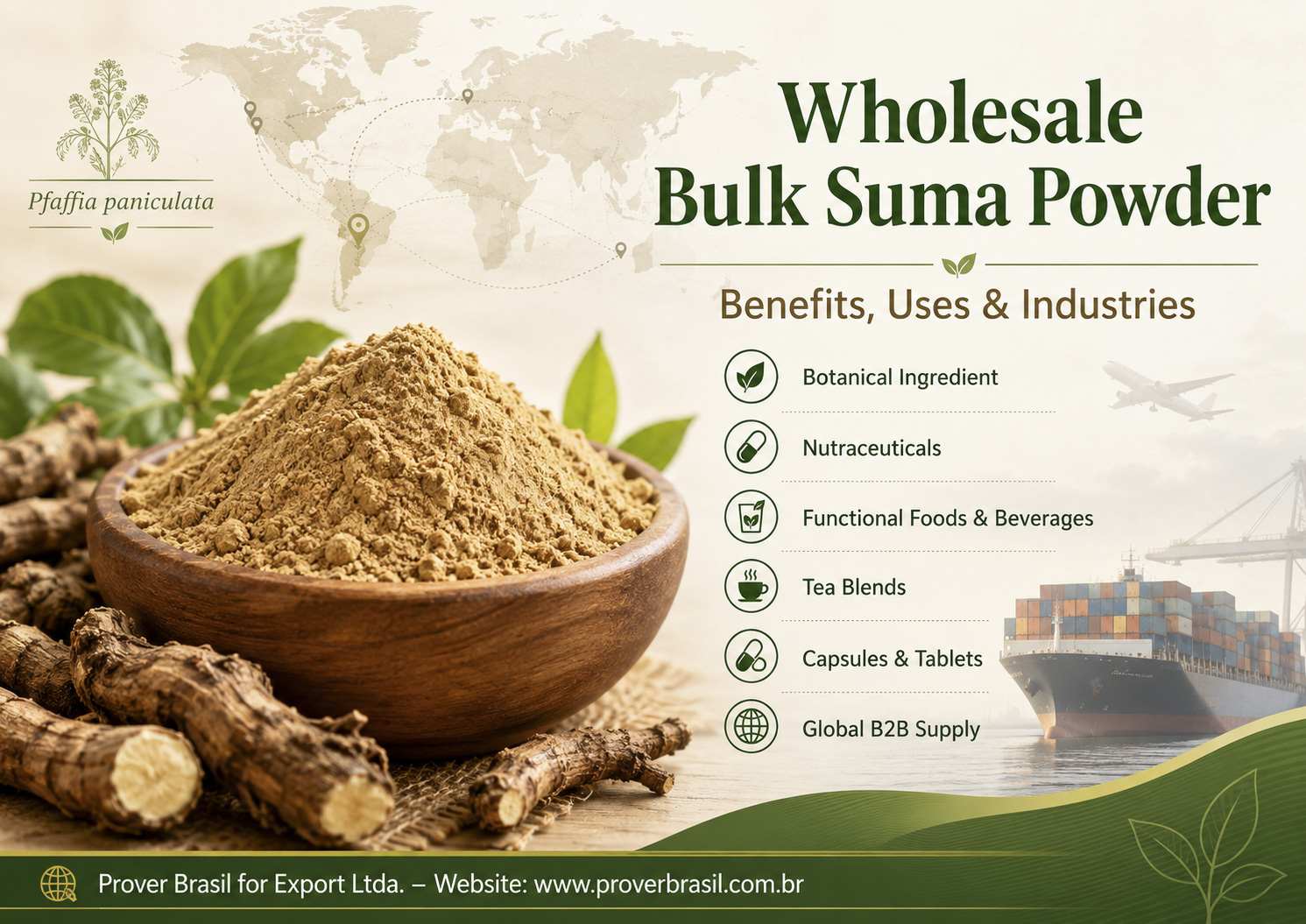
Wholesale Bulk Suma Powder gives international importers and product-development teams access to a distinctive Brazilian root ingredient for dry botanical applications. Produced from dried and finely milled Suma roots, this powder can be evaluated for supplements, botanical blends, sachets and selected food concepts, subject to the regulations of each destination country.
Suma is commercially identified as Pfaffia paniculata and is widely known as Brazilian Ginseng. However, it does not belong to the Panax genus and should not be confused with Asian or American ginseng.
Prover Brasil for Export Ltda. supplies Brazilian Suma ingredients to importers, distributors, wholesalers and industrial buyers worldwide. Buyers can review the company’s Suma Root Powder and Suma Extract 1:1 before requesting commercial information.
Wholesale Bulk Suma Powder is produced by drying and milling the root of the Suma plant. Unlike an extract, the powder retains the broader physical matrix of the root.
Picture: Suma Powder = Pfaffia Paniculata Powder = Brazilian Ginseng
Its natural appearance normally ranges from beige to brown. The powder also has an earthy botanical aroma and a characteristic root flavor. Exact properties can vary according to the raw material, particle size and batch specification.
| Product information | Description |
|---|---|
| Common name | Suma |
| Alternative trade name | Brazilian Ginseng |
| Commercial scientific name | Pfaffia paniculata (Mart.) Kuntze |
| Accepted taxonomic name | Hebanthe erianthos (Poir.) Pedersen |
| Botanical family | Amaranthaceae |
| Plant part | Root |
| Country of origin | Brazil |
| Commercial format | Fine root powder |
Correct botanical identification is important because common names can refer to different species. Purchase documents should clearly identify the botanical name, plant part and supplied format.
The principal benefits for professional buyers relate to formulation, sourcing and product positioning.
Suma has a strong connection with Brazil and South America. Therefore, it can support product concepts based on Brazilian herbs, traditional roots and regional botanical diversity.
The powder provides the physical matrix of the dried root. This characteristic can be useful for companies developing traditional botanical formulas instead of concentrated extract formulas.
Fine Suma Root Powder can be evaluated for capsules, tablets, sachets and powdered botanical blends. Product developers should still test its particle size, density, flow and compatibility with other ingredients.
Depending on local rules, Suma may support concepts associated with traditional botanical use, active lifestyles and general wellness. Any statement placed on a finished product must be reviewed for the intended market.
A dry ingredient can be weighed, blended and portioned using standard powder-processing equipment. Production teams should establish suitable controls for dust, humidity and cross-contamination.
Importers and ingredient distributors can use Brazilian Ginseng Powder to expand a catalog of South American herbs and botanical raw materials.
Wholesale Bulk Suma Powder may be considered by several industries. However, ingredient authorization and finished-product classification must be confirmed in each destination country.
Supplement companies may evaluate Suma Root Powder for:
Formulators should check particle size, bulk density, flow and the amount of powder required for each serving.
Suma can be studied alongside other botanical ingredients in multi-component formulations. Its Brazilian origin also makes it relevant to product lines focused on South American plants.
The ingredient may be evaluated for cocoa blends, fruit-flavored premixes and other dry beverage concepts. Conventional root powder should not automatically be considered fully soluble.
Beverage tests should examine dispersibility, sedimentation, flavor, color and stability after preparation.
Where permitted, Suma Powder can be assessed for botanical bites, cereal-based mixtures, cocoa products and dry food preparations.
Importers, wholesalers and distributors can offer the powder to supplement companies, herbal businesses, product developers and research laboratories.
Development teams can use small pilot batches to determine how the ingredient behaves with cocoa, fruits, spices, fibers, sweeteners and other botanical powders.
Companies looking for additional ingredients can explore the complete Brazilian ingredient catalog.
A specification alone does not show how a botanical powder will perform in every finished product. For this reason, laboratory and pilot-scale testing remain essential.
| Formulation factor | Recommended evaluation |
|---|---|
| Particle size | Flow, mouthfeel and blend uniformity |
| Flavor | Compatibility with cocoa, fruit and spices |
| Dispersibility | Suspension and sediment formation |
| Color | Effect on the finished formula |
| Bulk density | Capsule filling and powder handling |
| Moisture | Storage behavior and stability |
| Compatibility | Interaction with other ingredients |
| Packaging | Protection from moisture, heat and odors |
Suma has an earthy and slightly bitter botanical profile. Cocoa, cinnamon, apple, date, vanilla and ginger can help create a more balanced sensory result.
Suma Root Powder and Suma Extract are different ingredients.
The root powder consists of dried and milled botanical material. An extract undergoes additional processing to recover selected soluble components. Consequently, the two formats can have different composition, density, flavor and formulation behavior.
Buyers should not replace one format with the other without technical testing. They should also avoid interpreting an extraction ratio as proof of a specific biological effect.
Prover Brasil offers information about both formats on its Pfaffia Paniculata Suma Products page.
Scientific interest in Pfaffia paniculata includes research on its root composition and experimental biological properties. Much of the available evidence comes from laboratory or animal research. Therefore, these findings do not establish medical benefits for a commercial powder in humans.
A study by Oshima and colleagues examined the chemical composition of Pfaffia paniculata roots. The researchers reported compounds such as beta-sitosterol, stigmasterol, pfaffic acid, allantoin and saponins. The experimental portion of the study involved mice rather than human participants.
Read the Oshima study on PubMed
Another study evaluated a methanolic root extract in an experimental mouse model and investigated macrophage activity. Because it used a specific extract and an animal model, the results cannot be transferred directly to ordinary commercial Suma Powder or human use.
Read the Pinello study on PubMed
Research published in Food Research International compared low-pressure solvent extraction and supercritical fluid extraction of Brazilian ginseng species. This work helps demonstrate why botanical species, processing method and final ingredient format should be clearly documented.
View the Brazilian ginseng extraction research
These studies provide scientific background about the plant and its processing. They should not be used to state that Suma Powder diagnoses, prevents, treats or cures any disease.
The following 1,000-gram pilot formulas provide starting points for research and development. Final inclusion levels must be established through sensory testing, technical evaluation and regulatory review.
Pilot formula:
Total: 1,000 g
Preparation:
The cocoa, date and cinnamon help balance the earthy root profile.
Pilot formula:
Total: 1,000 g
Preparation:
This formula combines fruit acidity, gentle sweetness and warming spices.
Pilot formula:
Total: 1,000 g
Preparation:
Companies must review allergens, labeling requirements and permitted ingredient use before commercial release.
Professional buyers should compare more than price. They should request enough information to determine whether the product meets their technical and regulatory needs.
Important purchasing points include:
Buyers should also confirm whether the ingredient is authorized for the intended application in their country.
Prover Brasil for Export Ltda. has supplied Brazilian botanical ingredients to international markets since 2001.
The company serves professional buyers, including importers, wholesalers, distributors, supplement businesses, ingredient companies and product-development teams.
International customers can request:
Learn more about Prover Brasil for Export Ltda. or contact the export team with the required product, quantity, destination country and intended application.
Wholesale Bulk Suma Powder is a fine botanical ingredient produced from dried and milled Suma root. It is commercially identified as Pfaffia paniculata and is also known as Brazilian Ginseng Powder.
No. Brazilian Ginseng is a commercial name for Suma. The plant does not belong to the Panax genus used for Asian and American ginseng.
Its commercial benefits include Brazilian botanical identity, compatibility with selected dry formulations, whole-root positioning and potential use in diversified botanical product portfolios.
Potential industries include dietary supplements, nutraceutical products, botanical ingredient distribution, herbal preparations, powdered beverage development and research laboratories.
Conventional root powder should not automatically be described as fully soluble. Product developers should test dispersibility, suspension, sedimentation and mouthfeel in the final formula.
No. Suma Powder is produced from dried and milled root. Suma Extract 1:1 undergoes an extraction and drying process. Their technical and formulation properties can differ.
Published studies have investigated the plant’s composition and experimental properties. However, much of the research involves cells, animals or specific extracts. It does not establish therapeutic effects for commercial Suma Root Powder in humans.
Importers should request the specification, botanical identity, Certificate of Analysis, packaging information, shelf life, storage conditions and relevant export documentation.
Professional buyers can contact Prover Brasil for Export Ltda. in Brazil. The quotation request should state the required quantity, destination country, intended application and technical requirements.
Wholesale Bulk Suma Powder offers international buyers a distinctive whole-root ingredient for botanical supplements, dry blends and innovative product concepts.
Successful sourcing requires correct botanical identification, batch documentation, regulatory review and formulation testing. Importers should also assess flavor, particle size, dispersibility and compatibility with the finished product.
Contact Prover Brasil for Export Ltda. to request current specifications, availability and an international quotation.
Prover Brasil for Export Ltda.
Brazil
Exporting Brazilian botanical ingredients worldwide since 2001
Website: www.proverbrasil.com.br