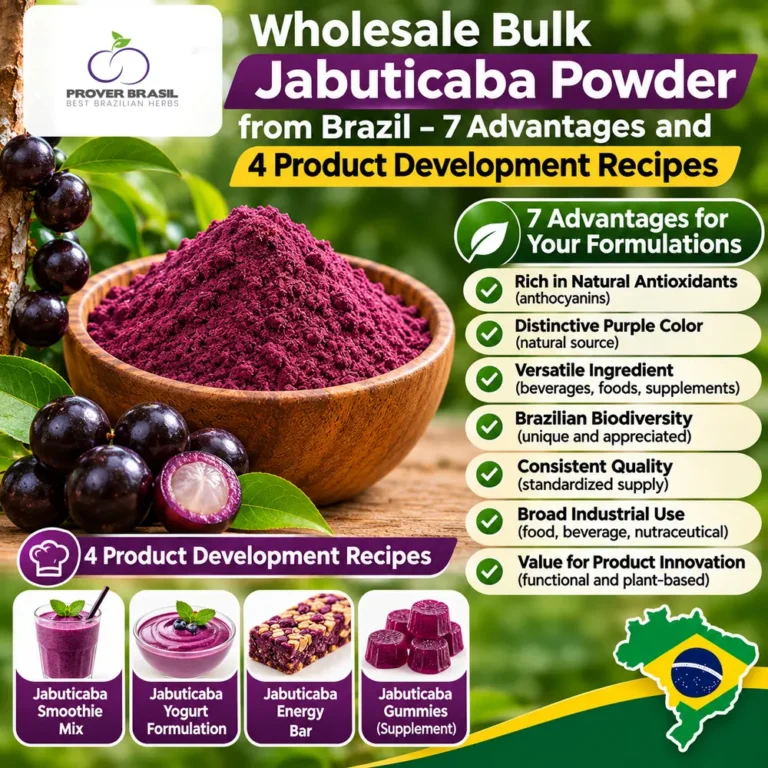
Wholesale Bulk Jabuticaba Powder from Brazil – 7 Advantages and 4 Product Development Recipes
What if the next distinctive flavor in an international beverage, dessert or nutritional product came from a small Brazilian fruit that grows directly on the trunk of its tree?
That fruit is Jabuticaba, a remarkable part of Brazil’s botanical and culinary heritage.
Its dark purple skin, characteristic fruit taste and natural connection to Brazilian food culture make it an interesting ingredient for companies looking beyond conventional berry flavors.
For industrial buyers, however, the real opportunity is not simply discovering a new fruit. It is finding a practical way to incorporate that fruit into products consumers can enjoy.
Prover Brasil for Export Ltda. supplies Jabuticaba Powder 2:1, spray dried, from Brazil to international importers, food companies, beverage developers, ingredient distributors and wholesale B2B customers.
This guide goes beyond a conventional product description. It explores seven practical advantages and presents four illustrative product-development recipes that can inspire new formulations.
The recipes are starting points for research and development rather than validated commercial formulas. Final inclusion levels, ingredient composition, processing safety and legal suitability must be confirmed before commercial production.
Meet Jabuticaba: A Brazilian Fruit with an Unusual Story
Jabuticaba is known for an unusual characteristic: its fruits grow directly along the trunk and larger branches of the tree.
When ripe, the fruit generally has a dark purple to nearly black exterior and a lighter pulp.
Its flavor can be described as fruity, with sweetness and acidity that vary according to the species, maturity and processing conditions.
Jabuticaba has traditionally been enjoyed in Brazil as a fresh fruit and in juices, jellies, desserts and other preparations.
Modern food science has investigated its technological possibilities, particularly because some fruit fractions contain anthocyanins, phenolic compounds and other naturally occurring constituents.
These characteristics have encouraged research into jabuticaba as an ingredient for food innovation.
From Fresh Fruit to Spray-Dried Powder
Fresh jabuticaba is highly perishable, creating practical challenges for transportation and industrial processing.
Transforming suitable fruit preparations into a powdered format can make the ingredient easier to weigh, portion, blend and transport.
Prover Brasil supplies a commercial Jabuticaba Powder 2:1 produced through spray drying.
Accepted botanical name used in modern references: Plinia cauliflora (Mart.) Kausel
Botanical family: Myrtaceae
Plant part: Fruit
Origin: Brazil
Processing: Spray dried
Commercial market: International wholesale and bulk B2B
The precise meaning of the 2:1 concentration, the fruit fractions used and the presence of any carrier ingredients should be confirmed against the applicable product specification.
Why Jabuticaba Powder Deserves a Place in Product Development
International food companies frequently compete with similar product portfolios.
Strawberry, raspberry, blueberry, mango and passion fruit are already familiar ingredients in many markets.
Jabuticaba provides a different story.
Its Brazilian origin, characteristic appearance and possibilities for fruit-based product development allow companies to investigate new combinations.
But differentiation alone is not enough.
A commercial ingredient must also meet the requirements of production, flavor development, stability, packaging and cost.
That is where the following seven advantages become relevant.
7 Advantages of Brazilian Jabuticaba Powder for Industrial Buyers
Advantage 1 — A Distinctive Brazilian Fruit Identity
Jabuticaba offers an opportunity to develop products built around a recognizable Brazilian origin.
For ingredient distributors, it can expand a fruit-powder catalog beyond conventional tropical fruits.
For food companies, it creates possibilities for distinctive flavors, recipes and product storytelling.
The origin claim should always reflect the actual sourcing and documentation of the supplied material.
Advantage 2 — Convenient Powdered Format
A spray-dried fruit ingredient offers practical handling possibilities compared with transporting fresh fruit.
Powdered ingredients can be weighed, portioned and incorporated into appropriate dry formulations.
They may also simplify some international logistics and storage operations.
The extent of these advantages depends on the product’s packaging, moisture behavior and recommended storage conditions.
Advantage 3 — Opportunities for Innovative Beverage Recipes
Jabuticaba Powder can be evaluated in fruit beverages, smoothie mixes, flavored dairy alternatives and drink premixes.
Its characteristic fruit profile offers potential for combinations with citrus, coconut, mango and other complementary flavors.
Technical testing is essential because powder dispersibility, sweetness, acidity and sediment formation can vary.
Advantage 4 — Potential for Naturally Occurring Fruit Pigments
Scientific studies have identified anthocyanins and other phenolic compounds in jabuticaba fruit, particularly in the skin.
Depending on the supplied fruit fractions and processing conditions, these constituents may contribute to the ingredient’s characteristics.
However, a specific commercial powder’s color intensity or anthocyanin level must be confirmed analytically.
Its behavior in finished products can also be affected by pH, temperature, light and storage.
Advantage 5 — Flexibility for Desserts and Dry Mixes
The powdered format may be evaluated in dessert preparations, bakery premixes, frozen dessert bases and other food concepts.
It can be easier to distribute a powdered ingredient through certain dry formulations than to handle fresh fruit.
Final results depend on the powder’s composition and the manufacturing process.
Advantage 6 — Opportunities for Multi-Fruit Combinations
Jabuticaba can be explored alongside other Brazilian fruit ingredients.
For example:
Jabuticaba + Açaí: A fruit combination inspired by Brazilian biodiversity.
Jabuticaba + Mango: A tropical flavor concept balancing different fruit characteristics.
Jabuticaba + Acerola: A combination worth exploring for acidity, sensory balance and complementary fruit profiles.
Jabuticaba + Cupuaçu: A distinctive Brazilian fruit combination for desserts and beverages.
Each combination requires formulation testing rather than relying on assumed compatibility.
Advantage 7 — International B2B Sourcing from Brazil
Prover Brasil for Export Ltda. supplies Jabuticaba Powder 2:1 for professional international buyers.
Importers can request commercial information about the current ingredient specification, packaging, availability, required quantities and international shipping arrangements.
For companies developing specialty fruit products, clear communication with a Brazilian export supplier can support a more structured purchasing process.
From Ingredient Inspiration to Finished Products: 4 Jabuticaba Recipes
The following recipes demonstrate how product developers can begin exploring Jabuticaba Powder 2:1 in food and beverage concepts.
They are illustrative bench-scale formulations, not recipes that have been tested or validated by Prover Brasil.
The actual powder should be evaluated for ingredient composition, food suitability, color, taste and processing performance before the formulas are used commercially.
Recipe 1 — Brazilian Jabuticaba Tropical Smoothie
<text color=”secondary” size=”sm”>Concept: ready-to-serve smoothie development | Trial batch: approximately 1 kg</text>
This concept combines Jabuticaba Powder with mango, banana and a creamy beverage base.
It is intended as an initial flavor-development experiment for companies exploring tropical smoothie products.
Ingredients
Ingredient
Quantity
Chilled water or suitable beverage base
650 g
Mango puree
180 g
Banana puree
120 g
Jabuticaba Powder 2:1
20 g
Sugar or permitted sweetener
20 g
Lemon juice
10 g
Total
1,000 g
Preparation
Add the chilled beverage base to a clean mixing vessel.
Incorporate mango and banana purees while blending.
Add the Jabuticaba Powder slowly to minimize lump formation.
Continue mixing until the powder is evenly dispersed.
Add the sweetener and lemon juice.
Evaluate flavor, appearance, acidity and texture.
Adjust the formulation according to the results of sensory and stability testing.
What the development team should evaluate
The principal questions are whether the jabuticaba flavor remains perceptible, whether visible particles settle during storage and whether the overall sweetness is appropriate.
For commercial development, the team must establish suitable preservation, processing and shelf-life conditions.
Potential product positioning: Brazilian tropical fruit smoothie, smoothie base or specialty food-service beverage.
Potential product positioning: Strawberry and jabuticaba yogurt, fruit-flavored dairy dessert or plant-based yogurt concept.
Moving from a 1 kg Trial to Industrial Production
A successful laboratory recipe is only the beginning.
Industrial food development requires evaluation at different production scales.
When moving from bench-scale mixing to larger batches, developers may encounter changes in dispersion, heating performance, color stability or ingredient handling.
For example, a fruit powder that disperses satisfactorily in a small laboratory mixer may behave differently in a production tank.
Similarly, a flavor that performs well immediately after preparation may change during storage.
A structured scale-up program should therefore investigate:
Ingredient consistency: Does the supplied powder meet the agreed technical specification?
Mixing performance: Can it be incorporated using the available production equipment?
Color and flavor: Do the desired characteristics remain acceptable throughout processing and storage?
Shelf life: Does the finished product meet the applicable stability and food-safety requirements?
Packaging: Does the selected packaging protect the product under its intended distribution conditions?
Commercial economics: What is the actual ingredient cost per finished unit at the chosen inclusion level?
The purpose of these investigations is to turn a promising concept into a reproducible commercial product.
What Does the Science Say About Jabuticaba?
Jabuticaba has attracted scientific interest because of the composition of its fruit and the potential applications of its different fractions.
Research has identified compounds such as anthocyanins and other polyphenols, particularly in the fruit skin.
Scientific investigations have also examined the relationship between processing conditions and the stability of these compounds.
A study published in the Journal of Food Science evaluated jabuticaba materials and approaches involving spray drying and microencapsulation.
Its findings help illustrate why fruit fraction selection, processing and formulation conditions matter when developing powdered ingredients.
Other research has investigated pectin extracted from jabuticaba peel and its possible technological relevance.
However, research findings involving specific fruit fractions or experimental preparations do not establish the exact composition or performance of a commercial Jabuticaba Powder 2:1 batch.
For industrial buyers, that distinction is essential.
If a formulation requires a particular anthocyanin content, color intensity or nutritional composition, the corresponding properties must be verified using appropriate product-specific information.
Similarly, scientific observations concerning antioxidant activity should not be presented as proof of particular clinical health outcomes.
The Purchasing Conversation: What an Importer Should Ask
Suppose an international beverage company wants to evaluate Jabuticaba Powder 2:1.
A useful first message to the exporter should contain more information than a request for price alone.
The buyer could explain that the company is developing a fruit beverage, requires an initial evaluation quantity and needs technical information about the commercial powder.
The purchasing team may then request:
The current product specification
Clarification of the 2:1 concentration
Complete composition, including any carriers
Available packaging formats
Information about moisture and physical properties
Applicable Certificate of Analysis
Required quantity and commercial price
Destination-country shipping arrangements
This approach improves the quality of the commercial discussion and helps prevent misunderstandings.
A Sample B2B Request for Quotation
Subject: Wholesale Bulk Jabuticaba Powder 2:1 – Brazil
Dear Export Team,
Our company is evaluating Jabuticaba Powder 2:1 for a new food and beverage development project.
Please provide the current product specification, available packing, commercial quotation and international shipping conditions.
Our intended destination is [Country], and our estimated purchasing requirement is [Quantity in KG].
We would also appreciate information about the powder’s composition and relevant technical documentation.
Kind regards,
International Purchasing Department
Jabuticaba Powder and the Opportunity for Brazilian Fruit Innovation
Companies developing new fruit products can consider jabuticaba as part of a wider Brazilian ingredient portfolio.
Prover Brasil also supplies several other fruit ingredients that may be suitable for independent formulation evaluation.
Jabuticaba and Açaí
Açaí provides another Brazilian fruit identity and may be explored in multi-fruit beverages, smoothie concepts and specialty preparations.
Jabuticaba and Cupuaçu
Cupuaçu’s distinctive tropical aroma may complement jabuticaba in selected dessert and beverage concepts.
Jabuticaba and Acerola
Acerola ingredients can contribute a different fruit profile and may be evaluated in formulations where acidity, flavor and ingredient composition are important.
The suitability of each combination depends on the specific product grades and the finished formulation.
From Brazilian Fruit to International Product Development
Jabuticaba offers more than an unfamiliar fruit name.
For international product developers, it provides a distinctive Brazilian ingredient that can be explored through beverage concepts, dessert applications, dry mixes and multi-fruit combinations.
The spray-dried powdered format provides a practical starting point for these investigations.
However, successful commercial adoption requires more than an attractive recipe.
Buyers need an appropriate product specification, technical evaluation, regulatory compliance and reliable purchasing information.
This is where professional ingredient sourcing connects with food innovation.
Scientific and Botanical References
1. Royal Botanic Gardens, Kew – Plants of the World Online
An authoritative botanical resource for accepted names, synonyms and species classification.
These publications provide scientific background and do not represent certificates or batch-specific test results for Prover Brasil’s commercial Jabuticaba Powder.
Request Wholesale Bulk Jabuticaba Powder from Brazil
Looking for a Wholesale Bulk Supplier of Jabuticaba Powder for your next food, beverage or fruit ingredient project?
Prover Brasil for Export Ltda. supplies Brazilian Jabuticaba Powder 2:1, spray dried, for international B2B buyers.
Our export team can discuss current product availability, technical specifications, bulk quantities, commercial packaging and international shipping arrangements.
The recipes presented are illustrative formulation concepts for qualified product developers. They have not been validated for commercial production. Ingredient composition, food safety, technical performance, labeling and destination-market regulatory requirements must be confirmed before use.
Discover 7 advantages of Aloe Vera Leaf Dry Extract 2:1 from Brazil. Explore spray-dried powder technology, industrial applications, research and international wholesale B2B sourcing.
Discover 7 advantages of Avocado Fruit Powder 2:1 from Brazil and 4 innovative savory recipes for dips, snack seasonings, crackers and sauces. Wholesale B2B sourcing by Prover Brasil.
Explore our full catalog of premium, certified Brazilian botanical ingredients. Select your required specifications and request a custom commercial quote directly from our export specialists.