

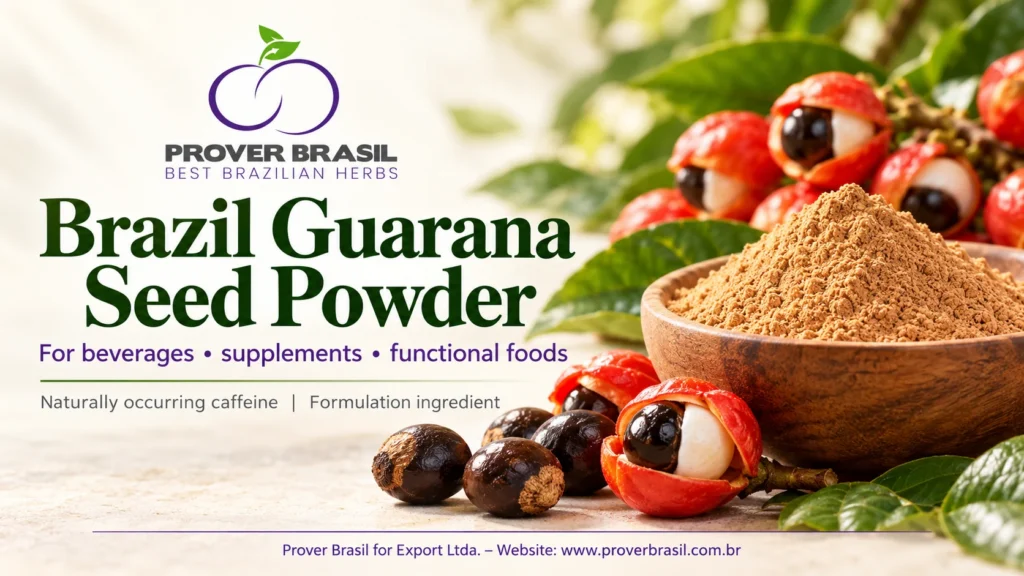
Brazil Guarana Seed Powder is a Brazilian botanical ingredient used by beverage, food, nutrition and supplement companies seeking a distinctive source of naturally occurring caffeine. Produced from milled guarana seeds, it combines Brazilian origin, a recognizable botanical identity and broad formulation potential.
Prover Brasil for Export Ltda. supplies Brazilian guarana powder to importers, distributors, ingredient companies and professional buyers worldwide. Available specifications, particle size, caffeine content, packaging and documentation should always be confirmed before purchase.
Guarana is botanically identified as Paullinia cupana Kunth. Its seeds naturally contain caffeine and other compounds, including theobromine, catechins and proanthocyanidins. Their concentrations can vary according to the raw material, growing region and processing conditions.
Companies interested in additional Brazilian ingredients can explore our complete product catalog or review our dedicated guarana product range.
Brazil Guarana Seed Powder is obtained by cleaning, preparing and milling guarana seeds into a powder suitable for further industrial evaluation. Unlike a concentrated extract, the powder retains more of the natural seed matrix.
This distinction matters during product development. Seed powder generally contributes more color, flavor and insoluble particles than a concentrated ingredient. It may also require additional dispersion tests in liquids.
The natural caffeine concentration must be verified through the batch documentation or laboratory analysis. Formulators should never assume that every guarana powder has the same caffeine level.
Guarana seed powder and guarana extract are not interchangeable ingredients.
The powder is produced from milled seeds. It retains the natural characteristics of the seed and normally has a less concentrated caffeine profile than a standardized extract.
An extract undergoes additional processing to concentrate selected components. Depending on its specification, it may have different solubility, flavor, color, particle behavior and caffeine concentration.
Professional buyers should define which format best fits their application before requesting prices or samples. Important questions include:
Brazilian guarana powder gives product developers several useful commercial and formulation options.
Guarana has a strong connection with Brazil. This origin can support product positioning based on Brazilian biodiversity, regional sourcing and authentic botanical ingredients.
Origin alone, however, does not replace technical evaluation. Importers should still review the specification, batch documentation, laboratory results and sensory characteristics.
The seed naturally contains caffeine. This makes guarana relevant to companies developing products in which caffeine content, botanical identity and Brazilian origin are important formulation considerations.
Caffeine statements and serving levels must be supported by analysis. Labeling requirements can differ significantly between countries.
A full-seed powder can be appropriate for formulas that do not require a highly concentrated extract. It can provide a distinct botanical profile, including the natural color, taste and solid components of the seed.
Brazil Guarana Seed Powder can be evaluated for powders, capsules, tablets, bars, confectionery products, cereal blends and other dry formulations.
Suitability depends on the final formula, processing conditions and target market. Pilot testing is essential because the ingredient may affect bitterness, color, texture and stability.
Guarana powder can be incorporated into powdered drink blends combined with fruit powders, cocoa, plant-based ingredients or flavor systems.
Its bitterness should be considered during flavor development. Citrus, cocoa, berry, vanilla and warm spice profiles may help create a more balanced sensory experience.
For a detailed discussion of beverage formulation, visit our guide to guarana powder for energy drink applications.
Supplement companies may evaluate guarana powder for capsules and compressed tablets. Particle size, flow behavior, bulk density and caffeine analysis are especially important in these formats.
The formulation team must also examine dose uniformity. A powder that separates from other ingredients during blending can produce inconsistent units.
Guarana may be considered for powdered nutrition formulas, pre-exercise blends and other products aimed at active consumers.
The complete formula must be evaluated because caffeine can also come from coffee, tea, cocoa or added caffeine. All sources should be included when calculating the total amount per serving.
Bulk guarana seed powder can be tested in date-based bites, oat bars, nut bars and cocoa snacks.
In these products, the surrounding ingredients help control bitterness. Dates, cocoa, nut pastes, cinnamon and vanilla can provide useful flavor balance.
Uniform distribution is important because the product is divided into individual portions after mixing.
Chocolate and cocoa pair naturally with the bitter character of guarana. Potential concepts include filled chocolates, cocoa bites, coated snacks and portioned confectionery products.
Developers should test the ingredient at several inclusion levels. Excessive quantities may produce strong bitterness or an uneven texture.
Guarana powder can be added to granola clusters, cereal blends and dry breakfast formulations. It should first be dispersed into a liquid binder or blended carefully with the other fine powders.
This reduces localized concentrations and improves batch uniformity.
Ingredient companies may purchase Paullinia cupana seed powder for further blending, analytical research or processing into their own finished formulations.
For this application, traceability, particle size, caffeine results, packaging and storage information are often more important than consumer-facing marketing language.
Caffeine is a defining characteristic of guarana, but its concentration is not identical in every batch. Request the applicable analytical result and calculate the final caffeine content based on:
Guarana seed powder has a naturally bitter and astringent profile. Appropriate flavor systems may include:
Sweetness can reduce perceived bitterness, but the amount should be established through sensory testing.
Seed powder should not automatically be described as fully soluble. It can leave suspended particles or sediment in liquid products.
Formulators can evaluate smaller particle sizes, pre-dispersion, controlled mixing and compatible stabilizing systems. The correct method depends on the final product.
The natural brown color may influence pale beverages, white nutrition powders and lightly colored foods. This effect is usually less noticeable in cocoa, coffee, berry or dark fruit applications.
Pilot tests should reproduce the actual production process. Heat, moisture, mixing time, pressure and storage conditions may change flavor, color and ingredient behavior.
The finished product must undergo its own stability program. Tests may include sensory stability, moisture, water activity, microbiological parameters, caffeine verification and packaging compatibility.
Before purchasing Brazil Guarana Seed Powder, an importer should request a specification that clearly identifies the product and its relevant quality parameters.
The review may include:
Requirements vary according to the intended application and destination market. Buyers should send their complete specification request before confirming an order.
Information about our preparation and export structure is available on the Prover Brasil factory page.
Scientific studies can help buyers understand why analytical control is important for guarana ingredients.
A study published in the Journal of Food Composition and Analysis described an HPLC method for the simultaneous determination of caffeine, theobromine, theophylline, catechin, epicatechin and selected procyanidins in Brazilian guarana. This research supports the value of using analytical markers when evaluating guarana composition. Read the HPLC guarana analysis study on PubMed.
Another investigation used UPLC-QTOF-MS and chemometric analysis to compare guarana seeds from different geographical origins. The researchers characterized multiple phenolic compounds and observed compositional differences between regional samples. Read the geographical chemical profiling study.
Research has also examined how different drying techniques can affect methylxanthine and flavonoid content in guarana seeds. This reinforces the importance of processing information and batch-specific evaluation. See the study on drying techniques and guarana composition.
An earlier analytical comparison evaluated caffeine and related markers in guarana seed powder and guarana-based products using capillary electrophoresis and HPLC. See the analytical methods study for guarana products.
These publications should be interpreted as scientific information about composition and analytical methods. They do not replace finished-product testing, regulatory review or evidence required for specific commercial claims.
The following recipes are one-kilogram pilot concepts for professional product development. They are different from the smoothies, coffee drinks, pancakes, brigadeiro and fruit beverages already presented in other Prover Brasil articles.
The five-gram guarana quantity is only a starting point. It must be recalculated according to the actual caffeine result, desired portion, total formula and destination-market rules.
Ingredients
Procedure
Check caffeine distribution, texture, water activity, allergen controls and shelf stability before commercial use.
Ingredients
Procedure
The final weight will change during baking because moisture is removed. Evaluate caffeine, texture, moisture and serving uniformity after processing.
Ingredients
Procedure
Coconut is an allergen in some regulatory systems. Confirm the labeling classification in the destination market.
A representative sample allows the buyer to assess the ingredient before placing a larger order.
A useful evaluation process includes:
Comparisons should use identical recipes and processing conditions. Changing several variables at the same time makes it difficult to identify the cause of a result.
International buyers should provide detailed information when requesting a quotation for bulk guarana seed powder.
The enquiry should include:
Clear requirements allow the supplier to confirm whether the available specification is suitable for the project.
It is a milled ingredient produced from Brazilian guarana seeds, botanically identified as Paullinia cupana Kunth. It naturally contains caffeine and retains characteristics of the seed matrix.
No. Seed powder is made from milled seeds, while an extract undergoes additional processing to concentrate selected components. They can differ in caffeine concentration, particle behavior, color, flavor and dispersion.
Yes, guarana seeds naturally contain caffeine. The exact concentration should be confirmed through batch-specific analysis.
It should not automatically be considered completely soluble. As a milled seed ingredient, it can produce suspended particles or sediment. Application testing is recommended.
Potential users include beverage, nutrition, supplement, snack, chocolate, confectionery, cereal and ingredient-processing companies.
Depending on the market and application, buyers may request a product specification, certificate of analysis, batch identification, origin information, packaging details, shelf-life information and relevant laboratory results.
No. The correct level depends on the caffeine concentration, portion size, other ingredients, sensory target and destination-market requirements.
Yes. International buyers can use the Prover Brasil contact page to describe their application, required specification, quantity and destination.
Brazil Guarana Seed Powder offers Brazilian origin, naturally occurring caffeine and flexibility for multiple professional applications. Successful use depends on selecting the appropriate specification, validating the formulation and confirming all applicable requirements.
Contact Prover Brasil for Export Ltda. to request product information, available specifications, packaging options, documentation and a B2B quotation.
Contact Prover Brasil about guarana products