
Wholesale Bulk Supplier Peach Powder
Explore peach powder for dessert mixes, bakery fillings and beverage development. Discover seven practical B2B benefits, three pilot recipes and sourcing considerations for international importers.
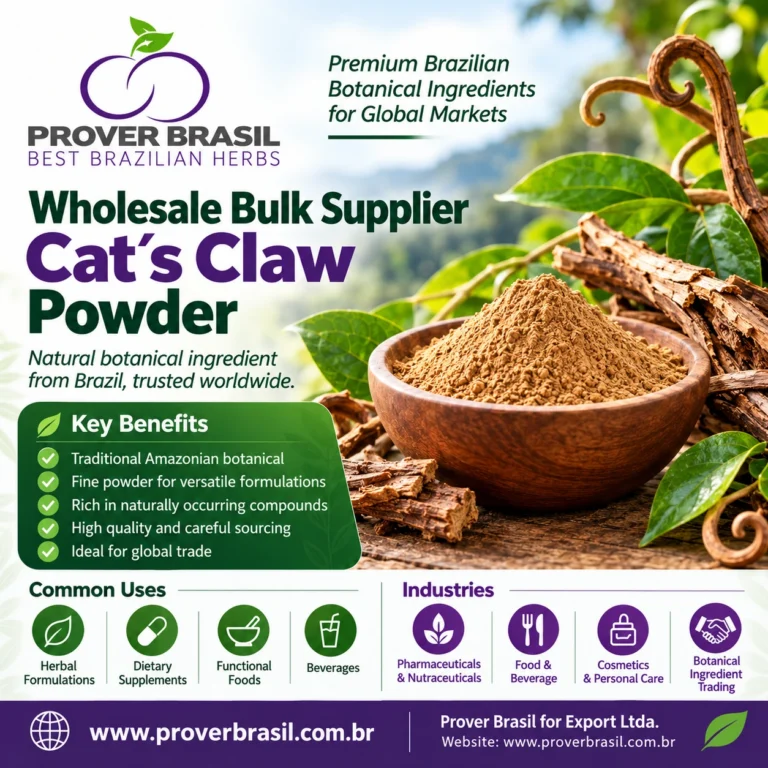
Wholesale Bulk Supplier Cat’s Claw Powder is an increasingly relevant search for international buyers exploring botanical ingredients from Brazil. Yet a successful sourcing decision requires more than finding an attractive product description.
For importers, ingredient distributors and product-development teams, identifying the correct botanical species, understanding the powder’s characteristics and reviewing analytical documentation are essential steps.
Cat’s Claw Powder, derived from Uncaria tomentosa, is recognized for its traditional South American heritage and its diverse phytochemical composition.
At Prover Brasil for Export Ltda., our international B2B focus connects buyers with Brazilian botanical ingredients for wholesale purchasing and specialized industrial applications.
This guide explores seven practical sourcing benefits, industry applications, scientific research, quality considerations and three laboratory formulation recipes for professional product developers.
Cat’s Claw is a tropical climbing plant belonging to the Rubiaceae family. Its curved thorns inspired the English name Cat’s Claw and the Spanish name Uña de Gato.
The scientific name is Uncaria tomentosa (Willd. ex Schult.) DC.
The plant occurs in tropical regions of Central and South America and has attracted scientific interest because it contains several classes of natural compounds.
Researchers have investigated:
The concentrations of these constituents can vary with botanical part, geographical origin and processing.
Importers should therefore evaluate the actual specifications of the material offered rather than assume that all Cat’s Claw powders have identical compositions.
Learn more about the ingredient through our Cat’s Claw Powder Product Page.
Cat’s Claw has a well-established history within South American botanical traditions.
Its recognizable name and distinctive climbing-plant characteristics make it relevant to specialty ingredient catalogs.
For international distributors, accurate botanical identification offers a useful foundation for presenting the ingredient to professional customers.
One notable characteristic of Uncaria tomentosa is its chemically diverse composition.
Scientific publications describe alkaloids, phenolic compounds and triterpene-related constituents.
This diversity makes Cat’s Claw relevant to phytochemical laboratories and ingredient researchers.
Although experimental studies have investigated antioxidant and inflammatory pathways, these findings should not be interpreted as demonstrated clinical benefits from consuming the powder.
Cat’s Claw Powder can be evaluated in different industrial processes, depending on its specifications.
Potential operations include dry blending, laboratory extraction, particle-size analysis and botanical characterization.
For professional buyers, the appropriate processing method depends on the material’s intended application and physical properties.
International distributors often seek ingredients that offer more variety than conventional botanical commodities.
Cat’s Claw can complement established South American ingredient portfolios by introducing another recognizable plant species.
This diversification can support purchasing programs aimed at botanical ingredient companies, research laboratories and specialty distributors.
Cat’s Claw Powder allows buyers to establish measurable acceptance criteria.
These may include:
Consistent purchasing specifications can reduce uncertainty when comparing samples or evaluating repeat shipments.
Research into Uncaria tomentosa continues to examine phytochemical composition, extraction behavior and biological mechanisms.
A scientific review published in 2025 discusses the plant’s ethnobotanical background, compound classes and experimental investigations.
This research provides information for R&D professionals studying plant-derived substances and analytical methods.
For professional importers, bulk purchasing supports planning around specific quantities, specifications and commercial requirements.
A clearly defined request for quotation can include packaging, delivery destination, analytical documentation and preferred shipment arrangements.
Prover Brasil for Export Ltda. provides an international B2B purchasing channel for companies seeking Brazilian botanical materials.
Cat’s Claw Powder may be investigated by several industrial sectors, subject to technical evaluation and destination-market regulations.
Supplement companies may assess Cat’s Claw Powder for botanical formulations in markets where the ingredient and intended use are permitted.
Technical teams should evaluate ingredient identity, applicable safety requirements, particle characteristics and compatibility before selecting a finished-product format.
Importantly, traditional use or laboratory findings do not establish therapeutic effectiveness.
Wholesalers may include Cat’s Claw Powder in catalogs designed for professional botanical buyers.
Clearly documented botanical identity, origin and physical specifications are particularly valuable in this market.
Research facilities may study the extraction of selected compound classes from Uncaria tomentosa.
Scientific work has examined both alkaloids and phenolic constituents from different plant parts.
Extraction efficiency and chemical profiles vary, so results obtained with one botanical preparation should not automatically be applied to another.
Cat’s Claw Powder can serve as a botanical test material for analytical method development.
Examples include compound identification, comparative phytochemical profiling and investigation of raw-material variability.
Industrial formulators may evaluate Cat’s Claw in dry botanical mixtures.
However, ingredient compatibility, uniformity, stability and compliance must be demonstrated before any commercial use.
Universities and independent research institutions may investigate Uncaria tomentosa through microscopy, botanical authentication, chromatographic analysis and controlled extraction experiments.
Scientific characterization can contribute to a better understanding of this South American species.
Not every botanical powder sold under the same common name is necessarily equivalent.
Scientific studies have investigated material derived from leaves, stems, bark and other botanical parts of Uncaria tomentosa.
Different plant parts can exhibit different phytochemical profiles.
For example, research on phenolic composition has demonstrated variation among examined plant materials.
Importers should request confirmation of the botanical part used in the specific commercial product.
This is especially important when the powder is intended for analytical research or a formulation requiring defined chemical characteristics.
Oxindole alkaloids are among the most studied compound classes associated with Uncaria tomentosa.
Scientists distinguish between pentacyclic and tetracyclic oxindole alkaloid groups.
Their relative proportions may differ depending on the botanical material.
These compounds can be important in phytochemical research and raw-material characterization.
However, the presence of a researched constituent does not automatically establish the safety, effectiveness or suitability of a commercial product for a particular application.
Buyers requiring particular analytical markers should communicate their specifications before requesting bulk quantities.
The following formulations are research prototypes for professional laboratories.
Unlike conventional botanical beverage or fruit-powder recipes, these concepts focus on physical characterization, comparative analysis and ingredient-processing behavior.
They are not consumption recipes or recommended finished-product formulations.
Objective: Investigate the handling properties of a powder mixture containing Cat’s Claw.
Laboratory batch: 100 g
| Ingredient | Quantity |
|---|---|
| Cat’s Claw Powder | 5 g |
| Laboratory-grade microcrystalline cellulose | 94 g |
| Laboratory-grade colloidal silicon dioxide | 1 g |
| Total | 100 g |
Preparation
Research purpose: Compare powder handling behavior against a control mixture without Cat’s Claw.
Objective: Investigate selected water-extractable constituents under controlled laboratory conditions.
Laboratory batch: 100 g
| Ingredient | Quantity |
|---|---|
| Cat’s Claw Powder | 2 g |
| Purified laboratory water | 98 g |
| Total | 100 g |
Preparation
Research purpose: Study extraction behavior and selected chemical characteristics of the sample.
The preparation is not intended for drinking or medicinal use.
Objective: Assess blending uniformity in a low-concentration botanical research mixture.
Laboratory batch: 200 g
| Ingredient | Quantity |
|---|---|
| Cat’s Claw Powder | 10 g |
| Laboratory-grade microcrystalline cellulose | 190 g |
| Total | 200 g |
Preparation
Research purpose: Evaluate dry-blend uniformity and identify possible segregation during laboratory handling.
Technical note: These laboratory percentages are illustrative starting compositions, not validated commercial specifications. They must not be treated as safe human-use concentrations or dosage recommendations.
Scientific literature provides valuable information about the phytochemistry and experimental study of Uncaria tomentosa.
Published in the International Journal of Molecular Sciences, this review examines the ethnobotanical background, phytochemical constituents and experimental research associated with Uncaria tomentosa.
It describes alkaloids, phenolic compounds and other botanical constituents and discusses areas requiring continued scientific investigation.
Read the 2025 Scientific Review – PubMed
This study investigated phenolic constituents in different plant parts, including leaves, stems, bark and wood.
The findings are relevant to botanical characterization and demonstrate why the plant part and extraction method matter.
Read the Phenolic Composition Research – PubMed
Published in Phytochemistry, this scientific review examines several species of the genus Uncaria, including their characteristic alkaloids and additional botanical compounds.
It provides useful background for analytical laboratories and botanical ingredient researchers.
Read the Uncaria Phytochemistry Review – PubMed
The U.S. National Center for Complementary and Integrative Health summarizes available research on Cat’s Claw and provides important information concerning evidence limitations and safety.
It reports that conclusive evidence from human studies does not support Cat’s Claw for any health purpose.
Read the NCCIH Scientific and Safety Overview
Scientific publications should be evaluated according to study type, botanical species, extract preparation and research limitations. Laboratory findings are not a substitute for human clinical evidence.
Before placing a wholesale order, international buyers should evaluate the following technical and commercial information.
Request Uncaria tomentosa (Willd. ex Schult.) DC. when that is the required species.
Confirm whether the material comes from the bark, leaves or another declared part.
Check available details concerning color, appearance, particle size and moisture.
Request specifications and a Certificate of Analysis relevant to the commercial batch.
Specify suitable packaging quantities, labeling information and storage conditions.
Check botanical import requirements, intended-use restrictions and documentation obligations in the destination market.
Evaluate quotations according to the quantity, agreed Incoterm, destination, shipping method and required documentation.
International buyers frequently source several botanical ingredients within one purchasing program.
In addition to Cat’s Claw Powder, Prover Brasil offers a broader selection of Brazilian botanical materials.
Professional buyers can explore:
These product resources can help buyers identify ingredients suited to their purchasing objectives.
An effective purchasing inquiry should clearly describe the intended commercial order.
Include:
Accurate information helps reduce unnecessary correspondence and facilitates preparation of an appropriate commercial quotation.
Prover Brasil for Export Ltda. supplies Cat’s Claw Powder for international B2B buyers. Professional importers can request details concerning quantities, specifications, documentation and export conditions.
The botanical name is Uncaria tomentosa (Willd. ex Schult.) DC., a tropical climbing plant belonging to the Rubiaceae family.
Its commercial advantages include recognizable botanical identity, a diverse phytochemical profile, potential laboratory processing applications and suitability for specialized botanical ingredient portfolios.
Cat’s Claw Powder is processed botanical material. An extract is produced through an extraction process and may have a different chemical composition, concentration and technical specification.
They should not be considered interchangeable without evaluation.
It may be evaluated for such applications where legally permitted. Companies must assess safety, regulatory status, ingredient specifications and applicable labeling requirements.
Researchers have identified several compound classes, including oxindole alkaloids, proanthocyanidins, phenolic compounds and quinovic acid glycosides.
The exact profile can differ among plant materials and preparations.
Relevant documentation may include product specifications, botanical identification, applicable laboratory results, batch information and necessary export documents.
Yes, appropriate samples can be evaluated for analytical research, extraction studies and controlled dry-blending investigations.
Laboratory suitability depends on the material specification and research protocol.
There is currently insufficient conclusive human clinical evidence to support the use of Cat’s Claw for any health purpose. Experimental studies should not be used to claim that commercial powder treats or prevents disease.
International buyers can contact Prover Brasil for current product availability, commercial quantities, export documentation and transportation arrangements.
Are you evaluating Cat’s Claw Powder for international botanical ingredient distribution, industrial research or specialized product-development projects?
Prover Brasil for Export Ltda. welcomes inquiries from importers, wholesalers, ingredient distributors and industrial buyers worldwide.
Submit your required quantities, technical specifications and destination details to receive commercial information for your sourcing project.
Product Information: Cat’s Claw Powder from Brazil
View Available Ingredients: Prover Brasil Product Catalog
Contact Our Export Team: Request a Wholesale Quotation
Prover Brasil for Export Ltda.
Brazilian Botanical Ingredients for International B2B Markets
Website: www.proverbrasil.com.br
Explore peach powder for dessert mixes, bakery fillings and beverage development. Discover seven practical B2B benefits, three pilot recipes and sourcing considerations for international importers.
Discover how apple powder fits into commercial food development, from savory seasonings to bakery mixes. Explore seven practical benefits, three pilot recipes and purchasing criteria for international ingredient buyers.
Discover Wholesale Bulk Supplier Quassia Amara Powder from Brazil. Explore 7 practical B2B benefits, industrial applications, scientific research, laboratory formulations and global sourcing opportunities with Prover Brasil for Export Ltda.
Explore our full catalog of premium, certified Brazilian botanical ingredients. Select your required specifications and request a custom commercial quote directly from our export specialists.