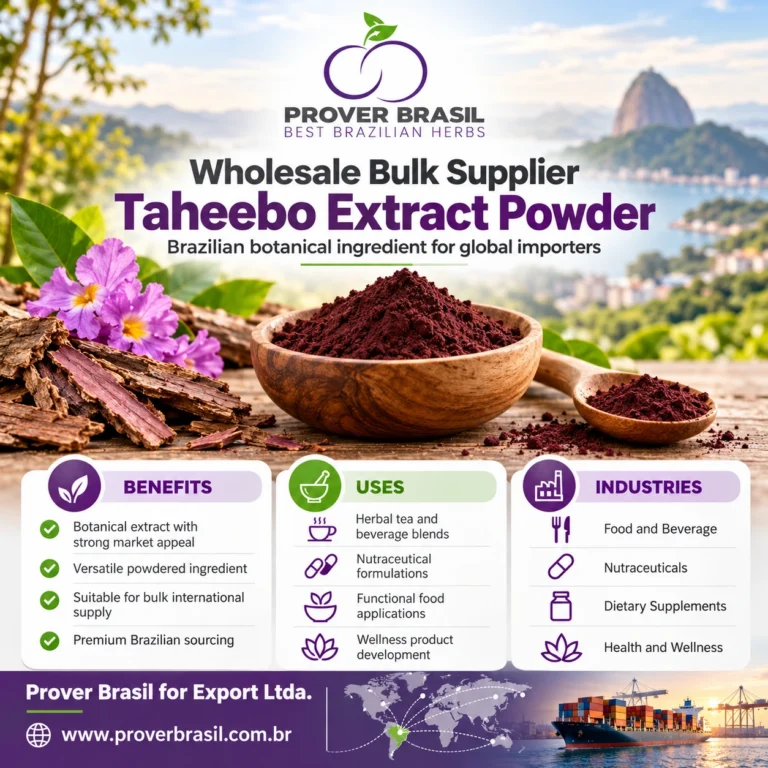
Wholesale Bulk Taheebo Extract Powder is a Brazilian botanical ingredient attracting attention from international importers, ingredient distributors, botanical research companies, and specialized formulation businesses.
Also known commercially as Pau D Arco or Lapacho Extract, Taheebo comes from the bark of South American trees associated with the Bignoniaceae family. Its commercial value depends on botanical identification, processing methods, technical documentation, ingredient suitability, and export planning.
For international procurement teams, choosing a botanical extract requires more than selecting a product by price or concentration ratio.
Prover Brasil for Export Ltda. supports global B2B buyers seeking Brazilian botanical ingredients for international sourcing and industrial applications.
This guide explores seven important considerations when purchasing Wholesale Bulk Taheebo Extract Powder.
Wholesale Bulk Taheebo Extract Powder: 7 B2B Insights
1. Botanical Identity: The Foundation of Reliable Taheebo Sourcing
Taheebo, Pau D Arco, and Lapacho are commercially recognized names associated with bark-derived botanical ingredients.
An important botanical species is Handroanthus impetiginosus (Mart. ex DC.) Mattos, historically referred to as Tabebuia impetiginosa and Tabebuia avellanedae.
However, common names alone are insufficient to identify a specific commercial ingredient.
Before purchasing, importers should verify:
-
Scientific botanical name.
-
Botanical family: Bignoniaceae.
-
Plant part used in production.
-
Country and region of origin.
-
Product identity and extraction format.
-
Batch traceability and supporting documentation.
B2B Benefit: Correct botanical identification helps purchasing teams reduce ingredient substitution risks and establish consistent specifications.
2. Extraction Ratio and Processing Characteristics
Wholesale Bulk Taheebo Extract Powder differs from ordinary milled bark because it undergoes an extraction and drying process.
For example, an extract described commercially as 4:1 generally indicates a declared relationship between botanical input and resulting extract material. However, this designation alone does not guarantee a particular concentration of phytochemical compounds.
Industrial buyers should clarify:
-
Declared extraction ratio.
-
Water or other extraction solvents used.
-
Native extract content.
-
Carrier ingredients, if present.
-
Drying technology.
-
Powder particle size.
-
Moisture and physical characteristics.
-
Solubility or dispersibility properties.
B2B Benefit: Understanding extraction specifications supports accurate product comparisons and technical formulation decisions.
3. Quality Documentation and Batch Consistency
International industrial sourcing depends on reliable technical documentation.
Before confirming an order, buyers should request the available Certificate of Analysis (COA), Technical Data Sheet (TDS), and product-specific analytical information.
Important parameters may include:
-
Botanical identification.
-
Physical appearance and sensory profile.
-
Moisture content.
-
Microbiological limits.
-
Relevant contaminant limits.
-
Extraction parameters.
-
Identification and quantification of selected constituents, where applicable.
-
Shelf life and storage recommendations.
For Taheebo products, analytical controls concerning naphthoquinones may be relevant to both characterization and safety assessment.
B2B Benefit: Documented quality requirements support regulatory review, purchasing consistency, and ongoing supplier evaluation.
4. Industrial Applications and Product Development
Wholesale Bulk Taheebo Extract Powder may be evaluated for specialized botanical applications, subject to safety assessments and the regulatory framework of each destination country.
Botanical Ingredient Research
Research teams can investigate extraction behavior, constituent profiles, and botanical identity using appropriately characterized Taheebo samples.
Analytical and Quality-Control Laboratories
Laboratories may use Taheebo extracts in methods development, botanical comparison studies, and compound-identification research.
Nutraceutical Research and Development
Specialized companies may assess Taheebo ingredients for proposed supplement concepts. Commercial use requires independent safety, formulation, and regulatory approval assessments.
Cosmetic Ingredient Development
Cosmetic research teams may examine Taheebo extracts for experimental topical formulations, subject to skin-safety evaluation, ingredient acceptance, and finished-product testing.
Botanical Ingredient Distribution
Importers and distributors may supply qualified professional customers requiring botanical extracts for authorized research or industrial applications.
B2B Benefit: A carefully characterized Taheebo extract provides opportunities for specialized ingredient research and product-development evaluation.
5. Phytochemical Research and Scientific Characterization
Scientific literature describes several naturally occurring compound classes associated with Taheebo and related Pau D Arco botanicals.
Frequently studied constituents include:
The presence and concentration of individual compounds cannot be assumed for every commercial extract. Analytical profiles vary with species, plant part, extraction method, and processing conditions.
Studies of isolated compounds and experimental extracts have reported biological activity in laboratory systems. Such findings do not demonstrate clinical effectiveness or establish that commercial Taheebo Extract Powder is safe for consumption.
B2B Benefit: Scientific characterization helps buyers evaluate extract identity, analytical requirements, and potential research applications without relying on unsupported health claims.
6. Packaging, Storage, and International Export Logistics
Taheebo Extract Powder intended for industrial supply requires appropriate packaging and logistical planning.
Professional buyers should discuss:
-
Bulk packaging options.
-
Moisture-resistant inner liners.
-
Packaging integrity.
-
Minimum order quantities.
-
Batch identification.
-
Storage and transportation conditions.
-
Export documentation.
-
Shipping by sea or air.
-
Applicable Incoterms.
Prover Brasil for Export Ltda. supports international commercial inquiries involving Brazilian botanical ingredients.
For shipments arranged under agreed FOB Santos conditions, the parties should clearly define responsibilities for delivery, loading, shipping documentation, and related export procedures.
B2B Benefit: Early logistics coordination helps importers organize purchasing schedules, inventory planning, and international delivery.
7. Supplier Communication and Long-Term Procurement Planning
A suitable botanical ingredient supplier should provide clear answers to technical and commercial questions.
When sourcing Wholesale Bulk Taheebo Extract Powder, importers should evaluate:
-
Accuracy of product identification.
-
Availability of technical documentation.
-
Responsiveness to quotation requests.
-
Product availability and lead times.
-
Packaging and order requirements.
-
Export experience.
-
Transparency of commercial conditions.
-
Ability to coordinate repeat orders.
Prover Brasil for Export Ltda. serves international B2B customers interested in sourcing Brazilian botanical raw materials and extracts.
B2B Benefit: Effective supplier communication can reduce purchasing uncertainties and support more consistent commercial planning.
Taheebo Extract Powder: Three Research Formulation Concepts
The following concepts are designed for professional laboratory investigation, not for human consumption or direct commercial use. They intentionally do not prescribe an ingestion dose or finished-product inclusion rate because safety and regulatory suitability have not been established.
Research Concept 1: Botanical Extract Identity Comparison
Objective: Compare Taheebo Extract Powder samples from different production batches.
Laboratory components:
-
Reference botanical material with documented identity.
-
Taheebo extract test samples.
-
Validated analytical reference standards, where available.
-
Suitable laboratory extraction and analytical reagents.
Procedure:
-
Record each sample’s batch number and technical specifications.
-
Prepare analytical solutions using a validated laboratory method.
-
Compare chromatographic or spectroscopic fingerprints.
-
Record relevant variation between samples.
-
Evaluate consistency against predefined acceptance criteria.
Industrial Application: Supplier qualification and raw-material quality assessment.
Research Concept 2: Dry Botanical Blend Compatibility
Objective: Evaluate the physical behavior of Taheebo Extract Powder alongside other botanical raw materials.
Laboratory components:
-
Characterized Taheebo Extract Powder.
-
Compatible reference botanical powders.
-
Laboratory blending equipment.
-
Moisture and particle-size testing equipment.
Procedure:
-
Record the properties of the individual ingredients.
-
Establish a laboratory-only test matrix.
-
Prepare small research blends using approved internal protocols.
-
Evaluate powder flow, segregation, and moisture sensitivity.
-
Document changes observed during controlled storage.
Industrial Application: Preliminary ingredient compatibility and dry-blend research.
Research Concept 3: Taheebo Extract Dispersibility Assessment
Objective: Examine how different Taheebo Extract Powder samples behave in selected laboratory solvent systems.
Laboratory components:
-
Taheebo Extract Powder test samples.
-
Laboratory-grade water and other permitted analytical solvents.
-
Mixing and filtration equipment.
-
Suitable analytical instruments.
Procedure:
-
Prepare a laboratory dispersion protocol.
-
Compare the behavior of samples under controlled mixing conditions.
-
Observe sedimentation, color, and dispersibility.
-
Evaluate relevant physical and chemical stability parameters.
-
Document results for technical ingredient comparison.
Industrial Application: Extraction characterization, analytical research, and preliminary process development.
These concepts require qualified personnel and appropriate laboratory safety procedures. They are not consumer recipes or evidence of suitability for beverages, supplements, or cosmetic products.
Scientific Research on Taheebo Extract Powder
Published scientific research provides useful context for evaluating Taheebo and related botanical compounds.
1. Red Lapacho as a Global Ethnopharmacological Commodity
A review published in the Journal of Ethnopharmacology discusses botanical identity, chemical constituents, international trade, product-quality variability, and the need for reliable analytical methods.
Industrial Relevance: Botanical authentication, extract characterization, and quality-control development.
Read Scientific Study – PubMed
2. Traditional Uses, Phytochemistry, and Immunopharmacological Properties
This comprehensive review examines traditional uses, phytochemical composition, and experimental research concerning Tabebuia impetiginosa.
Industrial Relevance: Scientific literature evaluation, constituent identification, and research planning.
Read Scientific Review – PubMed
3. Anticancer Potential and Toxicity of the Genus Handroanthus
This systematic review considers experimental studies and toxicological findings involving species within the genus Handroanthus.
Its findings reinforce the importance of further research and careful safety assessment rather than assuming that laboratory results translate into clinical benefits.
Industrial Relevance: Safety evaluation, toxicology research, and product-development risk assessment.
Read Scientific Review – PubMed
4. Beta-Lapachone: Properties, Biological Activities, and Toxicity
This scientific review examines the physicochemical properties, experimental biological activities, toxicity, and synthesis of beta-lapachone.
The research concerns a specific chemical constituent and must not be interpreted as evidence that every commercial Taheebo extract contains equivalent concentrations or has equivalent effects.
Industrial Relevance: Constituent characterization and analytical research.
Read Scientific Review – PubMed
Safety and International Regulatory Considerations
Taheebo-derived ingredients require careful safety evaluation.
Human evidence for therapeutic effectiveness and long-term safety remains limited. Research involving isolated constituents cannot establish the safety of a complete commercial bark extract.
Potential concerns include adverse gastrointestinal effects, bleeding-related interactions, and reproductive toxicity findings reported in some experimental studies.
Before developing an ingestible or topical finished product, companies should confirm:
-
Permitted ingredient status in the destination market.
-
Appropriate toxicological information.
-
Identity and constituent specifications.
-
Intended route of exposure.
-
Applicable labeling requirements.
-
Finished-product safety and stability.
No disease-treatment or disease-prevention claims should be made without appropriate authorization and supporting evidence.
Frequently Asked Questions About Wholesale Bulk Taheebo Extract Powder
What is Wholesale Bulk Taheebo Extract Powder?
It is a commercially supplied powdered botanical extract derived from bark associated with Taheebo or Pau D Arco, intended for qualified industrial sourcing and evaluation.
Are Taheebo, Pau D Arco, and Lapacho identical?
These terms are frequently used interchangeably in botanical trade. However, several related species can be associated with these names. Buyers should confirm the exact scientific identity.
Is Taheebo Extract Powder the same as ordinary bark powder?
No. Ordinary bark powder is milled botanical material. An extract has undergone additional processing, with characteristics depending on the extraction method and formulation.
Is a 4:1 extract automatically four times stronger?
No. The declared extraction ratio alone does not establish a fourfold concentration of any specific constituent or biological effect.
Which industries may evaluate Taheebo Extract Powder?
Botanical research laboratories, analytical testing companies, qualified ingredient distributors, and specialized formulation-development businesses may evaluate this ingredient for appropriate applications.
What quality documents should importers request?
Buyers should request available technical specifications, batch analysis, botanical identification, relevant safety information, and documentation required by the importing country.
Can Taheebo Extract Powder be used in dietary supplements?
That depends on ingredient identity, safety evidence, intended formulation, and the relevant regulations. Commercial suitability must be established before use.
What quantities can international buyers purchase?
Order quantities, available packaging, and commercial conditions should be confirmed directly with Prover Brasil for Export Ltda.
How can importers request a quotation?
Buyers can contact Prover Brasil with their required specification, quantity, destination country, intended application, and documentation requirements.
Wholesale Bulk Taheebo Extract Powder – Request a B2B Quotation
Choosing the right Taheebo extract requires a technical understanding of botanical identity, extract specifications, analytical documentation, safety considerations, and international export requirements.
Prover Brasil for Export Ltda. supports international buyers sourcing Brazilian botanical ingredients for professional applications.
Explore the available Pau D Arco, Taheebo and Lapacho Bark Products or browse our Brazilian Botanical Product Portfolio.
For technical specifications, bulk purchasing, product availability, and international export quotations, please contact Prover Brasil.
Prover Brasil for Export Ltda.
Brazilian Botanical Ingredients for International B2B Markets
Website: https://proverbrasil.com.br