

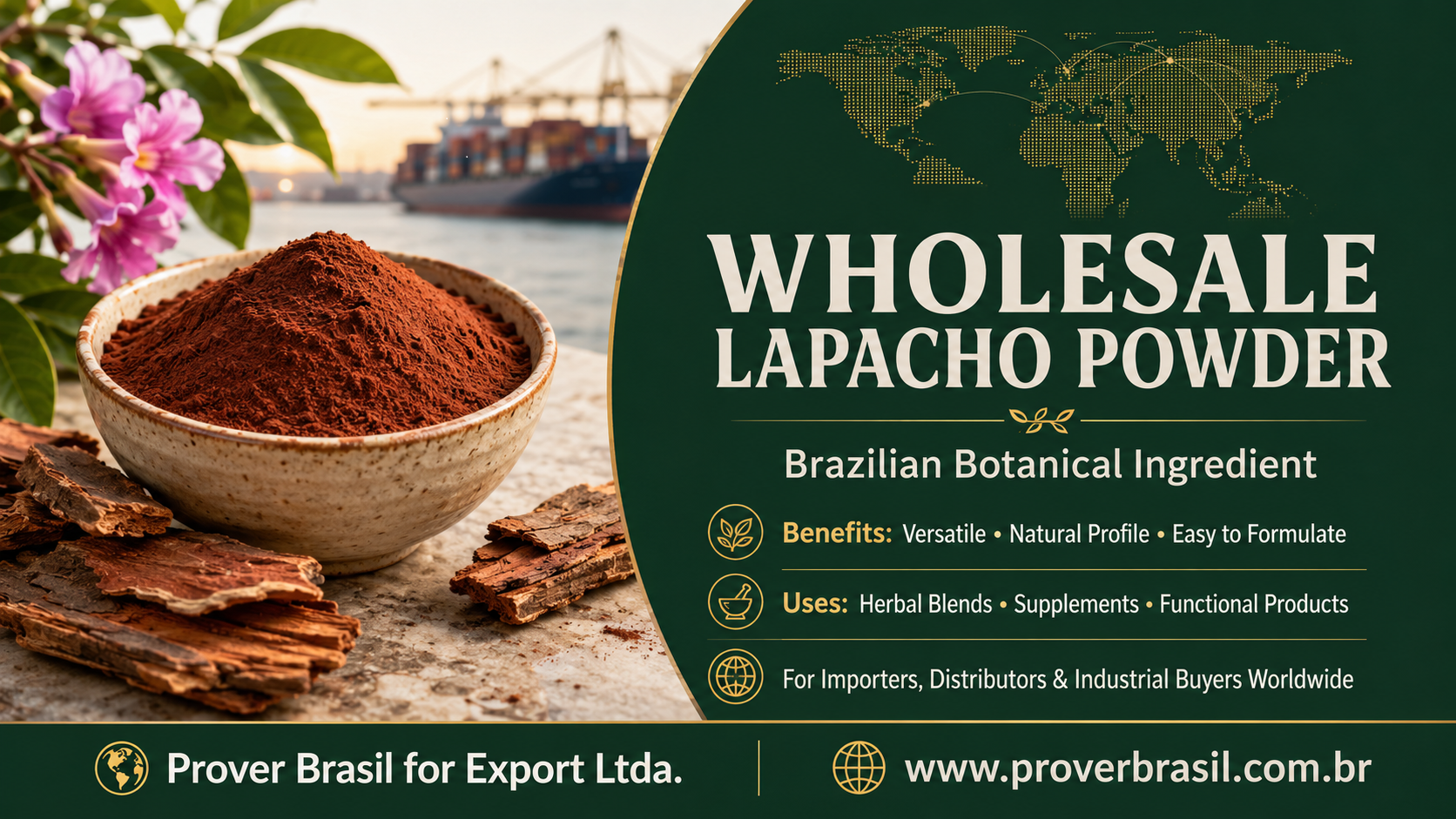
Companies searching for Wholesale Lapacho Powder need more than a competitive price. Importers, distributors, laboratories, botanical companies, tea businesses, supplement companies, and product developers also need clear information about botanical identity, plant part, particle size, applications, documentation, packaging, and international shipping.
Lapacho is also widely known as Pau D’Arco and Taheebo. It is a traditional South American botanical ingredient obtained from bark and used in several commercial applications.
Prover Brasil for Export Ltda. supplies Brazilian botanical ingredients for international B2B buyers and companies looking for reliable sourcing from Brazil.
View Pau D’Arco, Taheebo and Lapacho Bark Products
Wholesale Lapacho Powder is produced from dried and finely milled Lapacho bark.
The botanical is commonly known internationally by different names, including:
The traditional botanical name used in trade is Tabebuia avellanedae Lorentz ex Griseb. The currently accepted botanical name is Handroanthus impetiginosus (Mart. ex DC.) Mattos.
Because common botanical names may vary between countries, professional buyers should always check the scientific name, plant part, physical specification, and technical documentation before purchasing.
Lapacho Powder is different from cut bark and concentrated bark extract. Each format has different characteristics and potential industrial applications.
Wholesale Lapacho Powder attracts international buyers because of its Brazilian origin, traditional botanical use, distinctive profile, and versatility.
It can be evaluated for different product categories and industrial applications.
Lapacho also provides companies with an ingredient associated with traditional South American botanical knowledge.
For purchasing departments, one important advantage is its recognition under several commercial names. Buyers in different countries may search for Lapacho Powder, Pau D’Arco Powder, Taheebo Powder, or Lapacho Bark Powder.
Clear botanical identification helps international companies ensure that they are evaluating the correct ingredient.
The ideal specification depends on the intended application.
Before requesting a quotation, buyers should define how the ingredient will be used. This helps determine particle size, quantity, packaging, documentation, and other technical requirements.
Lapacho bark has traditionally been associated with herbal infusions and decoctions.
Tea companies may evaluate Lapacho Powder for:
Companies should evaluate taste, aroma, color, filtration, particle size, and compatibility with other herbs.
Lapacho has a characteristic woody and slightly bitter profile. Therefore, sensory evaluation is recommended during product development.
Wholesale Lapacho Powder may also be evaluated for botanical supplement formulations where permitted by local regulations.
Possible applications include:
Technical teams should evaluate particle size, moisture, density, flow properties, microbiological specifications, and compatibility with other ingredients.
Pilot testing can help determine how the powder performs with the buyer’s production equipment.
Importers and distributors may include Lapacho Powder within a broader portfolio of Brazilian botanical ingredients.
It may be particularly relevant for companies supplying:
Clear specifications help distributors distinguish Lapacho Powder from cut bark and concentrated extracts.
Lapacho Powder may also be evaluated for analytical and research applications.
Research teams may study:
The scientific literature contains several studies involving Lapacho bark, extracts, and compounds found naturally in the plant.
Lapacho has attracted scientific attention because researchers have investigated several naturally occurring compounds associated with the bark.
These include substances such as:
Scientific studies involving these compounds should be interpreted carefully.
Research involving isolated compounds, laboratory extracts, cell models, or animal models does not automatically establish the same effects for commercial Lapacho Powder.
Companies should therefore avoid translating scientific research directly into medical claims.
The following scientific publications provide useful background information for buyers, laboratories, researchers, and product development teams.
Published in Molecules in 2020, this scientific review discusses traditional use, phytochemistry, naturally occurring compounds, and experimental research involving the plant.
Read the full article on PubMed Central
Published in the Journal of Ethnopharmacology, this review discusses Red Lapacho, traditional uses, chemical constituents, product quality, commercialization, and scientific evidence.
This study investigated phenylpropanoid glycosides isolated from a water extract of Tabebuia avellanedae.
The researchers evaluated these compounds using laboratory methods.
This laboratory research examined compounds isolated from Tabebuia avellanedae and evaluated their activity in experimental models.
This study evaluated a water extract prepared from Tabebuia avellanedae inner bark using laboratory and animal research models.
This human study evaluated the safety and tolerability of an encapsulated Pau D’Arco preparation.
Because the study involved a limited number of participants, additional controlled research remains important.
Read the full study on PubMed Central
Scientific research can provide useful information about the chemistry and traditional background of Lapacho.
However, buyers should distinguish between:
Results obtained with one form of the botanical cannot automatically be applied to another form.
For international B2B trade, the most important considerations remain botanical identity, product specification, intended use, technical documentation, and applicable regulations in the destination country.
Professional buyers should define their technical requirements before placing an order.
Important factors include:
Confirm the scientific name associated with the supplied material.
Confirm that the supplied ingredient corresponds to the requested bark material.
Particle size can influence mixing, encapsulation, extraction, filtration, and handling.
Moisture specifications can affect storage stability and physical characteristics.
Packaging requirements may vary according to quantity, transportation method, warehouse conditions, and destination country.
Buyers should identify which commercial and technical documents are required before shipment.
Two buyers purchasing the same botanical may require very different specifications.
A capsule company may prioritize particle size, density, and flow characteristics.
A tea company may focus on flavor, filtration, aroma, and brewing properties.
A distributor may prioritize consistent specifications, commercial presentation, and technical documentation.
A laboratory may require detailed identification and controlled sample information.
For this reason, buyers should always inform the exporter about the intended application before requesting final commercial terms.
Before purchasing Wholesale Lapacho Powder, international buyers should confirm several details.
Ask about:
Providing this information at the beginning of the inquiry can make the quotation process faster and more precise.
Brazil is internationally recognized for its biodiversity and extensive botanical resources.
For companies developing botanical product portfolios, Brazilian ingredients can provide distinctive characteristics and strong geographic identity.
Lapacho is one example of a traditional Brazilian botanical ingredient that continues to attract interest from international purchasing teams.
Companies looking for Wholesale Lapacho Powder from Brazil should evaluate both the ingredient itself and the ability of the exporter to provide technical and commercial information suitable for international transactions.
Buyers may require different forms depending on their application.
Prover Brasil offers information about Pau D’Arco, Taheebo, and Lapacho products for international buyers.
View Pau D’Arco, Taheebo and Lapacho Bark Products
For further technical information about Pau D’Arco Bark Powder:
Read About Pau D’Arco Bark Powder from Brazil
Buyers looking for additional Brazilian ingredients can also visit:
View Brazilian Botanical Products
Wholesale Lapacho Powder may be considered by companies operating in several sectors.
Potential commercial areas include:
The final application must always comply with the laws and regulations of the destination market.
Prover Brasil for Export Ltda. has worked with Brazilian products for international markets since 2001.
The company serves international importers, distributors, botanical businesses, laboratories, product developers, and industrial buyers.
Companies interested in Lapacho can discuss:
Providing detailed purchasing information helps the export team prepare a more accurate commercial proposal.
Wholesale Lapacho Powder is dried and milled Lapacho or Pau D’Arco bark supplied in commercial quantities for professional and industrial buyers.
Yes. Lapacho, Pau D’Arco, and Taheebo are commonly used commercial names associated with this South American botanical.
Because common names can vary, buyers should confirm the scientific name and plant part before purchasing.
The traditional botanical name commonly used in trade is Tabebuia avellanedae Lorentz ex Griseb.
The currently accepted botanical name is Handroanthus impetiginosus (Mart. ex DC.) Mattos.
Potential B2B applications include herbal products, botanical blends, tea preparations, supplement formulations, ingredient distribution, product development, and research.
The intended use must comply with local regulations.
No.
Lapacho Powder consists of milled botanical bark material.
Lapacho Extract undergoes additional processing to produce a concentrated preparation.
Buyers should specify the required product format when requesting a quotation.
Yes.
Scientific publications have investigated Lapacho, Pau D’Arco, Taheebo, bark extracts, and naturally occurring compounds such as lapachol and beta-lapachone.
Much of the available research involves laboratory, animal, or isolated-compound studies. Therefore, these findings should not be presented as guaranteed effects of commercial Lapacho Powder.
For an accurate quotation, provide:
Prover Brasil for Export Ltda. supplies Brazilian botanical ingredients for international B2B buyers.
Companies can contact the export team with their purchasing requirements and destination information.
If your company is searching for Wholesale Lapacho Powder from Brazil, contact Prover Brasil for Export Ltda. with your purchasing requirements.
Please provide the destination country, estimated quantity, intended use, preferred particle size, packaging requirements, and delivery location.
Prover Brasil for Export Ltda.
Exporting Brazilian products since 2001
Website: www.proverbrasil.com.br