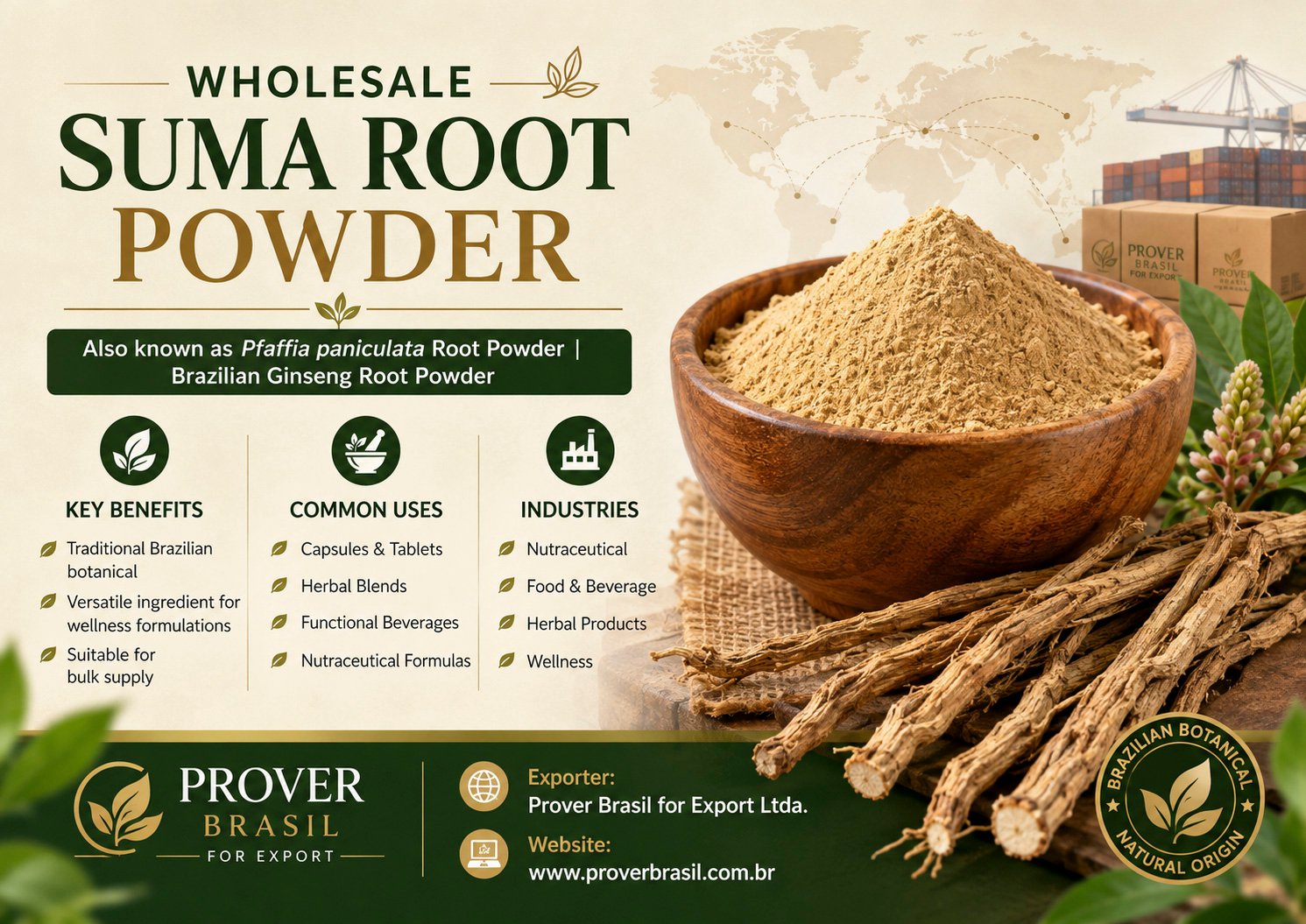
Wholesale Suma Root Powder from Brazil for B2B Buyers
Wholesale Suma Root Powder from Brazil is a botanical ingredient obtained from dried and finely milled Suma roots. The ingredient is traditionally traded under the botanical name Pfaffia paniculata and is also widely known as Brazilian Ginseng.
Today, Suma attracts interest from importers, botanical ingredient distributors, supplement companies and product developers looking for distinctive Brazilian plant ingredients.
Unlike a concentrated extract, Suma Root Powder provides the natural matrix of the dried root in powdered form. Therefore, formulators can evaluate it for capsules, tablets, botanical powder blends and other dry formulations, subject to the regulations of each destination market.
Prover Brasil for Export Ltda. supplies Brazilian botanical ingredients for international B2B markets. Buyers can explore our Pfaffia Paniculata (Suma) Root Products for additional commercial and product information.
What Is Suma Root Powder?
Suma Root Powder is made by preparing, drying and milling Suma roots into a fine botanical powder.
The whole-root format differs from a concentrated botanical extract. Root powder retains a broader representation of the dried plant material, while extracts are processed to concentrate selected soluble components.
Typical commercial identification includes:
-
Common name: Suma
-
Alternative name: Brazilian Ginseng
-
Traditional trade name: Pfaffia Paniculata
-
Accepted botanical name: Hebanthe erianthos (Poir.) Pedersen
-
Synonym: Pfaffia paniculata (Mart.) Kuntze
-
Botanical family: Amaranthaceae
-
Plant part: Root
-
Origin: Brazil
-
Commercial form: Powder
The Royal Botanic Gardens, Kew currently accepts Hebanthe erianthos as the botanical name and treats Pfaffia paniculata as a synonym. View the botanical record at Kew Science
Commercial specifications may vary by batch. For this reason, professional buyers should evaluate the applicable specification and Certificate of Analysis before confirming an order.
Suma, Brazilian Ginseng and Pfaffia Paniculata
Correct botanical identification is especially important in the international trade of herbs and botanical ingredients.
The name Pfaffia paniculata remains widely recognized in commercial trade and scientific literature. However, botanical taxonomy has changed over time.
According to Kew Science, Pfaffia paniculata (Mart.) Kuntze is currently considered a synonym of Hebanthe erianthos (Poir.) Pedersen. See the Pfaffia paniculata taxonomic record at Kew Science
Consequently, importers may encounter both names in:
-
Certificates of Analysis;
-
botanical specifications;
-
historical scientific papers;
-
supplier documents;
-
regulatory assessments;
-
product-development files.
Using both names where appropriate may help buyers understand the relationship between the traditional trade identity and current botanical taxonomy.
Is Suma the Same as Asian Ginseng?
No.
Suma is commonly called Brazilian Ginseng, but it is not the same botanical species as Asian ginseng.
Suma belongs to the Amaranthaceae family, while Panax ginseng belongs to a different botanical group.
The term Brazilian Ginseng developed through traditional and commercial usage. It should not be interpreted to mean that Suma and Asian ginseng are botanically identical.
Correct botanical identification can be particularly important for:
-
ingredient specifications;
-
Certificates of Analysis;
-
customs documentation;
-
finished-product labeling;
-
regulatory reviews.
Naturally Occurring Compounds in Suma Root
Researchers have investigated the phytochemical composition of Pfaffia paniculata roots for decades.
Scientific interest has focused particularly on triterpenoid compounds and saponins.
Pfaffic Acid
Pfaffic acid is one of the characteristic compounds associated with Pfaffia paniculata.
Research into the plant’s chemistry has identified pfaffic-acid-related compounds in the roots and contributed to the scientific characterization of Brazilian Ginseng.
Pfaffosides
Researchers have identified compounds known as pfaffosides in Pfaffia paniculata roots.
A study published in Phytochemistry reported the isolation of pfaffosides A, B and C from the roots and characterized them as nortriterpenoid saponins. Read the study on ScienceDirect
Additional research later described other pfaffosides associated with the same botanical material. View additional pfaffoside research on ScienceDirect
Other Phytochemical Groups
Scientific investigations of Suma and related botanical preparations have examined several groups of naturally occurring compounds.
These may include:
However, botanical materials naturally vary according to plant material, processing and analytical method.
Therefore, buyers should not assume that every commercial batch contains identical concentrations of individual phytochemicals.
When a particular chemical parameter is important, the buyer should request batch-specific analytical documentation.
Traditional Uses and Potential Benefits of Suma Root
Suma has a long-standing reputation in Brazilian and South American herbal traditions.
Its commercial identity as Brazilian Ginseng has often been associated with vitality, traditional tonic preparations and general wellness concepts.
However, traditional use must be clearly distinguished from clinically established medical effects.
Much of the published scientific literature involving Pfaffia paniculata consists of laboratory research, animal studies or research performed with extracts rather than ordinary commercial root powder.
Therefore, preclinical findings should not be converted into unsupported medical claims for Suma Root Powder.
Traditional Association with Vitality
Suma has traditionally been associated with vitality and tonic-style herbal preparations.
This traditional background has contributed to its international recognition as Brazilian Ginseng.
As a result, product developers may evaluate Suma for concepts related to:
-
botanical vitality blends;
-
active-lifestyle formulations;
-
general wellness products;
-
traditional herbal preparations;
-
South American botanical formulas.
Consumer-facing claims must always comply with the regulations of the destination market.
Traditional Association with Fatigue and Stress
Published scientific literature also recognizes the ethnobotanical background of Pfaffia paniculata and its traditional association with fatigue and stress.
Researchers have examined these traditional uses through different experimental models.
Nevertheless, experimental research does not establish that commercial Suma Root Powder prevents or treats fatigue, stress or any disease in humans.
Adaptogenic Positioning
Suma is sometimes commercially discussed alongside botanicals described as adaptogens.
However, the regulatory status and permitted use of the word adaptogen vary between countries.
Importers and finished-product companies should verify whether terminology such as:
-
adaptogen;
-
stress support;
-
energy support;
-
endurance support;
-
vitality support
is permitted in their target market before using these expressions on labels, advertising or product descriptions.
Scientific Research on Brazilian Ginseng
Researchers have investigated Pfaffia paniculata in several experimental settings.
However, much of this scientific evidence remains preclinical.
For this reason, these studies are most useful for understanding scientific interest in the plant rather than establishing therapeutic claims for commercial Suma Root Powder.
Research on Intestinal Inflammation
A 2015 study published in International Immunopharmacology investigated a Pfaffia paniculata preparation in an experimental rat model of intestinal inflammation. Read the 2015 study on PubMed
The researchers evaluated biological responses in a TNBS-induced experimental model.
The findings are scientifically relevant but should not be interpreted as evidence that Suma Root Powder treats intestinal inflammatory diseases in humans.
Research on MAPK and Mucin Pathways
A later study published in the Journal of Ethnopharmacology investigated Pfaffia paniculata extract in relation to MAPK and mucin pathways in an experimental model of intestinal inflammation. Read the study on PubMed
Again, this was experimental research involving a botanical extract.
It does not establish a therapeutic effect for ordinary commercial Suma Root Powder.
Research on Pfaffosides and Saponins
Phytochemical research published in Phytochemistry identified pfaffosides and nortriterpenoid saponins in Pfaffia paniculata roots. Read the phytochemical study on ScienceDirect
This research is particularly useful for understanding the botanical chemistry of the plant.
However, the chemical composition of research material should not automatically be assumed to represent every commercial batch.
Other Experimental Research
Researchers have also evaluated Pfaffia paniculata in other experimental models.
For example, a 2003 study published in Life Sciences investigated the plant in an experimental Ehrlich tumor model. Read the study on PubMed
This research was preclinical.
It must not be presented as evidence that Suma Root Powder can prevent, diagnose, cure or treat cancer in humans.
Main Uses of Wholesale Suma Root Powder
The powdered format provides practical options for companies working with dry botanical raw materials.
Potential applications depend on the regulatory classification of Suma in the destination country.
Dietary Supplement Formulations
Where regulations permit its use, Suma Root Powder may be evaluated for:
Formulators should consider particle size, dosage requirements, sensory characteristics and compatibility with other ingredients.
Botanical Blends
Suma may also be evaluated as part of multi-ingredient botanical blends.
Its Brazilian identity can support product concepts based on South American botanicals.
Potential applications include:
-
botanical wellness blends;
-
traditional herbal combinations;
-
active-lifestyle formulas;
-
plant-based supplement blends;
-
multi-botanical powder products.
Dry Powder Formulations
Suma Root Powder may also be considered for selected dry product formats.
Before using it, formulators should evaluate:
These factors may influence both processing and consumer acceptance.
Traditional Herbal Preparations
Suma roots also have a history of use in traditional herbal preparations.
Commercial manufacturers developing products inspired by traditional use should apply appropriate quality controls and standardized manufacturing procedures.
In addition, all finished-product claims must comply with the legislation of the country where the product is sold.
Suma Root Powder vs. Suma Root Extract
Suma Root Powder and Suma Root Extract are different botanical ingredient formats.
Suma Root Powder consists primarily of dried and milled root material.
Suma Root Extract undergoes an extraction process designed to concentrate selected soluble plant components.
Neither format is automatically superior.
The best option depends on the intended product and formulation requirements.
Important considerations include:
-
desired serving size;
-
concentration requirements;
-
finished-product format;
-
sensory properties;
-
manufacturing process;
-
formulation compatibility;
-
regulatory classification.
Importers should always request specifications for the exact ingredient they intend to purchase.
Powder and extract should not automatically be treated as interchangeable materials.
For information about available Suma formats, visit our Pfaffia Paniculata (Suma) Root Products page.
Industries Using Wholesale Suma Root Powder
Wholesale Suma Root Powder may be relevant to several industries working with botanical ingredients.
Nutraceutical and Dietary Supplement Companies
Supplement developers may evaluate Suma for capsules, tablets, powder formulas and botanical complexes where local regulations permit its use.
Botanical Ingredient Importers and Distributors
Importers, wholesalers and ingredient distributors may include Suma in portfolios of Brazilian and South American botanical ingredients.
The ingredient can appeal to buyers searching under several commercial terms, including:
-
Suma Root Powder;
-
Brazilian Ginseng Powder;
-
Pfaffia Paniculata Root Powder;
-
Brazilian botanical ingredients.
Herbal Product Companies
Companies specializing in herbal preparations may evaluate Suma for selected traditional botanical formulations.
Product Development Companies
Research and development teams can assess Suma alongside other botanical powders when designing new plant-based products.
Wellness and Lifestyle Brands
Suma’s traditional association with vitality has also made it relevant to companies researching broader botanical wellness concepts.
However, consumer claims must be reviewed before commercial use.
What B2B Buyers Should Check Before Purchasing Suma Root Powder
Price should not be the only consideration when purchasing botanical raw materials.
Professional importers should evaluate identity, technical specifications, documentation and regulatory requirements.
Confirm the Botanical Identity
Verify the botanical name, botanical family and plant part.
This is particularly important because common names may sometimes refer to different plants.
For Suma, buyers may encounter both Pfaffia paniculata and Hebanthe erianthos.
Kew Science currently identifies Hebanthe erianthos as the accepted name and Pfaffia paniculata as a synonym. Verify the taxonomy at Kew Science
Verify the Country of Origin
When sourcing Brazilian Suma Root Powder, the product documentation should identify the declared origin of the botanical raw material.
Origin can be relevant to:
-
traceability;
-
import documentation;
-
product positioning;
-
supplier qualification.
Review Product Specifications
Depending on the intended use, buyers may need to review parameters such as:
Additional testing may be required according to the buyer’s quality system or destination-market rules.
Request a Certificate of Analysis
A Certificate of Analysis provides batch-specific information.
It can help buyers determine whether a particular shipment meets their purchasing specification.
Importers should compare the Certificate of Analysis with their own technical requirements before approving a batch.
Review Packaging and Logistics
Suitable packaging helps protect botanical powders during international transportation and storage.
B2B buyers should also consider:
Check Destination-Market Regulations
Botanical regulations differ substantially between countries.
Before importing Suma or incorporating it into a finished product, companies should evaluate:
-
ingredient authorization;
-
permitted product categories;
-
labeling rules;
-
import documentation;
-
applicable dosage restrictions;
-
permitted health claims;
-
food or supplement classification.
Regulatory acceptance in one country does not automatically establish acceptance in another.
Why Source Suma Root Powder from Brazil?
Brazil has extensive botanical diversity and a long history of commercial and traditional use of native and regional plants.
Suma offers buyers a recognizable botanical identity linked to Brazil and South America.
It also benefits from established commercial terminology and decades of scientific interest in its phytochemistry.
Potential B2B advantages include:
-
Brazilian botanical origin;
-
established international trade names;
-
whole-root powder format;
-
suitability for selected dry formulations;
-
traditional herbal background;
-
scientific interest in characteristic phytochemicals;
-
potential inclusion in diversified botanical portfolios.
Companies interested in other ingredients from Brazil can also explore the Prover Brasil full botanical product catalog, which includes herbs, botanical extracts and Brazilian fruit ingredients.
Wholesale Suma Root Powder for International B2B Supply
Prover Brasil for Export Ltda. supplies Brazilian botanical ingredients to international B2B customers.
The company’s product portfolio includes Suma products alongside other herbs, botanical extracts and Brazilian fruit ingredients.
Companies evaluating Suma should select the ingredient according to their:
-
technical specifications;
-
manufacturing process;
-
finished-product application;
-
quality requirements;
-
destination-market regulations.
For product-specific information and commercial inquiries, visit our Pfaffia Paniculata (Suma) Root Products.
You can also explore our Brazilian Botanical Ingredients and Product Catalog.
Frequently Asked Questions About Suma Root Powder
What Is Suma Root Powder?
Suma Root Powder is produced from dried and milled Suma roots.
The ingredient has traditionally been traded as Pfaffia paniculata and is widely known as Brazilian Ginseng.
Is Suma Root Powder the Same as Brazilian Ginseng?
Brazilian Ginseng is a common commercial name for Suma.
However, Suma should not be confused with Asian ginseng or other Panax species.
What Is the Scientific Name of Suma?
Pfaffia paniculata is widely used in commercial trade and historical scientific literature.
Kew Science currently recognizes Hebanthe erianthos (Poir.) Pedersen as the accepted botanical name and treats Pfaffia paniculata (Mart.) Kuntze as a synonym. View the official Kew Science botanical record
Which Part of the Suma Plant Is Used?
The root is the main plant part used to produce commercial Suma Root Powder.
What Is the Difference Between Suma Powder and Suma Extract?
Suma Root Powder consists of dried and milled root.
A Suma extract undergoes an extraction process designed to concentrate selected components.
Therefore, their specifications, formulation properties and suggested use levels may differ.
Which Industries May Use Suma Root Powder?
Depending on applicable regulations, potential buyers may include:
-
dietary supplement companies;
-
botanical ingredient distributors;
-
herbal product companies;
-
nutraceutical businesses;
-
product-development laboratories.
Can Suma Root Powder Be Used in Capsules?
Where local regulations permit its use, Suma Root Powder may be evaluated for capsule formulations and other dry botanical products.
What Should Importers Request Before Purchasing?
Professional buyers should evaluate:
Is Suma Root Powder a Medicine?
Suma Root Powder should not be presented as a medicine merely because the plant has a history of traditional use or has been investigated scientifically.
Much of the available research is preclinical, and commercial claims must comply with applicable regulations.
Where Can International Buyers Source Wholesale Suma Root Powder from Brazil?
International B2B buyers can review Prover Brasil’s Pfaffia Paniculata (Suma) Root Products and request product and commercial information according to their sourcing requirements.
Reliable Scientific and Botanical References
Royal Botanic Gardens, Kew — Plants of the World Online
Hebanthe erianthos (Poir.) Pedersen
Kew Science lists Hebanthe erianthos as the accepted species and identifies Brazil among its native-range countries.
Royal Botanic Gardens, Kew — Hebanthe erianthos
Royal Botanic Gardens, Kew — Pfaffia Paniculata Taxonomy
Pfaffia paniculata (Mart.) Kuntze
Kew currently treats Pfaffia paniculata as a synonym of Hebanthe erianthos.
Royal Botanic Gardens, Kew — Pfaffia paniculata
Costa et al. — International Immunopharmacology
Costa, C.A.R.A. et al. (2015).
Anti-inflammatory effects of Brazilian ginseng (Pfaffia paniculata) on TNBS-induced intestinal inflammation: Experimental evidence.
International Immunopharmacology, 28(1), 459–469.
DOI: 10.1016/j.intimp.2015.07.002
View the scientific reference on PubMed
Costa, Quaglio and Di Stasi — Journal of Ethnopharmacology
Costa, C.A.R.A.; Quaglio, A.E.V.; Di Stasi, L.C. (2018).
Pfaffia paniculata (Brazilian ginseng) extract modulates Mapk and mucin pathways in intestinal inflammation.
Journal of Ethnopharmacology, 213, 21–25.
DOI: 10.1016/j.jep.2017.10.009
View the scientific reference on PubMed
Nishimoto et al. — Phytochemistry
Nishimoto, N. et al. (1984).
Pfaffosides and nortriterpenoid saponins from Pfaffia paniculata.
Phytochemistry, 23(1), 139–142.
DOI: 10.1016/0031-9422(84)83094-0
View the scientific article on ScienceDirect
Matsuzaki et al. — Life Sciences
Matsuzaki, P. et al. (2003).
Effect of Pfaffia paniculata (Brazilian ginseng) on the Ehrlich tumor in its ascitic form.
Life Sciences, 74(5), 573–579.
DOI: 10.1016/j.lfs.2003.05.010
View the scientific reference on PubMed
Source Wholesale Suma Root Powder from Brazil
Wholesale Suma Root Powder provides international buyers with a distinctive Brazilian botanical ingredient that combines an established commercial identity, traditional background and documented scientific interest.
Professional sourcing should consider more than price.
Buyers should evaluate botanical identity, specifications, batch documentation, intended application and destination-market requirements before making a purchasing decision.
Prover Brasil for Export Ltda. supplies Brazilian botanical ingredients for international B2B markets.
Explore our Pfaffia Paniculata (Suma) Root Products for product information.
Discover additional Brazilian ingredients through our full product catalog.