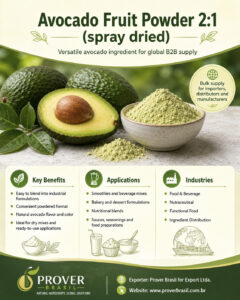

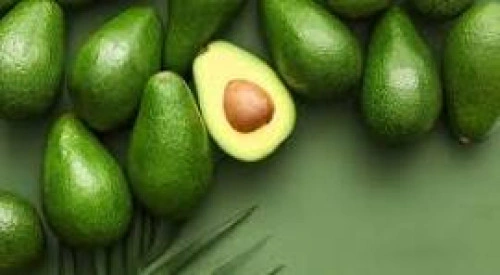
Avocado Fruit Powder 2:1 is a spray-dried Brazilian fruit ingredient developed for companies looking for a convenient powdered alternative to fresh avocado in product formulation.
Prover Brasil for Export Ltda. supplies Avocado Fruit Powder 2:1 (spray dried) for professional B2B buyers, including importers, distributors, wholesalers, food companies, beverage developers and nutritional product formulators.
Unlike fresh avocado, a powdered ingredient can be weighed, transported, stored and incorporated into dry formulation systems more conveniently.
Companies searching for additional Brazilian ingredients can also explore our complete product catalog.
Product: Avocado Fruit Powder
Concentration: 2:1
Processing: Spray dried
Scientific Name: Persea americana
Family: Lauraceae
Plant Part: Fruit
Origin: Brazil
Commercial Format: Powdered ingredient
Market: B2B / Bulk / Wholesale / Export
The commercial avocado belongs to the species Persea americana. Prover Brasil’s current product page identifies the product as Brazilian avocado fruit material from the Lauraceae family.
Fresh avocado creates several challenges for industrial handling. It is highly perishable, its texture changes rapidly during ripening, and its lipid-containing pulp requires careful processing and storage.
Drying technology offers a different approach.
Research published in Powder Technology has demonstrated the successful spray drying of avocado pulp and evaluated avocado powder as an ingredient for food formulations.
For commercial formulators, the powdered format can provide practical advantages such as:
The exact performance of any commercial avocado powder depends on its specification, carrier system, processing conditions and finished-product formulation.
Avocado has a distinctive position among fruits because of its creamy sensory profile and naturally occurring lipid fraction.
Published research on avocado fruit describes monounsaturated fats and lipid-soluble compounds such as vitamin E, phytosterols and carotenoids.
However, the nutrient composition of fresh avocado should not automatically be used as the specification of Avocado Fruit Powder 2:1.
Spray drying, raw-material variation, carriers and processing conditions can affect the final composition.
For commercial labeling and formulation calculations, buyers should use the current product specification and applicable Certificate of Analysis rather than values taken from fresh-fruit nutrition tables.
For general scientific food-composition information, manufacturers can consult USDA FoodData Central. USDA currently includes Hass avocado among its food-composition records.
Avocado Fruit Powder offers more than a familiar fruit name.
For R&D teams, it opens opportunities to develop products around creamy, tropical, savory and nutritional concepts without relying exclusively on refrigerated fresh avocado.
Possible development directions include:
Actual suitability must be evaluated in the finished formulation.
Food manufacturers can evaluate Avocado Fruit Powder 2:1 for a broad range of formulations.
Avocado naturally fits savory flavor profiles.
Potential concepts include:
Lime, lemon, tomato, onion, garlic, chili and herbs can be evaluated as complementary flavors during R&D.
Avocado powder can also be tested in:
Developers should evaluate how the ingredient affects flavor, color, texture and oxidation stability during processing and storage.
Avocado Fruit Powder 2:1 can be evaluated for powdered nutrition and beverage concepts where avocado identity adds value to the finished formulation.
Potential applications include:
Avocado is different from many highly acidic fruit powders.
Its sensory characteristics may therefore work particularly well in creamy formulations rather than sharp or strongly acidic beverage systems.
Formulators should conduct bench and pilot testing to determine the most appropriate inclusion rate.
Avocado has strong recognition among consumers interested in plant-origin food concepts.
Avocado Fruit Powder can be explored as part of formulations combining fruits, grains, seeds, plant proteins or other botanical ingredients.
Possible combinations include:
These combinations are formulation ideas rather than fixed recipes.
Sensory testing remains essential before commercial production.
Avocado Fruit Powder can also become part of a broader Brazilian or tropical ingredient portfolio.
For tart tropical formulations, manufacturers can evaluate Camu Camu Fruit Powder.
For distinctive Brazilian flavor concepts, companies can explore Cupuacu Fruit Products.
Importers looking for multiple botanical, herbal and fruit ingredients can browse the Brazilian Ingredients Product Catalog.
A professional buyer should evaluate much more than the product name before approving an avocado powder.
A fruit powder should not automatically be described as completely water soluble.
Developers should test dispersibility in the actual beverage or food system where the ingredient will be used.
Avocado naturally contains lipids.
For this reason, formulation teams should pay attention to oxidation stability, packaging, oxygen exposure and storage conditions.
Avocado powder may contribute characteristic fruit and vegetal notes.
The sensory profile should be evaluated at several inclusion levels.
Natural fruit-based ingredients can present variation in color.
Processing conditions and the other ingredients in a finished formulation may also influence appearance.
Particle behavior can affect:
Request the applicable technical specification when these characteristics are important for your production process.
Spray-dried fruit powders may use processing aids or carrier materials depending on the production specification.
Professional buyers should confirm the composition before completing:
Avocado Fruit Powder is supplied as a 2:1 commercial concentration according to the applicable product specification.
The concentration ratio should not be interpreted as meaning that every vitamin, mineral, lipid or other constituent is automatically present at twice the level found in another avocado ingredient.
The concentration ratio and nutritional analysis are different technical concepts.
For formulation and labeling purposes, always use the actual specification and analytical documentation for the supplied material.
Avocado Fruit Powder 2:1 can offer several practical advantages for professional buyers.
The ingredient can be handled through conventional dry-ingredient production systems.
Avocado works across savory, nutrition, tropical and plant-based product concepts.
Avocado is widely recognized internationally and can be incorporated into product concepts without requiring extensive consumer explanation.
The powder can be evaluated alongside other fruit powders, proteins, grains, seasonings and botanical ingredients.
Its powdered form is better adapted to international ingredient logistics than fresh fruit.
Combine avocado fruit powder with lime flavor, onion, garlic and mild seasoning for application trials on crackers or savory snacks.
Evaluate avocado powder together with banana or other tropical fruit powders in a creamy nutrition shake concept.
Combine avocado fruit powder with a selected plant protein system for a savory or neutral nutritional formulation.
Develop a dry culinary base using avocado powder alongside herbs, spices and vegetable ingredients.
Avocado and cocoa can be evaluated together for creamy nutrition or smoothie powder development.
Each concept requires stability, sensory, microbiological and regulatory evaluation before commercialization.
Potential professional users include:
Before approving Avocado Fruit Powder for a project, purchasing and R&D teams should request the documentation relevant to their market and intended application.
Important information can include:
Requirements vary between countries and finished-product categories.
Importers remain responsible for confirming the regulatory requirements applicable in the destination market.
Keep Avocado Fruit Powder in its original sealed packaging and follow the storage conditions stated in the product specification.
As a general handling principle, powdered fruit ingredients should be protected from:
Close opened packaging properly and use clean, dry handling equipment.
Because avocado contains a natural lipid fraction, suitable packaging and storage conditions deserve particular attention.
Avocado has been widely studied as a food and has an interesting nutritional profile. Scientific literature discusses its unsaturated fat fraction, fiber and several naturally occurring micronutrients and phytochemicals.
However, research on fresh avocado should not automatically be converted into medical or therapeutic claims for a commercial Avocado Fruit Powder.
Manufacturers should distinguish between:
Avocado Fruit Powder should not be promoted as a treatment, prevention or cure for disease.
Coutinho, I. B. et al.
Spray drying of avocado pulp using the seed as an adjuvant.
Powder Technology, Volume 408, 2022.
The study evaluated spray drying of avocado pulp and the potential application of the resulting powder in food formulations.
Read the research at ScienceDirect
Qin, X.; Zhong, J.
A Review of Extraction Techniques for Avocado Oil.
Journal of Oleo Science, 2016.
The review discusses avocado’s monounsaturated lipid fraction and lipid-soluble constituents.
Avocado has also been investigated through clinical, observational and mechanistic research addressing its nutritional characteristics.
Explore the scientific review at PubMed
For general food-composition information about avocado, manufacturers and researchers can consult:
Commercial formulation decisions should nevertheless use analytical information for the actual Avocado Fruit Powder supplied.
It is a fruit-based powdered ingredient supplied at a 2:1 concentration and produced using spray-drying technology.
The commercial avocado belongs to the species Persea americana in the Lauraceae family.
No.
Avocado Fruit Powder is derived from fruit material and supplied as a powder. Avocado oil is a lipid extract and has different technical and formulation characteristics.
Complete solubility should not be assumed.
Dispersibility depends on the powder specification, carrier system, particle characteristics and finished formulation.
Manufacturers should conduct application testing.
It can be evaluated for powdered smoothies, nutrition shakes and other beverage premixes.
Its performance should be tested in the intended beverage system.
Yes. Avocado is particularly interesting for savory concepts such as seasoning blends, crackers, dry sauces, snack coatings and culinary premixes.
No.
The commercial concentration ratio should not be used as a nutrient assay.
Nutrient values should come from the applicable analytical specification.
Medical claims should not be made for the ingredient.
Any nutrition or health statement used on a finished product must comply with the regulations of the destination market and be supported by appropriate analytical and scientific evidence.
The product offered by Prover Brasil for Export Ltda. originates from Brazil.
The product is intended for professional B2B buyers such as importers, distributors, wholesalers, food companies and other industrial users.
Prover Brasil for Export Ltda. supplies Avocado Fruit Powder 2:1 (spray dried) for international B2B customers.
Companies evaluating avocado powder for food, beverage, nutrition, snack or dry formulation projects can request current commercial and technical information.
When requesting a quotation, please provide:
Contact Prover Brasil for Export Ltda. to request current specifications, availability and export quotation.
You can also view our complete range of Brazilian ingredients.
Prover Brasil for Export Ltda.
Brazil
Exporting Brazilian ingredients worldwide since 2001.